
Search results for "Extracting" in Home Design Ideas
 Williamsons Kitchens
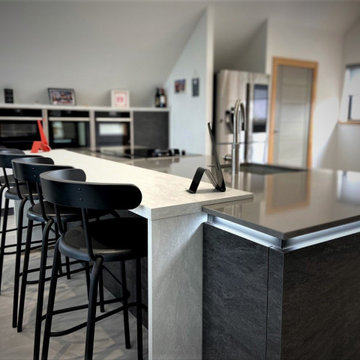
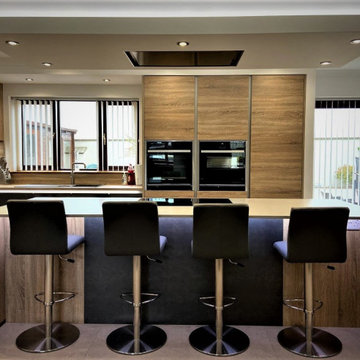
Our client presented us with a unique challenge: to craft a modern, open-plan kitchen in the upstairs open space of their new build. They were looking for a space that wasn’t just functional but also acted as a secondary eating area and transitioned smoothly into the living space.
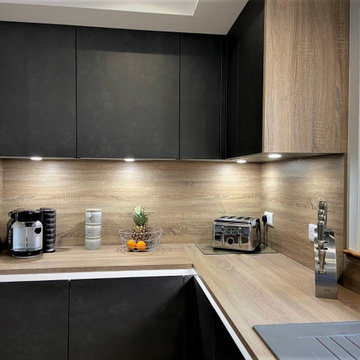
We selected Nolte Stone in Basalt, complemented by an accent in Glacier. The Quartz Grey MatrixArt handleless trims equipped with integrated lighting add a touch of modernity, ensuring a sleek finish.
A 20mm thick Silestone Gris Expo solid surface worktop was chosen, and we added a Glacier breakfast bar and Basalt table to align with the colour theme. For appliances, we trusted NEFF to deliver on performance, including their single oven, combination microwave, steam oven, induction hob, and gas domino hob. The downdraft extraction was a key addition, ensuring efficiency without the overhead extractor, and we integrated the client's existing American fridge freezer into the design seamlessly.
Special touches include a Blanco 1 ½ bowl undermounted sink paired with a Quooker Flex stainless Steel instant boiling water tap. Laminate flooring was laid to ensure longevity and ease of cleaning. To extend the functionality, we constructed a matching Nolte table and seamlessly moved the design into the living space, adding a contemporary sideboard unit and a media unit in the sitting area.
Thinking about a kitchen revamp? Get in touch for a transformative experience.
 Tile Doctor Ltd
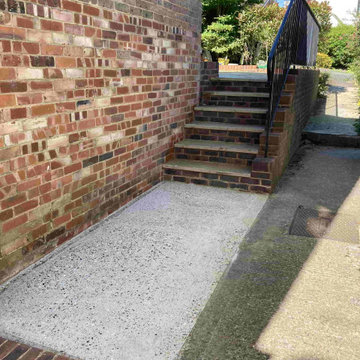
I am sure you will be able relate to this client in Folkstone who had a concrete and brick path and steps to the side of their house that had turned black with dirt. I know many of you reading this post will probably own a Karcher pressure washer and would be happy to do this job themselves, however for those that do not it’s good to know that we don’t just cover expensive patios and driveways and happily deep clean concrete paths as well.
The machine I use for this type of work operates at very high pressure, far higher than that of a Karcher and is so large and heavy its actually installed in a van. This type of machine is known in the trade as a Truck Mount and results in a much deeper clean that cleans and extracts the waste at the same time.
I popped over to see the client to see what needed to be done and gave them a quote for the work. Having looked round the property I was confident of making a difference. I also noted that steps were not only black with dirt but had become green with algae in places which is slippery when wet and dangerous for the elderly.
Before going over with the machine, I wetted the path with Tile Doctor Patio & Brick Driveway Cleaner and left it to soak into the concrete for a good twenty to thirty minutes so it could breakdown the dirt and deal with blackspots, lichen, moss, and general staining.
The concrete path was in several sections so whilst I was waiting for the cleaner to soak into one section, I was able to run the Truck Mount pressure washer over another section. When you use the jet wash at home, it can be a very messy business, bringing up all the dirt and spreading it around the nearby walls and usually the user. With our machine washing and extracting the dirt at the same time there is zero mess, and you can literally see the path become transformed in front of your eyes which is very satisfying.
Once done the concrete path looked like it was laid yesterday. The client was amazed saying it now complimented the work they had recently done on the front and back patios. It does show up the neighbour’s path though so I would not be surprised if I get a call soon to do their path as well!
There was no need to apply any type of sealer to this path. Regular cleaning will maintain it and a once a year deep clean like this would keep it in great shape.
Michael Conlon
South Kent Tile Doctor
 Tile Doctor Ltd
Most stone and tile benefit from the protection that a sealer provides to stop dirt becoming ingrained into its pores. However, the act of walking on the tile causes wear and this over time will lead to the sealer wearing off and dirt reaching the pores; the worse thing is you rarely notice it happening because it takes a long time to wear down a sealer.
Most of my customers have this problem and call on me to clean and reseal the floors every few years when it becomes difficult to clean effectively. The alternative which I do for a number of my clients is to have the floor lightly cleaned and a new layer of sealer added every six to twelve months.
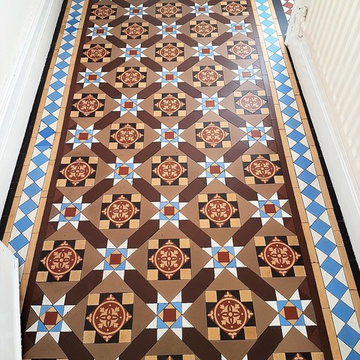
This Victorian tiled entrance at a period house in Ilkley was not in too bad a shape just a little dirty and dull and the owner was keen to have is renovated in the run up to the Christmas holidays. Ilkley is a lovely town in West Yorkshire which became very fashionable in the Victorian era due to the health benefits of the local water, this led to a lot of Victorian architecture and tiled entrance floors like this one are very typical in the area.
To get the dirt out of the tile and grout I applied a strong dilution of Tile Doctor Pro-Clean to the tiles and left it to soak in for fifteen minutes. Pro-Clean is a very reliable cleaner for all types of tile and grout including natural stone, Limestone, Slate and Travertine, amongst others; additionally, when used in a strong dilution it will strip off old sealers. The solution was then worked into the tile using a black scrubbing pad fitted to a rotary machine and the soil extracted using a wet vacuum.
I gave the floor a light rinse with water to remove any trace of cleaning products and then inspected the floor to ensure it was up to standard. At this point I could see there were flecks of paint on the tile around the edges of the floor from previous decorating work and, so I removed carefully removed these with a scrapper and a hand-held diamond block.
The floor was given a final rinse and the wet vacuum used to extract as much moisture from the floor as possible before leaving it to dry for the evening.
I returned the next day to seal the floor first discussing the finish that the customer wanted for the tiles. Typically, I recommend using a satin sealer for Victorian tiles as it adds a nice sheen to the tile however surprisingly the owner wanted a matt finish.
Tile Doctor has a full range of sealers available to cater for all requirements so for this floor I applied three coats of Tile Doctor Colour Grow which leaves a matt finish whilst enriching the colours in the tile.
The tiles are now full of life and with the paint specs removed there is now a crisp black edge between the floor and the skirting which the customer also picked up on.
Nigel Stoker
North West Yorkshire Tile Doctor
Find the right local pro for your project
 Williamsons Kitchens
Our client was in the process of building a new house to their specification in Fraserburgh. The centrepiece? A contemporary, open-plan kitchen that not only serves as a functional space but also as an inviting hub for family gatherings.
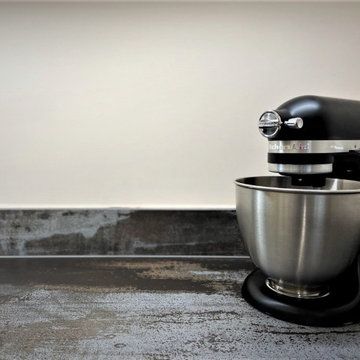
Opting for the Nolte SoftLack range, we integrated the Silver MatrixArt handleless trims, complemented by elegant integrated lighting. The main furniture showcases a soothing Sahara hue, contrasted smartly by the Lava accent.
The 20mm Dekton Trilium worktop exudes sophistication, while the 40mm Nolte Platinum Bough Oak table adds a touch of warmth. We included a full suite of NEFF appliances: a single oven, combination microwave, induction hob, ceiling extraction, and a full-height fridge and freezer, meeting every culinary need.
Special requests are what make a design truly personal. We incorporated a Blanco Subline undermounted sink in Alumetallic, a state-of-the-art Quooker Fusion Square Stainless Steel instant boiling water tap, and durable Pergo flooring. Notably, the elevated dishwasher was positioned conveniently beside the sink, based on the client's preference. The tall units were seamlessly integrated into the ceiling, complemented by an artful goal-post niche. Furthermore, the extractor finds its home within a stylish ceiling drop box, highlighted by a subtly lit stepped ledge.
Dreaming of your own bespoke kitchen? Let us transform your vision into reality.
 Williamsons Kitchens
Our client was in the process of building a new house to their specification in Fraserburgh. The centrepiece? A contemporary, open-plan kitchen that not only serves as a functional space but also as an inviting hub for family gatherings.
Opting for the Nolte SoftLack range, we integrated the Silver MatrixArt handleless trims, complemented by elegant integrated lighting. The main furniture showcases a soothing Sahara hue, contrasted smartly by the Lava accent.
The 20mm Dekton Trilium worktop exudes sophistication, while the 40mm Nolte Platinum Bough Oak table adds a touch of warmth. We included a full suite of NEFF appliances: a single oven, combination microwave, induction hob, ceiling extraction, and a full-height fridge and freezer, meeting every culinary need.
Special requests are what make a design truly personal. We incorporated a Blanco Subline undermounted sink in Alumetallic, a state-of-the-art Quooker Fusion Square Stainless Steel instant boiling water tap, and durable Pergo flooring. Notably, the elevated dishwasher was positioned conveniently beside the sink, based on the client's preference. The tall units were seamlessly integrated into the ceiling, complemented by an artful goal-post niche. Furthermore, the extractor finds its home within a stylish ceiling drop box, highlighted by a subtly lit stepped ledge.
Dreaming of your own bespoke kitchen? Let us transform your vision into reality.
 Tile Doctor Ltd
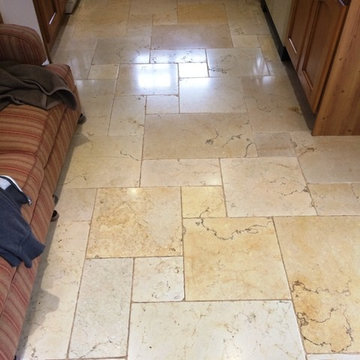
Polished stone floors will lose their shine over time depending on the amount of wear and cleaning products used and this Travertine Tiled Floor in Lower Woodrow had basically experienced this problem. The solution is to burnish the floor with diamond encrusted pads, a process that will remove any dirt and bring back the polish.
We started by smothering the floor is a mild dilution of Tile Doctor Pro-Clean and left it to dwell for ten minutes. We then scrubbed the grout lines using a stiff grout brush to get the grout clean. Next we fitted a course diamond burnishing pad to a rotary machine and slowly burnished each and every tile. We then extracted the slurry using a wet vacuum and rinsed. We continued this procedure with the medium, fine and very fine pads rinsing in-between until the shine had been restored. We then left the floor overnight to dry.
Upon our return we sealed the floor using Tile Doctor Colour Grow which is an impregnating sealer that soaks into he pores of the stone protecting it from within and enhancing the natural colours in the stone. Once the seal had dried I used a white buffing pad attached to the rotary machine and buffed the travertine to a nice shine.
Stuart Ford
Wiltshire Tile Doctor
 Patience Designs Studio Ltd
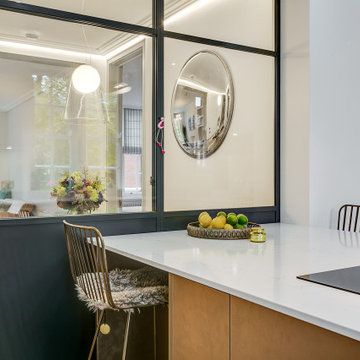
This St Johns Wood mansion block flat was one of our recent projects with a luxurious property developer in the area. We opened up spaces between the hallway, living area and kitchen to create a much more open feel throughout. A bespoke bench wrapped around the living space providing extra seating as well as storage whilst, keeping as much of the floor space free. Hidden cabling, Samsung Frame TV and biofires helped to add the luxuries without drawing away from the tranquillity.
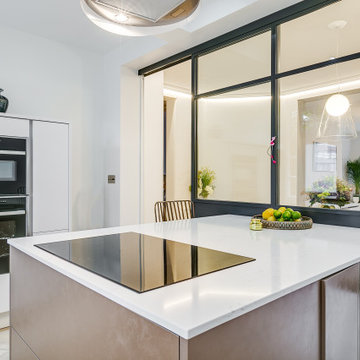
Another view of the St Johns Wood mansion block flat, the modern kitchen layout with it's central island and induction hob and ceiling mounted extraction pendant above. The brushed bronze finish on the island's facade contrasts with the sleek minimal gloss white cabinetry for the rest of the kitchen.
 Patience Designs Studio Ltd
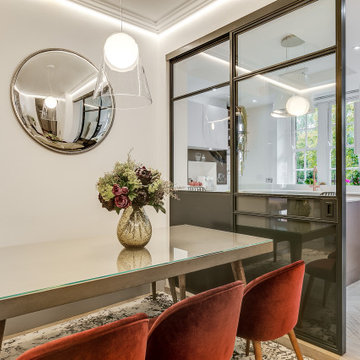
This St Johns Wood mansion block flat was one of our recent projects with a luxurious property developer in the area. We opened up spaces between the hallway, living area and kitchen to create a much more open feel throughout. A bespoke bench wrapped around the living space providing extra seating as well as storage whilst, keeping as much of the floor space free. Hidden cabling, Samsung Frame TV and biofires helped to add the luxuries without drawing away from the tranquillity.
Another view of the St Johns Wood mansion block flat, the modern kitchen layout with it's central island and induction hob and ceiling mounted extraction pendant above. The brushed bronze finish on the island's facade contrasts with the sleek minimal gloss white cabinetry for the rest of the kitchen.
 Patience Designs Studio Ltd
This St Johns Wood mansion block flat was one of our recent projects with a luxurious property developer in the area. We opened up spaces between the hallway, living area and kitchen to create a much more open feel throughout. A bespoke bench wrapped around the living space providing extra seating as well as storage whilst, keeping as much of the floor space free. Hidden cabling, Samsung Frame TV and biofires helped to add the luxuries without drawing away from the tranquillity.
Another view of the St Johns Wood mansion block flat, the modern kitchen layout with it's central island and induction hob and ceiling mounted extraction pendant above. The brushed bronze finish on the island's facade contrasts with the sleek minimal gloss white cabinetry for the rest of the kitchen.
 Williamsons Kitchens
Our client was in the process of building a new house to their specification in Fraserburgh. The centrepiece? A contemporary, open-plan kitchen that not only serves as a functional space but also as an inviting hub for family gatherings.
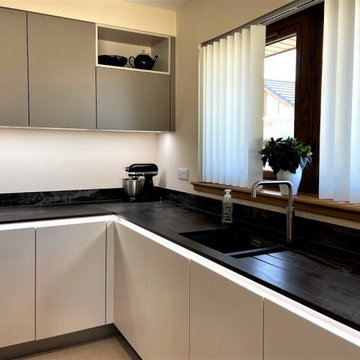
Opting for the Nolte SoftLack range, we integrated the Silver MatrixArt handleless trims, complemented by elegant integrated lighting. The main furniture showcases a soothing Sahara hue, contrasted smartly by the Lava accent.
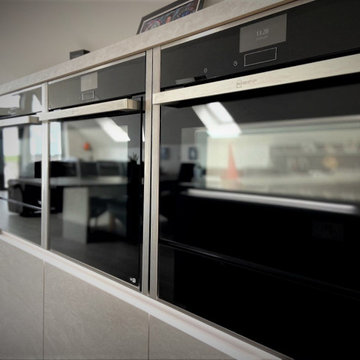
The 20mm Dekton Trilium worktop exudes sophistication, while the 40mm Nolte Platinum Bough Oak table adds a touch of warmth. We included a full suite of NEFF appliances: a single oven, combination microwave, induction hob, ceiling extraction, and a full-height fridge and freezer, meeting every culinary need.
Special requests are what make a design truly personal. We incorporated a Blanco Subline undermounted sink in Alumetallic, a state-of-the-art Quooker Fusion Square Stainless Steel instant boiling water tap, and durable Pergo flooring. Notably, the elevated dishwasher was positioned conveniently beside the sink, based on the client's preference. The tall units were seamlessly integrated into the ceiling, complemented by an artful goal-post niche. Furthermore, the extractor finds its home within a stylish ceiling drop box, highlighted by a subtly lit stepped ledge.
Dreaming of your own bespoke kitchen? Let us transform your vision into reality.
 Williamsons Kitchens
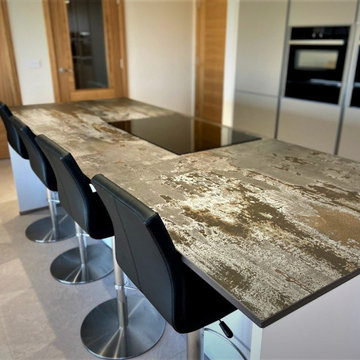
Our client presented us with a unique challenge: to craft a modern, open-plan kitchen in the upstairs open space of their new build. They were looking for a space that wasn’t just functional but also acted as a secondary eating area and transitioned smoothly into the living space.
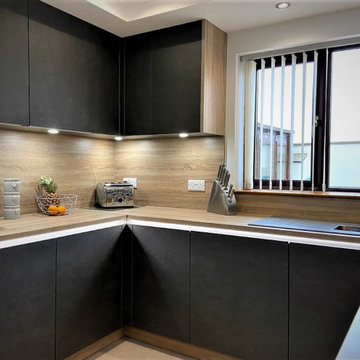
We selected Nolte Stone in Basalt, complemented by an accent in Glacier. The Quartz Grey MatrixArt handleless trims equipped with integrated lighting add a touch of modernity, ensuring a sleek finish.
A 20mm thick Silestone Gris Expo solid surface worktop was chosen, and we added a Glacier breakfast bar and Basalt table to align with the colour theme. For appliances, we trusted NEFF to deliver on performance, including their single oven, combination microwave, steam oven, induction hob, and gas domino hob. The downdraft extraction was a key addition, ensuring efficiency without the overhead extractor, and we integrated the client's existing American fridge freezer into the design seamlessly.
Special touches include a Blanco 1 ½ bowl undermounted sink paired with a Quooker Flex stainless Steel instant boiling water tap. Laminate flooring was laid to ensure longevity and ease of cleaning. To extend the functionality, we constructed a matching Nolte table and seamlessly moved the design into the living space, adding a contemporary sideboard unit and a media unit in the sitting area.
Thinking about a kitchen revamp? Get in touch for a transformative experience.
 Williamsons Kitchens
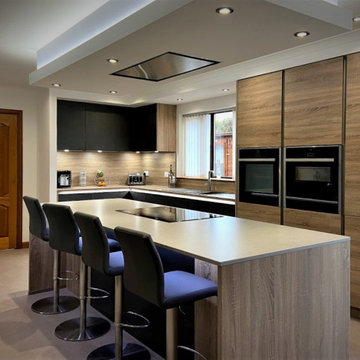
Our client in Inverallochy near Fraserburgh approached us with a vision for their project. The goal was to not just update their kitchen but also reconfigure the space by taking down partitions for a more fluid layout.
For the Inverallochy kitchen, we selected the Nolte Metal range. The main door's Grey Steel colour was paired with an accent in Kansas Oak, offering a harmonious blend of modern and traditional tones. The Silver MatrixArt handleless trims, coupled with integrated lighting, further elevated the design's sleek aesthetic.
Our choice of worktops included 20mm Silestone Eternal Serena Suede for the island and Nolte 25mm Kansas Oak for the perimeter. In terms of appliances, we integrated a comprehensive suite of Siemens products: from the single oven and combination microwave to the warming drawer, induction hob, and a unique ceiling extraction unit. The addition of a full-height fridge and a 600mm wine cooler ensured every culinary need was met.
Attention to detail was key. We incorporated a Blanco Zia 1 ½ sink in Alumetallic and a Quooker Fusion Square Stainless Steel instant boiling water tap for added functionality. A noteworthy design feature was the extractor built into a ceiling drop box, accentuated by a stepped ledge with dedicated lighting. Pergo flooring provided the finishing touch, ensuring durability and style.
Thinking of transforming your kitchen space? Get in touch for expert guidance and design.
 Williamsons Kitchens
Our client in Inverallochy near Fraserburgh approached us with a vision for their project. The goal was to not just update their kitchen but also reconfigure the space by taking down partitions for a more fluid layout.
For the Inverallochy kitchen, we selected the Nolte Metal range. The main door's Grey Steel colour was paired with an accent in Kansas Oak, offering a harmonious blend of modern and traditional tones. The Silver MatrixArt handleless trims, coupled with integrated lighting, further elevated the design's sleek aesthetic.
Our choice of worktops included 20mm Silestone Eternal Serena Suede for the island and Nolte 25mm Kansas Oak for the perimeter. In terms of appliances, we integrated a comprehensive suite of Siemens products: from the single oven and combination microwave to the warming drawer, induction hob, and a unique ceiling extraction unit. The addition of a full-height fridge and a 600mm wine cooler ensured every culinary need was met.
Attention to detail was key. We incorporated a Blanco Zia 1 ½ sink in Alumetallic and a Quooker Fusion Square Stainless Steel instant boiling water tap for added functionality. A noteworthy design feature was the extractor built into a ceiling drop box, accentuated by a stepped ledge with dedicated lighting. Pergo flooring provided the finishing touch, ensuring durability and style.
Thinking of transforming your kitchen space? Get in touch for expert guidance and design.
 Principle Builders Group
Galina Coada, Architectural Photographer
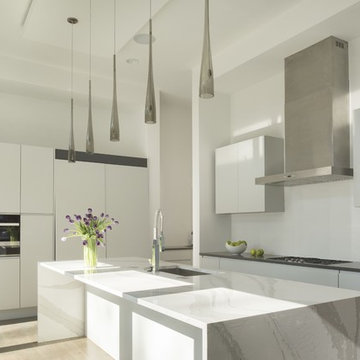
Enclosed kitchen - mid-sized modern galley light wood floor enclosed kitchen idea in Atlanta with a drop-in sink, flat-panel cabinets, white cabinets, marble countertops, white backsplash, stainless steel appliances and an island
Enclosed kitchen - mid-sized modern galley light wood floor enclosed kitchen idea in Atlanta with a drop-in sink, flat-panel cabinets, white cabinets, marble countertops, white backsplash, stainless steel appliances and an island
 Patience Designs Studio Ltd
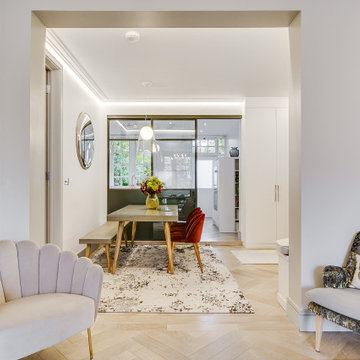
This St Johns Wood mansion block flat was one of our recent projects with a luxurious property developer in the area. We opened up spaces between the hallway, living area and kitchen to create a much more open feel throughout. A bespoke bench wrapped around the living space providing extra seating as well as storage whilst, keeping as much of the floor space free. Hidden cabling, Samsung Frame TV and biofires helped to add the luxuries without drawing away from the tranquillity.
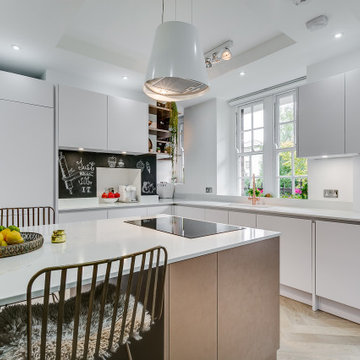
Another view of the St Johns Wood mansion block flat, the modern kitchen layout with it's central island and induction hob and ceiling mounted extraction pendant above. The brushed bronze finish on the island's facade contrasts with the sleek minimal gloss white cabinetry for the rest of the kitchen.
 Patience Designs Studio Ltd
This St Johns Wood mansion block flat was one of our recent projects with a luxurious property developer in the area. We opened up spaces between the hallway, living area and kitchen to create a much more open feel throughout. A bespoke bench wrapped around the living space providing extra seating as well as storage whilst, keeping as much of the floor space free. Hidden cabling, Samsung Frame TV and biofires helped to add the luxuries without drawing away from the tranquillity.
Another view of the St Johns Wood mansion block flat, the modern kitchen layout with it's central island and induction hob and ceiling mounted extraction pendant above. The brushed bronze finish on the island's facade contrasts with the sleek minimal gloss white cabinetry for the rest of the kitchen.
 Williamsons Kitchens
Our client in Inverallochy near Fraserburgh approached us with a vision for their project. The goal was to not just update their kitchen but also reconfigure the space by taking down partitions for a more fluid layout.
For the Inverallochy kitchen, we selected the Nolte Metal range. The main door's Grey Steel colour was paired with an accent in Kansas Oak, offering a harmonious blend of modern and traditional tones. The Silver MatrixArt handleless trims, coupled with integrated lighting, further elevated the design's sleek aesthetic.
Our choice of worktops included 20mm Silestone Eternal Serena Suede for the island and Nolte 25mm Kansas Oak for the perimeter. In terms of appliances, we integrated a comprehensive suite of Siemens products: from the single oven and combination microwave to the warming drawer, induction hob, and a unique ceiling extraction unit. The addition of a full-height fridge and a 600mm wine cooler ensured every culinary need was met.
Attention to detail was key. We incorporated a Blanco Zia 1 ½ sink in Alumetallic and a Quooker Fusion Square Stainless Steel instant boiling water tap for added functionality. A noteworthy design feature was the extractor built into a ceiling drop box, accentuated by a stepped ledge with dedicated lighting. Pergo flooring provided the finishing touch, ensuring durability and style.
Thinking of transforming your kitchen space? Get in touch for expert guidance and design.
 Williamsons Kitchens
Our client in Inverallochy near Fraserburgh approached us with a vision for their project. The goal was to not just update their kitchen but also reconfigure the space by taking down partitions for a more fluid layout.
For the Inverallochy kitchen, we selected the Nolte Metal range. The main door's Grey Steel colour was paired with an accent in Kansas Oak, offering a harmonious blend of modern and traditional tones. The Silver MatrixArt handleless trims, coupled with integrated lighting, further elevated the design's sleek aesthetic.
Our choice of worktops included 20mm Silestone Eternal Serena Suede for the island and Nolte 25mm Kansas Oak for the perimeter. In terms of appliances, we integrated a comprehensive suite of Siemens products: from the single oven and combination microwave to the warming drawer, induction hob, and a unique ceiling extraction unit. The addition of a full-height fridge and a 600mm wine cooler ensured every culinary need was met.
Attention to detail was key. We incorporated a Blanco Zia 1 ½ sink in Alumetallic and a Quooker Fusion Square Stainless Steel instant boiling water tap for added functionality. A noteworthy design feature was the extractor built into a ceiling drop box, accentuated by a stepped ledge with dedicated lighting. Pergo flooring provided the finishing touch, ensuring durability and style.
Thinking of transforming your kitchen space? Get in touch for expert guidance and design.
 Tile Doctor Ltd
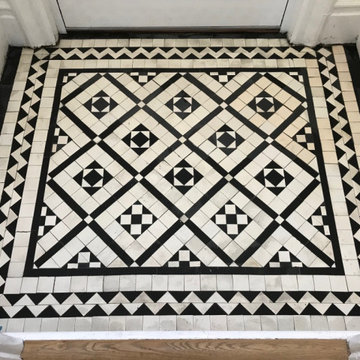
I visited this property in Lytham St Annes to survey a small Victorian tiled lobby which was in a sorry state. The client was keen to have it restored and wanted to know if it was possible. I discussed with them what we could do, and I gave them a quote for the work. Although it was only a small lobby, I could see the job could be quite involved and would be subject to the replacement tiles which I was confident we could source.
This is one of those jobs you wish you hadn’t started as there were a lot more tiles to remove than anticipated and it mushroomed into replacing half the floor. Once the area was cleaned up, I applied a self-levelling compound to bring up the height of the base.
Once the levelling compound had set, I was able relay the Victorian tiles using a combination of original tiles and replacements which had to be cut to shape. Cutting tiles to fit is quite intricate and time-consuming work especially when you consider new tiles are all metric in size and a 2mm difference becomes very telling after a foot or so! My solution was to use 150 mm tiles which are the biggest the stockist offers and then cut them down on my Rubi cutter using a template made from the original tiles. This the only way I could get it to look tight, it takes longer but it makes for a thorough job and a better finish.
I always use flexible floor adhesive when laying tiles, my preference is Keraquick Grey from Mapei. There are other brands off course but this one is quite easy to get hold of and as the term grouting is a relatively modern invention (in the past it was called pointing ) I find it looks right with this type of tile and similar to the screed cement the Victorians used in the past.
After the tiling had been completed, I left the floor to cure and fully dry and returned at a later date to give the floor an overall clean. For this I ran a coarse 200-grit diamond floor pad across the floor lubricated with water and used handheld diamond blocks for the edges where the pad can’t reach. The slurry was rinsed off with water and extracted with a wet vacuum.
With old floors like this, which don’t have a damp-proof membrane installed under the floor, efflorescence is always a concern and can lead to white salts appearing on the surface of the tile as moisture rises through the floor. To counter this, I finished cleaning the floor by scrubbing it with Tile Doctor Acid Gel. This was then rinsed off with water and the soil extracted using a wet vacuum.
The client was happy to seal the floor themselves (they wanted to save some money and it wasn’t a big area) so I supplied them with a bottle of Tile Doctor Colour Grow. I recommended this sealer as it will enhance the dark colours and being fully breathable it will cope with any moisture rising through the base. I recommended they apply two coats to start leaving time to allow the first coast to dry they could also then decide to leave it at that if they were happy with the finish.
Russell Taylor
Lancashire Tile Doctor

25