
Search results for "Posts viewer" in Home Design Ideas

 CJS Woodworking & Design
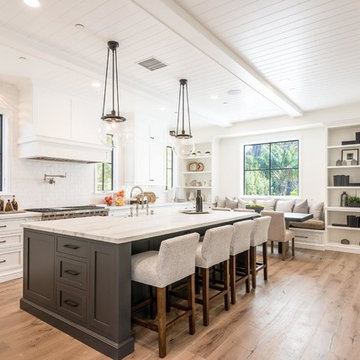
Example of a transitional l-shaped medium tone wood floor and brown floor eat-in kitchen design in Los Angeles with shaker cabinets, white cabinets, white backsplash, subway tile backsplash, stainless steel appliances, an island and white countertops
 M. Barnes & Co
Danny Piassick
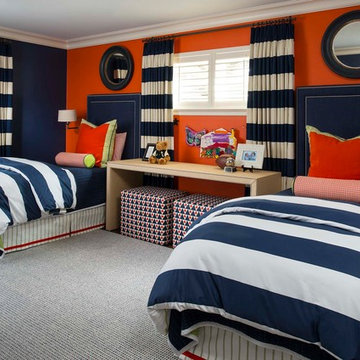
Kids' bedroom - transitional carpeted and gray floor kids' bedroom idea in Dallas with multicolored walls
Kids' bedroom - transitional carpeted and gray floor kids' bedroom idea in Dallas with multicolored walls
Find the right local pro for your project
 O’Hara Interiors
Martha O'Hara Interiors, Interior Design & Photo Styling | John Kraemer & Sons, Remodel | Troy Thies, Photography
Please Note: All “related,” “similar,” and “sponsored” products tagged or listed by Houzz are not actual products pictured. They have not been approved by Martha O’Hara Interiors nor any of the professionals credited. For information about our work, please contact design@oharainteriors.com.
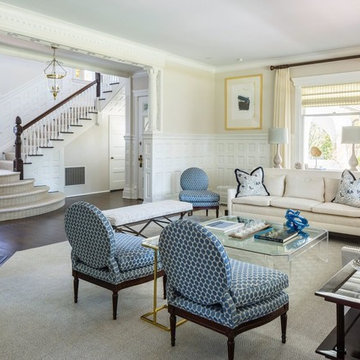
 Greenwich Redesign
Living room - large traditional formal and enclosed dark wood floor and brown floor living room idea in New York with beige walls, a corner fireplace, a concrete fireplace and no tv
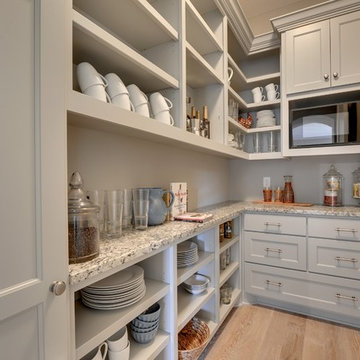
 Gonyea Custom Homes
Walk-in pantry has plenty of space for dishes, service ware, and even ingredients.
Photography by Spacecrafting
Example of a large transitional l-shaped light wood floor kitchen pantry design in Minneapolis with a farmhouse sink, white cabinets, gray backsplash, subway tile backsplash, stainless steel appliances, an island and open cabinets
Example of a large transitional l-shaped light wood floor kitchen pantry design in Minneapolis with a farmhouse sink, white cabinets, gray backsplash, subway tile backsplash, stainless steel appliances, an island and open cabinets
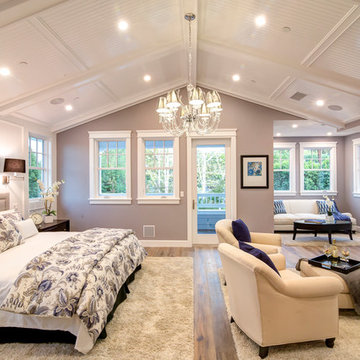
Elegant medium tone wood floor bedroom photo in Los Angeles with gray walls and a standard fireplace
Sponsored
Columbus, OH
Free consultation for landscape design!

Peabody Landscape Group
Franklin County's Reliable Landscape Design & Contracting
 HEYDT DESIGNS
Photography by Golden Gate Creative
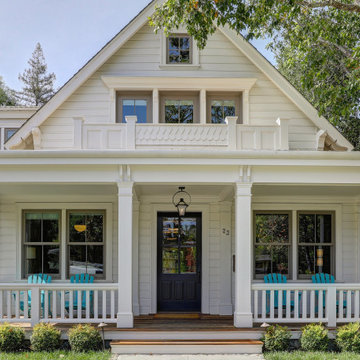
Mid-sized farmhouse white two-story wood and clapboard exterior home photo in San Francisco with a shingle roof and a gray roof
Mid-sized farmhouse white two-story wood and clapboard exterior home photo in San Francisco with a shingle roof and a gray roof
 Mercury Mosaics and Tile
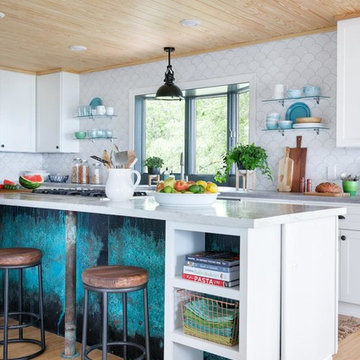
This Florida Gulf home is a project by DIY Network where they asked viewers to design a home and then they built it! Talk about giving a consumer what they want!
We were fortunate enough to have been picked to tile the kitchen--and our tile is everywhere! Using tile from countertop to ceiling is a great way to make a dramatic statement. But it's not the only dramatic statement--our monochromatic Moroccan Fish Scale tile provides a perfect, neutral backdrop to the bright pops of color throughout the kitchen. That gorgeous kitchen island is recycled copper from ships!
Overall, this is one kitchen we wouldn't mind having for ourselves.
Large Moroccan Fish Scale Tile - 130 White
Photos by: Christopher Shane


 Wright Building Company
www.wrightbuild.com
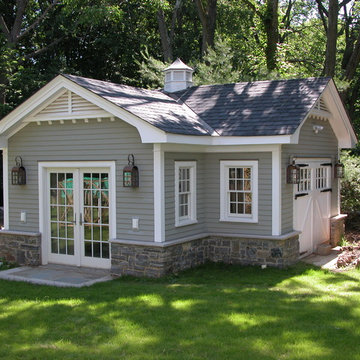
Example of a large classic mixed siding exterior home design in New York
Example of a large classic mixed siding exterior home design in New York
 Living Stone Design + Build
Ryan Theed
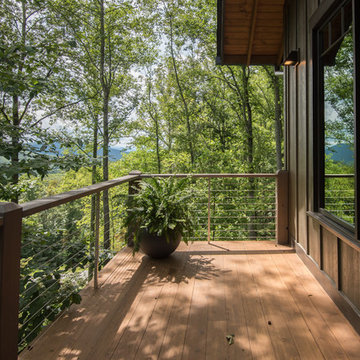
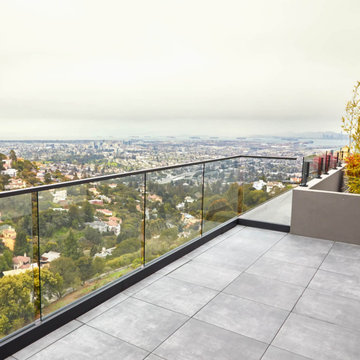
Inviting rustic balcony featuring natural wood elements and traditional mountain craftsmanship. The Gold's Residence balcony creates a perfect outdoor retreat with its thoughtful blend of rustic charm and modern functionality, offering expansive mountain views while providing a sheltered space for relaxation. This well-crafted exterior space complements the home's overall design while embracing traditional Appalachian building materials and techniques.
 Viewrail
For the exterior portion of the project, black Ascend Talons are mounted on top of the pre-existing half wall presenting a strong, “post-like” feel to the glass railing. Finally, where the view is at its best, obscure Base Rail is supports the glass from beneath with a cap rail on top. While sitting behind the glass the viewer is protected from any strong winds while being able to completely enjoy the view. This is just one beautiful example of what makes glass railing the fastest growing modern railing solution.
Sponsored
Columbus, OH

Structural Remodeling
Franklin County's Heavy Timber Specialists | Best of Houzz 2020!

 OVKO Art & Design
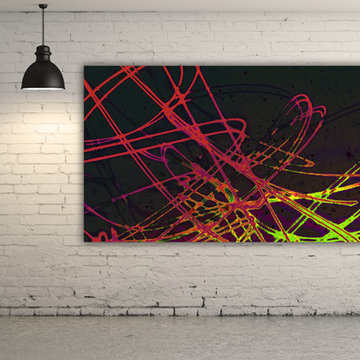
Industrial Gritty Abstract Artwork Panorama is a bold focal point for the creative trendsetter. Flowing lines have a graffiti style vibe. Spontaneous red mixes with neon green against a cool black. The art is framed under an acrylic glass for a modern city chic look. The large size captivates the viewer and makes a statement which redefines street style.
 OVKO Art & Design
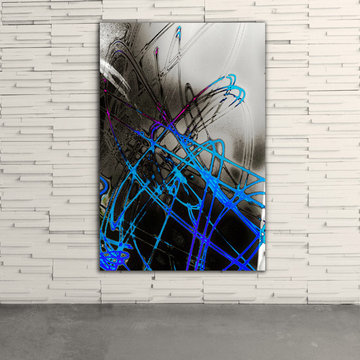
Graffiti Style Abstract Art makes a presence in the home of a hip urban dweller. Fluid lines of bold blue run throughout the piece. A stormy grey combines to give feelings of urban chaos. The result is an edgy, modern and gritty focal point that is sure to intrigue viewers. The print is mounted under a trendy acrylic glass which gives depth and vibrant color.
 Smith Boyd Interiors
Interior Design: By Michel Boyd of Smith Boyd Interiors
Photography: Allen Cooley
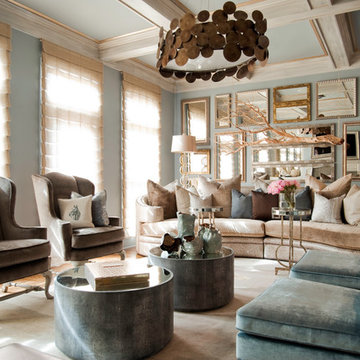
Inspiration for a contemporary living room remodel in Atlanta
Inspiration for a contemporary living room remodel in Atlanta
Sponsored
Delaware, OH

Buckeye Basements, Inc.
Central Ohio's Basement Finishing ExpertsBest Of Houzz '13-'21
 My Architect | Tim Lynch
My Architect
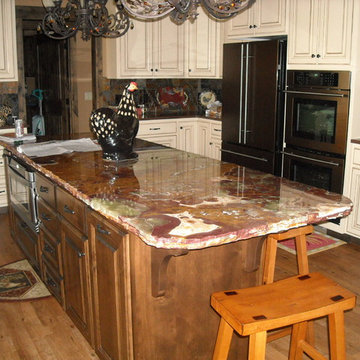
Example of a large trendy u-shaped medium tone wood floor eat-in kitchen design in Seattle with a double-bowl sink, beaded inset cabinets, distressed cabinets, marble countertops, brown backsplash, stone slab backsplash, stainless steel appliances and an island
Example of a large trendy u-shaped medium tone wood floor eat-in kitchen design in Seattle with a double-bowl sink, beaded inset cabinets, distressed cabinets, marble countertops, brown backsplash, stone slab backsplash, stainless steel appliances and an island

 safe ZOnea
If you’re active on GardenWeb sharing plant photos, asking for advice, tracking seasonal progress you already understand how much detail goes into gardening. Soil pH, rainfall, emerging leaves, bloom counts, fertilizer schedules it adds up fast. But all that rich information often remains buried in posts, lists or memory. What if you could visualize that data and turn it into clear quick insights? That’s where a graph maker becomes a game-changer for your gardening workflow.
1. Why garden data belongs on a graph
On GardenWeb, you’ll find forums for everything from perennial care, vegetable gardening, patios, herbs, even cooking and craft projects. While plant lovers share observations and ask questions, many track progress manually in spreadsheets or memory. A graph maker flips that around:
Instead of a list of numbers (e.g., “Soil test: pH 6.4 in May, 6.1 in October”), you get a line graph showing the decline over time.
Instead of guessing which plant bloomed most, you see a bar chart comparing counts across plants.
Instead of manually calculating average rainfall effect, you plot scatter points of bloom count vs. rainfall.
By turning your data into visuals, you’re not just recording—you’re analysing, learning and improving. For GardenWeb users this means smarter decisions: Which fertilizer actually improves bloom count? Which shady spot recovers slower? A graph maker gives clarity.
2. What is a graph maker and how to use one
A graph maker is a web tool or software that lets you input raw data (numbers, dates, categories) and output visual charts like line graphs, bar charts, scatter plots, etc. It might allow you to import a spreadsheet, select chart type, customize colours, label axes, and export the image for your blog, forum post or personal log.
Here’s how you could apply it for gardening:
Log blooms per week for each rose plant.
Using the graph maker, choose line graph to track changes over weeks.
Label your y-axis “Number of Blooms”, x-axis “Week of Year”.
Add colour lines for each plant for easy comparison.
Export as PNG and embed it in a GardenWeb forum post: “See bloom trend for my ‘Peace’ vs ‘Knock Out’ roses”.
This isn’t just pretty-to-look-at: it makes the trend obvious, invites discussion (“Hey, your ‘Knock Out’ line dips after week 28—what changed?”) and helps you refine your routine.
3. Use these specific scenarios on GardenWeb
A. Soil pH and plant health tracking
After multiple tests you have pH values over time and bloom results. Upload both datasets into the graph maker, produce a dual-axis line graph: soil pH on one axis, bloom count on the other. Post your findings in the “Soil, Fertility & Nutrients” forum and get feedback.
B. Seasonal pest or disease appearance
Record number of aphids spotted each month and whether you used treatment. A bar chart via the graph maker can show pre- and post-treatment figures. Then ask the “Insect & Disease Control” forum for advice based on your visual data.
C. Yield comparison between varieties
You grow two zucchini varieties. You keep weekly yield in pounds. Use the graph maker for a side-by-side bar chart. Share in the “Vegetable Gardening” forum: “Which was better this year? See the chart”.
D. Rainfall vs growth rate
You log weekly rainfall and growth (in cm) of your tomato plants. Use scatter plot in graph maker. If a pattern emerges, you’re ready to post: “Is my growth plateau due to drought? Chart shows a clear correlation.”
4. Why this elevates your GardenWeb contributions
When you post with a chart made by a graph maker, you’re doing more than asking or showing off. You’re investigating. You’re analysing. You invite the community to give feedback on data, not just anecdotes. That elevates the discussion. Instead of “My plant died, any ideas?” you post “See this graph of pH drop and bloom count—what might be the limiting factor?” High-quality visuals raise your post’s value and garner more thoughtful responses.
Plus, your posts become useful references for others: someone else can say, “Cool graphic, can you share your data sheet?” You build credibility and help the forum become a learning hub—not just a Q&A board.
5. Tips for using a graph maker effectively in the GardenWeb context
Keep it simple: One chart, one insight. Don’t overcrowd.
Label clearly: Titles, axis labels, units (e.g., cm/week, mg/L, °F).
Use readable colours: Avoid faint tones that vanish on mobile.
Annotate when needed: Add notes like “Fertiliser switched week 12” or “Shade cloth added”.
Provide context in your post: Don’t leave the chart alone—write a few sentences explaining what it shows and what you’re seeking.
Embed carefully: Make sure your image displays properly in GardenWeb; check mobile view.
Share raw data: If possible link to your spreadsheet so others can replicate or comment.
Be open to feedback: The chart invites questions; embrace them.
6. Possible pitfalls and how to avoid them
Bad data = bad chart: If your measurements aren’t consistent, your graph will mislead. Use standardized data collection.
Too much complexity: Multi-axis charts, too many variables—confusing. Stick to one or two variables.
Overlooking mobile viewers: Many GardenWeb users browse via phones. Use large fonts and simple visuals.
Ignoring the narrative: Chart alone won’t answer. Explain what it means and what you need.
Outdated charts: If you update your data annually, keep your visuals current or label them clearly as “2024 data”.
7. Final thoughts
On GardenWeb you’ll find a vibrant community of gardeners, DIYers, cooks and design lovers.Using a graph maker for your posts and progress turns your experience from casual hobby-logging into smart data-driven gardening. You’ll not only learn more—your peers will learn more, too.
So next time you log your plant growth, record your yield, test your soil or track pests—don’t just note it. Plot it. Use a graph maker. Share it in the forum. Let your garden tell the story, and let the community help you write the next chapter.
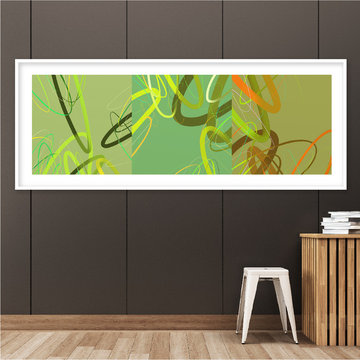
 Landkamer Art / Mark Landkamer
Landkamer Art / Avenida Triptych 007 • This series began in a more sparse mode as shown in this piece and was primarily inspired by the swaying California coastal kelp forests. There’s a blog post about that on my site. But an additional layer of meaning was on my mind—a frightening incident when very young where I was pushed off a Minnesota lake dock and needed to be pulled out of the lake quickly as I could not swim. This series references both inspiration moments into one positive healing work. There is the beauty and power of the swaying ocean kelp linked to the turbulence and fright of being knocked into the lake and looking up to the water’s surface from below.
Unintentionally the result is uplifting beauty and abundant positive energy for me. Like three frames from a film, the triptych panels communicate with each other. My hope is viewers can relate to where the work is coming from and share a positive emotional bond with it that puts them in a better space as well. • View more new art on Instagram: @landkamerart • Custom size prints available. Send an Email inquiry to: Mark@LandkamerArt.com • © 2019 Mark Landkamer. All rights reserved.
1