
Search results for "Reduce does" in Home Design Ideas
 Refugia Design/Build
Losing large specimen trees is never desirable. But when the unimaginable happens, we are presented with an opportunity to rethink and refresh, even in traditional residential settings.
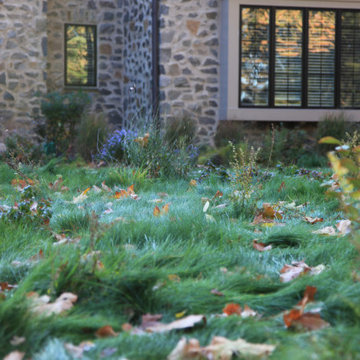
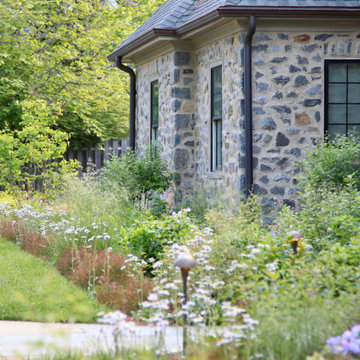
We replaced the lawn area beneath the remaining London plane with a fine fescue seed mix. Our design strategy was to hold space and create immediate impact while reducing maintenance needs as the landscape matured. Into this base, we planted evergreen basal foliage, long bloomers and early spring/late fall color to create an immersive all-season groundcover that will slowly intermingle. Annually, this low mow is cut no lower than 4” (thereby safeguarding habitat) while the tidily trimmed perimeter utilizes remnant turf grass as visible cues to care.
Dissecting the rectilinear green space, permeable hardscaping offers a gently curved path towards the front entryway; an invitation to pause and observe the landscape’s diverse textures and activity up close. Within which, a legacy planting of new specimen trees.
Traditional shrub heavy foundation plantings are often static and rigid; this perennial rich redesign is structured yet airy to retain design cohesion with the naturalistic stylized meadow and offer vibrant textural all-season interest.
This project blends different landscape styles to create a biodiverse habitat that is ecologically beneficial, beautiful and resilient. In high summer, a doe finds refuge for her fawn while the family’s children delight in the buzzing activity of smaller inhabitants, native bees and assorted pollinators, that now call this habitat home.
 Refugia Design/Build
Losing large specimen trees is never desirable. But when the unimaginable happens, we are presented with an opportunity to rethink and refresh, even in traditional residential settings.
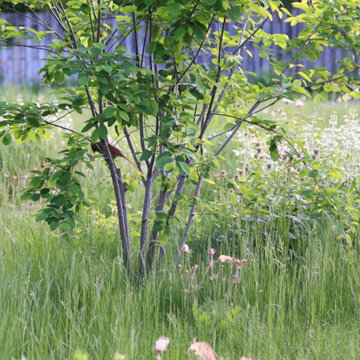
We replaced the lawn area beneath the remaining London plane with a fine fescue seed mix. Our design strategy was to hold space and create immediate impact while reducing maintenance needs as the landscape matured. Into this base, we planted evergreen basal foliage, long bloomers and early spring/late fall color to create an immersive all-season groundcover that will slowly intermingle. Annually, this low mow is cut no lower than 4” (thereby safeguarding habitat) while the tidily trimmed perimeter utilizes remnant turf grass as visible cues to care.
Dissecting the rectilinear green space, permeable hardscaping offers a gently curved path towards the front entryway; an invitation to pause and observe the landscape’s diverse textures and activity up close. Within which, a legacy planting of new specimen trees.
Traditional shrub heavy foundation plantings are often static and rigid; this perennial rich redesign is structured yet airy to retain design cohesion with the naturalistic stylized meadow and offer vibrant textural all-season interest.
This project blends different landscape styles to create a biodiverse habitat that is ecologically beneficial, beautiful and resilient. In high summer, a doe finds refuge for her fawn while the family’s children delight in the buzzing activity of smaller inhabitants, native bees and assorted pollinators, that now call this habitat home.
 Refugia Design/Build
Losing large specimen trees is never desirable. But when the unimaginable happens, we are presented with an opportunity to rethink and refresh, even in traditional residential settings.
We replaced the lawn area beneath the remaining London plane with a fine fescue seed mix. Our design strategy was to hold space and create immediate impact while reducing maintenance needs as the landscape matured. Into this base, we planted evergreen basal foliage, long bloomers and early spring/late fall color to create an immersive all-season groundcover that will slowly intermingle. Annually, this low mow is cut no lower than 4” (thereby safeguarding habitat) while the tidily trimmed perimeter utilizes remnant turf grass as visible cues to care.
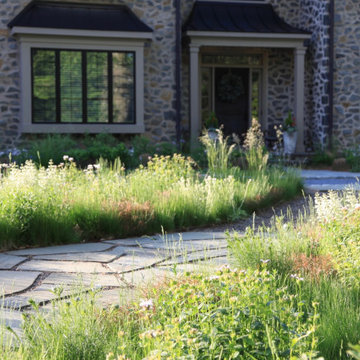
Dissecting the rectilinear green space, permeable hardscaping offers a gently curved path towards the front entryway; an invitation to pause and observe the landscape’s diverse textures and activity up close. Within which, a legacy planting of new specimen trees.
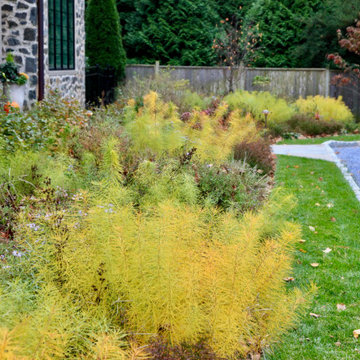
Traditional shrub heavy foundation plantings are often static and rigid; this perennial rich redesign is structured yet airy to retain design cohesion with the naturalistic stylized meadow and offer vibrant textural all-season interest.
This project blends different landscape styles to create a biodiverse habitat that is ecologically beneficial, beautiful and resilient. In high summer, a doe finds refuge for her fawn while the family’s children delight in the buzzing activity of smaller inhabitants, native bees and assorted pollinators, that now call this habitat home.
Find the right local pro for your project
 Refugia Design/Build
Losing large specimen trees is never desirable. But when the unimaginable happens, we are presented with an opportunity to rethink and refresh, even in traditional residential settings.
We replaced the lawn area beneath the remaining London plane with a fine fescue seed mix. Our design strategy was to hold space and create immediate impact while reducing maintenance needs as the landscape matured. Into this base, we planted evergreen basal foliage, long bloomers and early spring/late fall color to create an immersive all-season groundcover that will slowly intermingle. Annually, this low mow is cut no lower than 4” (thereby safeguarding habitat) while the tidily trimmed perimeter utilizes remnant turf grass as visible cues to care.
Dissecting the rectilinear green space, permeable hardscaping offers a gently curved path towards the front entryway; an invitation to pause and observe the landscape’s diverse textures and activity up close. Within which, a legacy planting of new specimen trees.
Traditional shrub heavy foundation plantings are often static and rigid; this perennial rich redesign is structured yet airy to retain design cohesion with the naturalistic stylized meadow and offer vibrant textural all-season interest.
This project blends different landscape styles to create a biodiverse habitat that is ecologically beneficial, beautiful and resilient. In high summer, a doe finds refuge for her fawn while the family’s children delight in the buzzing activity of smaller inhabitants, native bees and assorted pollinators, that now call this habitat home.
 Refugia Design/Build
Losing large specimen trees is never desirable. But when the unimaginable happens, we are presented with an opportunity to rethink and refresh, even in traditional residential settings.
We replaced the lawn area beneath the remaining London plane with a fine fescue seed mix. Our design strategy was to hold space and create immediate impact while reducing maintenance needs as the landscape matured. Into this base, we planted evergreen basal foliage, long bloomers and early spring/late fall color to create an immersive all-season groundcover that will slowly intermingle. Annually, this low mow is cut no lower than 4” (thereby safeguarding habitat) while the tidily trimmed perimeter utilizes remnant turf grass as visible cues to care.
Dissecting the rectilinear green space, permeable hardscaping offers a gently curved path towards the front entryway; an invitation to pause and observe the landscape’s diverse textures and activity up close. Within which, a legacy planting of new specimen trees.
Traditional shrub heavy foundation plantings are often static and rigid; this perennial rich redesign is structured yet airy to retain design cohesion with the naturalistic stylized meadow and offer vibrant textural all-season interest.
This project blends different landscape styles to create a biodiverse habitat that is ecologically beneficial, beautiful and resilient. In high summer, a doe finds refuge for her fawn while the family’s children delight in the buzzing activity of smaller inhabitants, native bees and assorted pollinators, that now call this habitat home.

 MPC Cashway Lumber - Kitchen and Bath Showroom
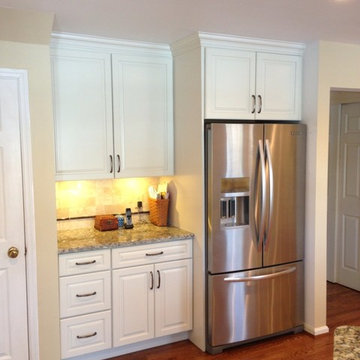
With timeless appeal and an endless array of options, Schrock's classic cabinets are just the right offering to transform your space into an enduring expression of your personality.
CABINETS: Schrock Entra
COUNTERTOPS: Laminate Countertop
REFRIGERATOR: Haier
RANGE: GE Profiles
Photos: Jim Schuon

 Margot Hartford Photography
Photo: Margot Hartford Photography © 2016 Houzz
Inspiration for a timeless dining room remodel in Amsterdam
Inspiration for a timeless dining room remodel in Amsterdam
Sponsored
Columbus, OH

Structural Remodeling
Franklin County's Heavy Timber Specialists | Best of Houzz 2020!
 gardenaar
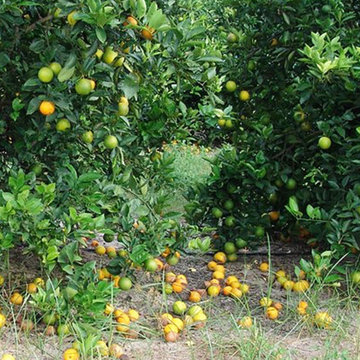
Does your orange tree drop its fruit before it reaches full size, or worse, does it drop flowers before the fruit starts to form?
Trees photosynthesize to produce carbohydrates like sugar which they store as a source of energy. They can maintain a limited amount, which is used to drive the growth of new leaves, branches, roots and stem. Fruitfulness requires the tree to divert its limited energy sources away from these vital functions to the production of flowers, blossoms and fruits.
Fruit development involves maturity followed by fertilization, growth, maturity and maturity. This process takes between 6-7 months in warmer climates, which requires a large number of tree energy sources as a result.
Trees are able to manage their resources, and will also divert them to emergencies ...
Fruit Drop and Crop Depression
In regions where oranges produce one crop per year, they go through a series of growth stages as follows:
Sprout formation and flower launching (mid-winter)
Flowers and fruit set (early spring)
Fruit growth - cell division (late spring to early summer)
Fruit growth - cell proliferation (mid-summer to early autumn)
Fruit ripening (autumn to late winter)
The difference is in the regions where most citrus crops are produced year-round. In these cases, the different stages of development will take place simultaneously.
The orange tree can handle its plant load well, and it will bear as much fruit as we can support. It is natural for all citrus trees to produce too little fruit and too little flowers in early spring to prevent overproduction. There is no need to worry too much about flowering, as an orange tree needs only 1% to 2% of flowers to produce a good crop, and sometimes even less than 1% is enough.
If a tree is depressed because it does not get enough water in hot, dry weather, and if it dies of nitrogen starvation because it is not given enough fertilizer, fruit set will be very difficult in the spring. There may also be a small number of fruit losses in the summer under stressful conditions.
Solution: Provide enough water, and water often in hot weather and strong winds. Orange feed with moderate fertilizer in early spring (September in Southern hemisphere, March in the Northern Hemisphere)
Fruit Drop and Lack of Potassium Nutrient
When orange trees are heavy, the decline in fruit can be exacerbated by low potassium levels.
Potassium, also known as potash (represented by the chemical mark K on fertilizer labels meaning N-P-K or nitrogen-phosphorus-potassium ratio) is a major macronutrient needed for flowering and fruit formation. Next to nitrogen, plants absorb more potassium than any other nutrient. Without potassium, the trees stop flowering and fruiting, which is what happens if they are not fed regularly.
Before any smug horticulturist declares to you that potassium has no direct effect on flowering and fruit set, let me say that as a horticulturist and biochemist, plant chemistry, like the chemistry of all living things is complex, but some input it is necessary to produce certain results. , and the references I have made to the end of this article support what I am saying!
Entering science, Potassium (K) is essential for water, nutrients and the movement of carbohydrates in plant tissues. It also activates enzymes that facilitate the synthesis of complex chemicals within the plant - such as starch, protein and adenosine triphosphate (ATP) production. The role of ATP is to transport the energy needed for all cellular metabolic activities to all living things, and in plants ATP production can regulate the level of photosynthesis.
Potassium also helps regulate the opening and closing of stomata, holes or cavities under which oxygen and carbon dioxide are exchanged with the atmosphere, and respiratory losses are controlled. It increases root growth which increases the absorption of nutrients and improves drought resistance, and increases resistance to frost, pests and diseases. High potassium levels produce similar maturity and fruit growth rate, as well as better nutritional quality, taste and range.
Agricultural extension agencies suggest that large amounts of potash are needed in many crops, and that potassium deficiency or macronutrient deficiency leads to reduced crop growth and reduced yields, and that potassium levels not only affect yield, but fruit size, juice. quality and shelf life.
Since potassium plays an important role in water regulation, deficiency can clearly increase the pressures associated with the declining fruit mentioned in the previous section.
Solution: Make sure that the orange trees are fertilized with the right fertilizer as previously discussed. Extra potassium can be brought in using seaweed extract (which is not a fertilizer but contains a good amount of potassium), wood ash (used in small quantities only as it is very alkaline), or potash sulphate (potassium sulphate) - all this is guaranteed. as acceptable in a natural garden.
Never use potassium chloride as it can be harmful to plants, it is a very inexpensive alternative to fertilizer manufacturers to save money!
Even if there are sufficient levels of potassium in the soil, it may not be accessible to plants, unless we make some improvements.


 JAZ Design, Inc.
Mid-sized elegant u-shaped medium tone wood floor eat-in kitchen photo in Boston with an undermount sink, raised-panel cabinets, white cabinets, quartzite countertops, multicolored backsplash, stone tile backsplash, stainless steel appliances and an island

 Kitchen Design Concepts
This super transformative kitchen has become one of our favorites when it comes to how much it changed! Plus, not only does It have all the qualities of what’s on trend, but also has qualities of what’s going to last long-term. We love the brightness of the white cabinets on the perimeter paired with the warmer grey cabinets on the island. If you compare it with the original, it’s essentially night and day! Curious to learn more? Keep reading!
Cabinets
The biggest change to the space is the cabinetry. For the perimeter, we painted it white while painting the island a dark grey. In addition, the bar-height walls surrounding the island was reduced to a counter-height which helped open up the kitchen even more.
Countertops
Introducing even more warmth to the space, we spec’ed a 3 cm Caesarstone Quartz in London Grey. This is a great option if you’re looking for a material that has a marble look but want something a little more durable and low maintenance.
Backsplash
For backsplash we selected a 3×6 Arizona Tile H-Line series, in Pumice installed in a brick lay as field tile. As an insert in the main backsplash, we installed a Soci Oxford Blend in a Valencia Pattern.
remodel your kitchen island
Fixtures and Finishes
From Blanco, we have a Silgranit 1 & ¾ sink in the color Truffle. From Newport Brass, we have a Jacobean pulldown faucet in Satin Gold and a Jacobean cold water dispenser also in Satin Gold. From Mountain Plumbing, we have an air disposal switch in satin gold. As for hardware, we installed Top Knobs pulls on doors and drawer fronts in their gold finish.


 KINGDOM WOODWORKS
Collaboration with Canonbury Homes and Frank Neely Design Associates.
Inspiration for a timeless open concept kitchen remodel in Atlanta with beaded inset cabinets and two islands
Inspiration for a timeless open concept kitchen remodel in Atlanta with beaded inset cabinets and two islands

 Kitchen Design Concepts
This super transformative kitchen has become one of our favorites when it comes to how much it changed! Plus, not only does It have all the qualities of what’s on trend, but also has qualities of what’s going to last long-term. We love the brightness of the white cabinets on the perimeter paired with the warmer grey cabinets on the island. If you compare it with the original, it’s essentially night and day! Curious to learn more? Keep reading!
Cabinets
The biggest change to the space is the cabinetry. For the perimeter, we painted it white while painting the island a dark grey. In addition, the bar-height walls surrounding the island was reduced to a counter-height which helped open up the kitchen even more.
Countertops
Introducing even more warmth to the space, we spec’ed a 3 cm Caesarstone Quartz in London Grey. This is a great option if you’re looking for a material that has a marble look but want something a little more durable and low maintenance.
Backsplash
For backsplash we selected a 3×6 Arizona Tile H-Line series, in Pumice installed in a brick lay as field tile. As an insert in the main backsplash, we installed a Soci Oxford Blend in a Valencia Pattern.
remodel your kitchen island
Fixtures and Finishes
From Blanco, we have a Silgranit 1 & ¾ sink in the color Truffle. From Newport Brass, we have a Jacobean pulldown faucet in Satin Gold and a Jacobean cold water dispenser also in Satin Gold. From Mountain Plumbing, we have an air disposal switch in satin gold. As for hardware, we installed Top Knobs pulls on doors and drawer fronts in their gold finish.

 CoverMyPatio.com
The Arcadia Louvered Roof enhances the beauty of any style home and provides the flexibility of having an open roof when the weather is good or a solid roof to keep the rain off your patio when the weather turns bad.
Eco-friendly Construction
The Arcadia system is made up of recycled aluminum making it an extremely Green product. It is also eco-friendly, helping consumers save on passive solar heating and cooling.
We Think Green
Arcadia is proud to continue the company's tradition with its approach to Environmental Innovation. From the choice of lightweight materials and lean production methods to the efficiency of its drive system and designs, Arcadia is committed to operating as a more sustainable business and reducing its overall environmental impact.
High-quality Building Materials
Each Arcadia system is a work of art, constructed with care and attention to every little detail.
Our system is powered coated, extruded aluminum with stainless steel components giving us the most durable louvered roof on the market today. From our superior drive system, which is UL & CE certified, down to the stainless steel tex screws that secures the system together. Nothing but the best!
Our low-maintenance components eliminate painting, staining, and waterproofing of traditional shading structures. Using powder-coated aluminum construction prevents warping, cracking, and corrosion.
Photographed by: Roger Chafin
 Kitchen Design Concepts
This super transformative kitchen has become one of our favorites when it comes to how much it changed! Plus, not only does It have all the qualities of what’s on trend, but also has qualities of what’s going to last long-term. We love the brightness of the white cabinets on the perimeter paired with the warmer grey cabinets on the island. If you compare it with the original, it’s essentially night and day! Curious to learn more? Keep reading!
Cabinets
The biggest change to the space is the cabinetry. For the perimeter, we painted it white while painting the island a dark grey. In addition, the bar-height walls surrounding the island was reduced to a counter-height which helped open up the kitchen even more.
Countertops
Introducing even more warmth to the space, we spec’ed a 3 cm Caesarstone Quartz in London Grey. This is a great option if you’re looking for a material that has a marble look but want something a little more durable and low maintenance.
Backsplash
For backsplash we selected a 3×6 Arizona Tile H-Line series, in Pumice installed in a brick lay as field tile. As an insert in the main backsplash, we installed a Soci Oxford Blend in a Valencia Pattern.
remodel your kitchen island
Fixtures and Finishes
From Blanco, we have a Silgranit 1 & ¾ sink in the color Truffle. From Newport Brass, we have a Jacobean pulldown faucet in Satin Gold and a Jacobean cold water dispenser also in Satin Gold. From Mountain Plumbing, we have an air disposal switch in satin gold. As for hardware, we installed Top Knobs pulls on doors and drawer fronts in their gold finish.

 Four Blocks South
Example of a mid-sized minimalist master blue tile and glass tile ceramic tile and gray floor freestanding bathtub design in Toronto with flat-panel cabinets, medium tone wood cabinets, a wall-mount toilet, gray walls, an integrated sink, a hinged shower door and white countertops
 Kitchen Design Concepts
This super transformative kitchen has become one of our favorites when it comes to how much it changed! Plus, not only does It have all the qualities of what’s on trend, but also has qualities of what’s going to last long-term. We love the brightness of the white cabinets on the perimeter paired with the warmer grey cabinets on the island. If you compare it with the original, it’s essentially night and day! Curious to learn more? Keep reading!
Cabinets
The biggest change to the space is the cabinetry. For the perimeter, we painted it white while painting the island a dark grey. In addition, the bar-height walls surrounding the island was reduced to a counter-height which helped open up the kitchen even more.
Countertops
Introducing even more warmth to the space, we spec’ed a 3 cm Caesarstone Quartz in London Grey. This is a great option if you’re looking for a material that has a marble look but want something a little more durable and low maintenance.
Backsplash
For backsplash we selected a 3×6 Arizona Tile H-Line series, in Pumice installed in a brick lay as field tile. As an insert in the main backsplash, we installed a Soci Oxford Blend in a Valencia Pattern.
remodel your kitchen island
Fixtures and Finishes
From Blanco, we have a Silgranit 1 & ¾ sink in the color Truffle. From Newport Brass, we have a Jacobean pulldown faucet in Satin Gold and a Jacobean cold water dispenser also in Satin Gold. From Mountain Plumbing, we have an air disposal switch in satin gold. As for hardware, we installed Top Knobs pulls on doors and drawer fronts in their gold finish.
15