
Search results for "Shrugged" in Home Design Ideas
 Rocky Tops Granite & Marble LLC
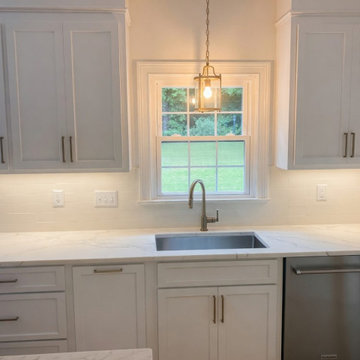
Spectrums Indulgence quartz, manufactured right here in Latta South Carolina, went into this kitchen in Columbia, and it's the kind of stone that works quietly hard in a room people actually cook and live in. It's engineered quartz, so what you're looking at is a mix of ground quartz and resin, blended and pressed to give a background that stays consistent slab to slab. That matters more than people think when you're trying to keep a kitchen looking pulled together across a run of cabinets, an island, and a backsplash.
The color reads as a soft, workable background with movement in it, enough character to give the room some depth without turning into something that fights with the cabinets or the floor. That's the appeal of a pattern like this one. It's not a plain solid, but it's not so busy that it limits what else goes in the space. Kitchens live a long time with the same countertop, and a stone that holds up visually over the years is worth choosing over something flashier that gets tiring.
Quartz like this is also just practical for a working kitchen. It doesn't need sealing the way natural stone does, it resists staining from wine, oil, and citrus, and it shrugs off the daily scratches from knives and pans that would show on a softer stone. Heat is the one thing we tell people to respect, a hot pan straight off the stove can shock the resin, so a trivet is the smart habit to build. Otherwise it's about as low-maintenance a surface as you can put in a kitchen.
We set the edge as eased, which is the clean, simple choice that lets the stone itself do the talking instead of the profile. Templating and fabrication on a job like this comes down to getting the seams tight and matching the pattern across the island and the runs so it reads as one continuous piece even where the slabs meet.
Jobs like this are what we like doing around Columbia and the rest of the Midlands, where a kitchen remodel means getting the material, the layout, and the fit all right in a space a family's going to use every single day.
 Rocky Tops Granite & Marble LLC
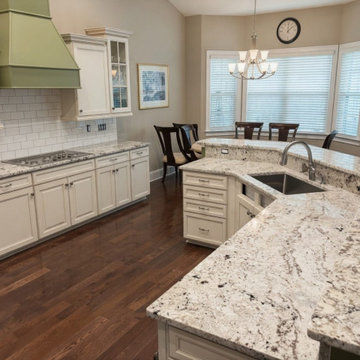
This kitchen in Lexington came together in BSI Zurich granite, and it's the kind of stone that does a lot of the work in a room just by sitting there. Zurich has a cool gray background with movement that breaks up into darker flecks and softer crystal patches, so it reads calm from across the room but keeps your eye busy up close. That range makes it easy to live with next to most cabinet colors, whether the boxes are painted white, a soft gray, or a warmer wood tone.
Granite like this is quarried in big blocks and cut into slabs, and no two slabs come out exactly the same. That's part of why we template each kitchen on site instead of working off a generic plan. We measure the actual cabinets, account for the sink and cooktop cutouts, and lay out the slabs so the veining and pattern flow the way they should across the island and the runs of counter, especially where two pieces meet at a seam. Getting that seam tight and matched so it disappears into the pattern takes a steady hand and slabs picked with the layout in mind from the start.
Granite is one of the toughest countertop materials you can put in a kitchen. It shrugs off hot pans, resists scratching from everyday knife work, and holds up to the kind of daily traffic a real kitchen sees, dishes, coffee, kids doing homework at the island, all of it. It does need to be sealed, and staying on top of that keeps it looking like day one for years. We finished this one with an eased edge, clean and simple, which is the right call for a stone with this much going on in the surface. It doesn't need extra shaping to look finished.
Lexington's seen a lot of kitchens go through updates like this one, and granite remains a favorite around the Midlands because it holds up to how people actually cook and live. This Zurich kitchen is a good example of why: a stone with real character, installed tight and clean, that's going to keep earning its keep for a long time.
 Rocky Tops Granite & Marble LLC
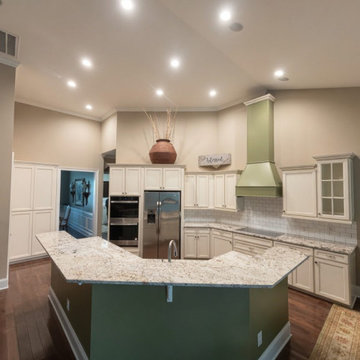
This kitchen in Lexington came together in BSI Zurich granite, and it's the kind of stone that does a lot of the work in a room just by sitting there. Zurich has a cool gray background with movement that breaks up into darker flecks and softer crystal patches, so it reads calm from across the room but keeps your eye busy up close. That range makes it easy to live with next to most cabinet colors, whether the boxes are painted white, a soft gray, or a warmer wood tone.
Granite like this is quarried in big blocks and cut into slabs, and no two slabs come out exactly the same. That's part of why we template each kitchen on site instead of working off a generic plan. We measure the actual cabinets, account for the sink and cooktop cutouts, and lay out the slabs so the veining and pattern flow the way they should across the island and the runs of counter, especially where two pieces meet at a seam. Getting that seam tight and matched so it disappears into the pattern takes a steady hand and slabs picked with the layout in mind from the start.
Granite is one of the toughest countertop materials you can put in a kitchen. It shrugs off hot pans, resists scratching from everyday knife work, and holds up to the kind of daily traffic a real kitchen sees, dishes, coffee, kids doing homework at the island, all of it. It does need to be sealed, and staying on top of that keeps it looking like day one for years. We finished this one with an eased edge, clean and simple, which is the right call for a stone with this much going on in the surface. It doesn't need extra shaping to look finished.
Lexington's seen a lot of kitchens go through updates like this one, and granite remains a favorite around the Midlands because it holds up to how people actually cook and live. This Zurich kitchen is a good example of why: a stone with real character, installed tight and clean, that's going to keep earning its keep for a long time.
Find the right local pro for your project
 Rocky Tops Granite & Marble LLC
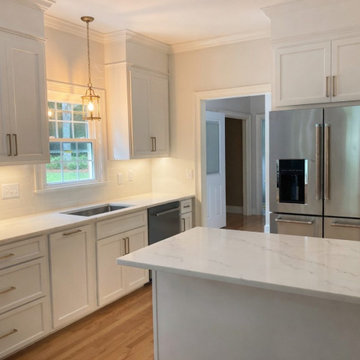
Spectrums Indulgence quartz, manufactured right here in Latta South Carolina, went into this kitchen in Columbia, and it's the kind of stone that works quietly hard in a room people actually cook and live in. It's engineered quartz, so what you're looking at is a mix of ground quartz and resin, blended and pressed to give a background that stays consistent slab to slab. That matters more than people think when you're trying to keep a kitchen looking pulled together across a run of cabinets, an island, and a backsplash.
The color reads as a soft, workable background with movement in it, enough character to give the room some depth without turning into something that fights with the cabinets or the floor. That's the appeal of a pattern like this one. It's not a plain solid, but it's not so busy that it limits what else goes in the space. Kitchens live a long time with the same countertop, and a stone that holds up visually over the years is worth choosing over something flashier that gets tiring.
Quartz like this is also just practical for a working kitchen. It doesn't need sealing the way natural stone does, it resists staining from wine, oil, and citrus, and it shrugs off the daily scratches from knives and pans that would show on a softer stone. Heat is the one thing we tell people to respect, a hot pan straight off the stove can shock the resin, so a trivet is the smart habit to build. Otherwise it's about as low-maintenance a surface as you can put in a kitchen.
We set the edge as eased, which is the clean, simple choice that lets the stone itself do the talking instead of the profile. Templating and fabrication on a job like this comes down to getting the seams tight and matching the pattern across the island and the runs so it reads as one continuous piece even where the slabs meet.
Jobs like this are what we like doing around Columbia and the rest of the Midlands, where a kitchen remodel means getting the material, the layout, and the fit all right in a space a family's going to use every single day.
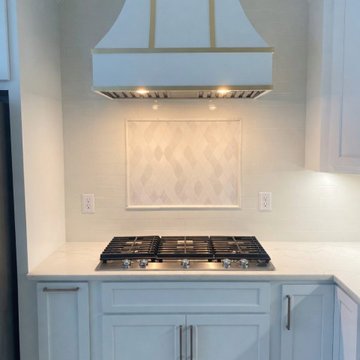 Rocky Tops Granite & Marble LLC
Spectrums Indulgence quartz, manufactured right here in Latta South Carolina, went into this kitchen in Columbia, and it's the kind of stone that works quietly hard in a room people actually cook and live in. It's engineered quartz, so what you're looking at is a mix of ground quartz and resin, blended and pressed to give a background that stays consistent slab to slab. That matters more than people think when you're trying to keep a kitchen looking pulled together across a run of cabinets, an island, and a backsplash.
The color reads as a soft, workable background with movement in it, enough character to give the room some depth without turning into something that fights with the cabinets or the floor. That's the appeal of a pattern like this one. It's not a plain solid, but it's not so busy that it limits what else goes in the space. Kitchens live a long time with the same countertop, and a stone that holds up visually over the years is worth choosing over something flashier that gets tiring.
Quartz like this is also just practical for a working kitchen. It doesn't need sealing the way natural stone does, it resists staining from wine, oil, and citrus, and it shrugs off the daily scratches from knives and pans that would show on a softer stone. Heat is the one thing we tell people to respect, a hot pan straight off the stove can shock the resin, so a trivet is the smart habit to build. Otherwise it's about as low-maintenance a surface as you can put in a kitchen.
We set the edge as eased, which is the clean, simple choice that lets the stone itself do the talking instead of the profile. Templating and fabrication on a job like this comes down to getting the seams tight and matching the pattern across the island and the runs so it reads as one continuous piece even where the slabs meet.
Jobs like this are what we like doing around Columbia and the rest of the Midlands, where a kitchen remodel means getting the material, the layout, and the fit all right in a space a family's going to use every single day.


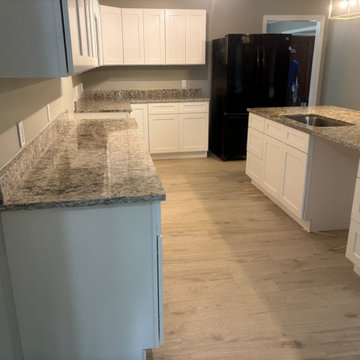 Rocky Tops Granite & Marble LLC
This kitchen came together with Ornamental White granite on the counters. No waterfall, no fancy backsplash story here, just solid granite doing what granite does best, holding up to real cooking and real life in a busy South Carolina kitchen.
We finished the edges with an eased profile, which is the detail people don't think about until they're leaning on the counter every day. An eased edge takes the sharp corner off the slab and rounds it just enough so it's comfortable to work against, without adding a bunch of extra machining that can chip or crack down the line. It's a clean, classic look that doesn't fight with the granite's natural pattern, and it wears well over years of use.
Granite is still one of the best choices you can put in a kitchen. It's hard, it's heat resistant, and you can set a hot pan on it without worrying. It'll take a knife dragged across it by accident and shrug it off. Every slab has its own movement in the stone, its own crystal structure catching light differently depending on where you stand, and templating a kitchen like this means matching that pattern at the seams so it reads like one continuous piece instead of two pieces bolted together.
Day to day, this countertop is going to earn its keep. Granite seals up easily and, once it's sealed, it resists staining from wine, oil, coffee, whatever gets set down on it. It doesn't scratch from normal kitchen use, and it doesn't dull over time the way some softer stones can. That's why we keep coming back to it for kitchens that actually get used, not just looked at.
We fabricate and install jobs like this all over the Midlands, and it's the same story every time: good stone, cut right, set level, edges finished clean. That's what makes a countertop last for decades instead of years, and that's what you're getting here.
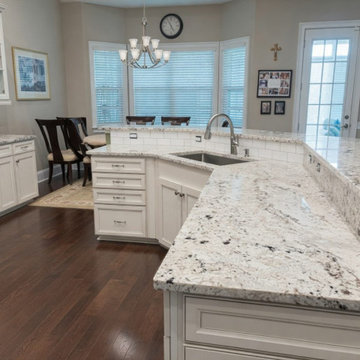 Rocky Tops Granite & Marble LLC
This kitchen in Lexington came together in BSI Zurich granite, and it's the kind of stone that does a lot of the work in a room just by sitting there. Zurich has a cool gray background with movement that breaks up into darker flecks and softer crystal patches, so it reads calm from across the room but keeps your eye busy up close. That range makes it easy to live with next to most cabinet colors, whether the boxes are painted white, a soft gray, or a warmer wood tone.
Granite like this is quarried in big blocks and cut into slabs, and no two slabs come out exactly the same. That's part of why we template each kitchen on site instead of working off a generic plan. We measure the actual cabinets, account for the sink and cooktop cutouts, and lay out the slabs so the veining and pattern flow the way they should across the island and the runs of counter, especially where two pieces meet at a seam. Getting that seam tight and matched so it disappears into the pattern takes a steady hand and slabs picked with the layout in mind from the start.
Granite is one of the toughest countertop materials you can put in a kitchen. It shrugs off hot pans, resists scratching from everyday knife work, and holds up to the kind of daily traffic a real kitchen sees, dishes, coffee, kids doing homework at the island, all of it. It does need to be sealed, and staying on top of that keeps it looking like day one for years. We finished this one with an eased edge, clean and simple, which is the right call for a stone with this much going on in the surface. It doesn't need extra shaping to look finished.
Lexington's seen a lot of kitchens go through updates like this one, and granite remains a favorite around the Midlands because it holds up to how people actually cook and live. This Zurich kitchen is a good example of why: a stone with real character, installed tight and clean, that's going to keep earning its keep for a long time.
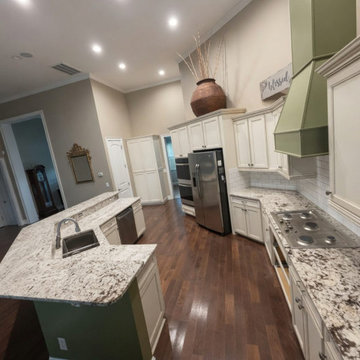 Rocky Tops Granite & Marble LLC
This kitchen in Lexington came together in BSI Zurich granite, and it's the kind of stone that does a lot of the work in a room just by sitting there. Zurich has a cool gray background with movement that breaks up into darker flecks and softer crystal patches, so it reads calm from across the room but keeps your eye busy up close. That range makes it easy to live with next to most cabinet colors, whether the boxes are painted white, a soft gray, or a warmer wood tone.
Granite like this is quarried in big blocks and cut into slabs, and no two slabs come out exactly the same. That's part of why we template each kitchen on site instead of working off a generic plan. We measure the actual cabinets, account for the sink and cooktop cutouts, and lay out the slabs so the veining and pattern flow the way they should across the island and the runs of counter, especially where two pieces meet at a seam. Getting that seam tight and matched so it disappears into the pattern takes a steady hand and slabs picked with the layout in mind from the start.
Granite is one of the toughest countertop materials you can put in a kitchen. It shrugs off hot pans, resists scratching from everyday knife work, and holds up to the kind of daily traffic a real kitchen sees, dishes, coffee, kids doing homework at the island, all of it. It does need to be sealed, and staying on top of that keeps it looking like day one for years. We finished this one with an eased edge, clean and simple, which is the right call for a stone with this much going on in the surface. It doesn't need extra shaping to look finished.
Lexington's seen a lot of kitchens go through updates like this one, and granite remains a favorite around the Midlands because it holds up to how people actually cook and live. This Zurich kitchen is a good example of why: a stone with real character, installed tight and clean, that's going to keep earning its keep for a long time.
 Rocky Tops Granite & Marble LLC
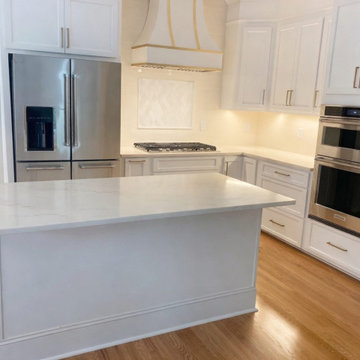
Spectrums Indulgence quartz, manufactured right here in Latta South Carolina, went into this kitchen in Columbia, and it's the kind of stone that works quietly hard in a room people actually cook and live in. It's engineered quartz, so what you're looking at is a mix of ground quartz and resin, blended and pressed to give a background that stays consistent slab to slab. That matters more than people think when you're trying to keep a kitchen looking pulled together across a run of cabinets, an island, and a backsplash.
The color reads as a soft, workable background with movement in it, enough character to give the room some depth without turning into something that fights with the cabinets or the floor. That's the appeal of a pattern like this one. It's not a plain solid, but it's not so busy that it limits what else goes in the space. Kitchens live a long time with the same countertop, and a stone that holds up visually over the years is worth choosing over something flashier that gets tiring.
Quartz like this is also just practical for a working kitchen. It doesn't need sealing the way natural stone does, it resists staining from wine, oil, and citrus, and it shrugs off the daily scratches from knives and pans that would show on a softer stone. Heat is the one thing we tell people to respect, a hot pan straight off the stove can shock the resin, so a trivet is the smart habit to build. Otherwise it's about as low-maintenance a surface as you can put in a kitchen.
We set the edge as eased, which is the clean, simple choice that lets the stone itself do the talking instead of the profile. Templating and fabrication on a job like this comes down to getting the seams tight and matching the pattern across the island and the runs so it reads as one continuous piece even where the slabs meet.
Jobs like this are what we like doing around Columbia and the rest of the Midlands, where a kitchen remodel means getting the material, the layout, and the fit all right in a space a family's going to use every single day.
 Rocky Tops Granite & Marble LLC
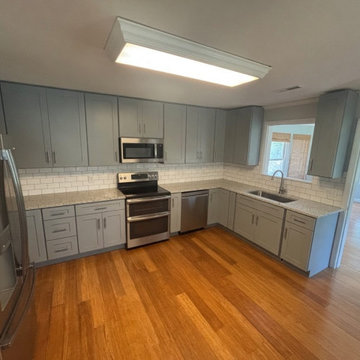
This West Columbia kitchen got new countertops in White Alpes granite, a stone with a light background scattered through with dark speckling and mineral flecks that catch the light differently depending on where you stand. It's the kind of pattern that reads calm from across the room and gets more interesting up close, which is exactly what you want on a surface you're going to be looking at every day.
Granite like this is quarried and cut into slabs, then polished to bring out that natural fleck and depth. It's dense, heat resistant, and about as tough a countertop material as you can put in a kitchen. You can set a hot pan on it without worrying, and it shrugs off the daily knife-and-cutting-board traffic that wears down softer stones. With a good sealer applied at install, it resists staining from wine, oil, and the usual kitchen spills for years before it needs to be redone.
We templated the space to fit around the existing gray shaker cabinets and stainless appliances, cutting the sink opening for the stainless steel sink and squaring up the seams so the pattern in the granite carries through cleanly from one run to the next. That's the part of the job that doesn't show up in a photo: getting the slab cut so the speckling doesn't look choppy at the seam, and getting the sink cutout dialed in so the reveal is even all the way around.
With the backsplash area still open, the countertop is doing a lot of the visual work right now, and it's holding its own. The light background of the White Alpes plays well against the gray cabinetry, and it'll give whatever backsplash goes in next a neutral, textured surface to build off of.
We do a lot of this kind of granite work around West Columbia and the rest of the Midlands. Kitchens like this one are a good reminder of why granite has stayed a go-to choice for so long: it looks good, it holds up, and it doesn't ask much of the homeowner once it's in.
 Rocky Tops Granite & Marble LLC
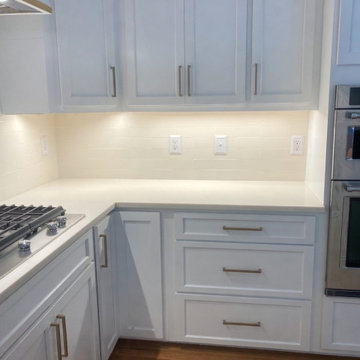
Spectrums Indulgence quartz, manufactured right here in Latta South Carolina, went into this kitchen in Columbia, and it's the kind of stone that works quietly hard in a room people actually cook and live in. It's engineered quartz, so what you're looking at is a mix of ground quartz and resin, blended and pressed to give a background that stays consistent slab to slab. That matters more than people think when you're trying to keep a kitchen looking pulled together across a run of cabinets, an island, and a backsplash.
The color reads as a soft, workable background with movement in it, enough character to give the room some depth without turning into something that fights with the cabinets or the floor. That's the appeal of a pattern like this one. It's not a plain solid, but it's not so busy that it limits what else goes in the space. Kitchens live a long time with the same countertop, and a stone that holds up visually over the years is worth choosing over something flashier that gets tiring.
Quartz like this is also just practical for a working kitchen. It doesn't need sealing the way natural stone does, it resists staining from wine, oil, and citrus, and it shrugs off the daily scratches from knives and pans that would show on a softer stone. Heat is the one thing we tell people to respect, a hot pan straight off the stove can shock the resin, so a trivet is the smart habit to build. Otherwise it's about as low-maintenance a surface as you can put in a kitchen.
We set the edge as eased, which is the clean, simple choice that lets the stone itself do the talking instead of the profile. Templating and fabrication on a job like this comes down to getting the seams tight and matching the pattern across the island and the runs so it reads as one continuous piece even where the slabs meet.
Jobs like this are what we like doing around Columbia and the rest of the Midlands, where a kitchen remodel means getting the material, the layout, and the fit all right in a space a family's going to use every single day.
 Rocky Tops Granite & Marble LLC
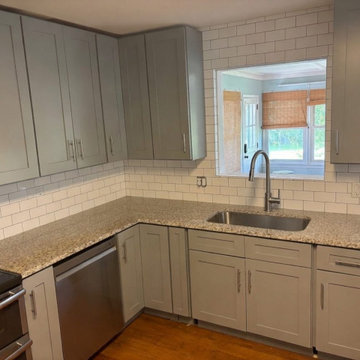
This West Columbia kitchen got new countertops in White Alpes granite, a stone with a light background scattered through with dark speckling and mineral flecks that catch the light differently depending on where you stand. It's the kind of pattern that reads calm from across the room and gets more interesting up close, which is exactly what you want on a surface you're going to be looking at every day.
Granite like this is quarried and cut into slabs, then polished to bring out that natural fleck and depth. It's dense, heat resistant, and about as tough a countertop material as you can put in a kitchen. You can set a hot pan on it without worrying, and it shrugs off the daily knife-and-cutting-board traffic that wears down softer stones. With a good sealer applied at install, it resists staining from wine, oil, and the usual kitchen spills for years before it needs to be redone.
We templated the space to fit around the existing gray shaker cabinets and stainless appliances, cutting the sink opening for the stainless steel sink and squaring up the seams so the pattern in the granite carries through cleanly from one run to the next. That's the part of the job that doesn't show up in a photo: getting the slab cut so the speckling doesn't look choppy at the seam, and getting the sink cutout dialed in so the reveal is even all the way around.
With the backsplash area still open, the countertop is doing a lot of the visual work right now, and it's holding its own. The light background of the White Alpes plays well against the gray cabinetry, and it'll give whatever backsplash goes in next a neutral, textured surface to build off of.
We do a lot of this kind of granite work around West Columbia and the rest of the Midlands. Kitchens like this one are a good reminder of why granite has stayed a go-to choice for so long: it looks good, it holds up, and it doesn't ask much of the homeowner once it's in.
 Miriam's River House Designs, LLC
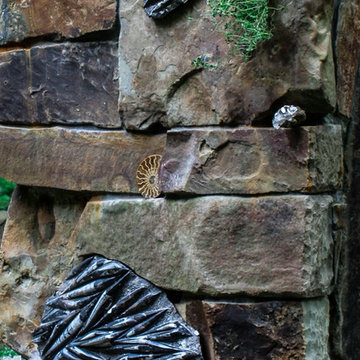
The light from South Arch side window is focused upon the North wall where there is a large granite fossil. A smaller version of these swimming creatures appears above. Next to these is a cave-like opening where a thyme plant meanders down the rock wall. Other interesting artifacts are included in the design.
Photo credits: Dan Drobnick
 Rocky Tops Granite & Marble LLC
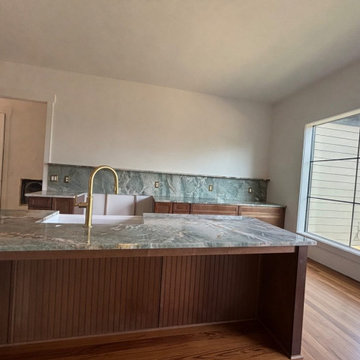
Tiffany Crystal quartzite is one of those stones that earns its keep in a kitchen. It's got that cool, crystalline background, whites and grays moving quietly across the surface with enough sparkle in the light to keep it from feeling flat. It reads clean and bright without going stark, which is why it works so well in a kitchen where people actually cook and gather, not just admire counters from across the room.
Quartzite is real stone, not engineered, so it comes with natural hardness that holds up to daily kitchen abuse. It resists scratching and handles heat well, though we still tell folks to use a trivet, because no counter needs a hot pan set straight on it just to prove a point. Sealing it right after install and keeping up with it over the years keeps the surface performing the way it should, and Tiffany Crystal takes a seal well because of its tight, dense structure.
Fabricating a slab like this takes some care in the layout. We spend real time bookmatching and dry-fitting pieces so the movement in the stone flows across seams instead of fighting itself at the corners. On a kitchen island or a run of perimeter counters, getting that continuity right is what separates a good installation from one that just gets the measurements correct. We kept the edge eased here, which is the right call on a stone with this much personality. It doesn't need extra shaping to draw the eye, the stone's already doing that work.
Day to day, this is a kitchen counter that's going to live hard and look good doing it. Quartzite shrugs off knife marks, stands up to acidic spills, and cleans up with regular dish soap and water. It's the kind of surface you stop babying after the first few months because it simply holds up.
Jobs like this one in Lexington are what we like seeing come through the shop. It's a straightforward kitchen application done with a stone that's got real depth to it, installed by people who care about how the seams and the veining line up when the job's done. That's the kind of work that keeps the Midlands trade honest.
 Rocky Tops Granite & Marble LLC
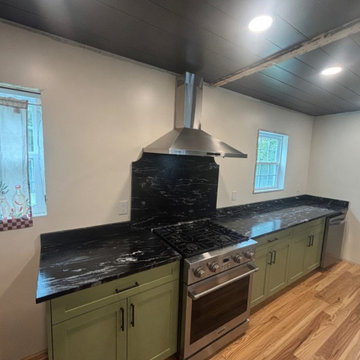
We fabricated and installed Black Forest Leather granite in a kitchen out in St. Matthews, and this is one of those stones that changes the whole feel of a room the second it goes in. It's a granite, but with a leathered finish instead of polished, so the surface has texture you can actually feel under your hand. That leathering knocks the shine down and brings out the depth of the stone, the blacks and dark grays shifting as the light moves across the counters through the day.
Black Forest works in a kitchen because it's granite through and through, hard, dense, and about as tough a countertop material as you're going to find. Heat off a pan straight from the stove isn't going to bother it. Knives, hot pots, everyday kitchen abuse, it shrugs all that off. The leathered texture actually helps hide the small stuff too, fingerprints and water spots don't show up the way they would on a polished slab, which matters in a kitchen that's getting used every single day.
Getting a leathered finish right takes some care in the shop. You can't rush the process or you end up with a surface that feels inconsistent from one section to the next. We templated the kitchen carefully, cut it to fit tight against the cabinets, and set the seams where they'd be least noticeable, matching the movement in the stone across the joints so it reads like one continuous surface instead of pieced-together slabs. We kept the edge eased, clean and simple, which is the right call on a stone with this much character. You don't need a fussy edge competing with what the granite's already doing.
Day to day, this countertop is going to hold up. Granite like this doesn't scratch easily, and with a leathered finish there's less concern about micro-scratching showing over time compared to a high polish. A sealer keeps it easy to wipe down and keeps stains from setting in, and beyond that it's low maintenance, just regular cleaning and it'll look the way it does now for years.
It's good to see stone like this going into a kitchen in St. Matthews. We do a lot of work across the Midlands, and every job's a little different, but a granite with this much texture and depth always makes an impression walking into the room.
 Rocky Tops Granite & Marble LLC
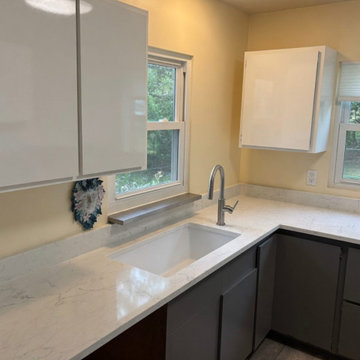
We put MSI Calacatta Aidana quartz into a kitchen out in Hopkins, and it's the kind of stone that changes how a room feels the day it goes in. Aidana's got that bright white background with soft veining moving through it, the kind of pattern that reads clean and calm from across the room but still has movement when you get up close to it. For a kitchen that gets used every day, that's exactly what you want. It doesn't compete with cabinets or fight the light coming through the windows, it just sits there looking good year after year.
Quartz like this is engineered, so the slabs come off the line consistent. That matters more than people think when you're templating a kitchen with a lot of linear footage, corners, and a sink cutout to deal with. We're not chasing a wild vein across a seam or hoping two slabs happen to match. The veining in Aidana is soft enough that seams disappear into the field instead of announcing themselves, and that's a craftsmanship thing as much as a material thing. Getting a seam tight and a pattern lined up right takes patience at the saw and patience setting it, not just a good slab to start with.
The kitchen itself got the full treatment, counters and an eased edge, which is the right call for a stone with this kind of quiet pattern. An eased edge keeps the eye on the surface and the veining instead of on the edge detail, and it's a practical choice too, it holds up well and doesn't chip the way a sharper profile can over time.
Day to day, this is a stone that just works. Quartz doesn't need sealing, it resists staining better than natural stone, and it shrugs off the usual kitchen abuse, knives set down too hard, hot pans set too close, kids leaning on the counter doing homework. It's a surface built for a family that actually cooks and lives in the space rather than one that's roped off for company.
Hopkins has been getting more of these kitchen jobs lately, and it's easy to see why homeowners out that way keep landing on Calacatta Aidana. It's a stone that photographs well and lives even better, bright and clean without being cold, and it gives a kitchen that finished, put-together look the moment you walk in.


 Rocky Tops Granite & Marble LLC
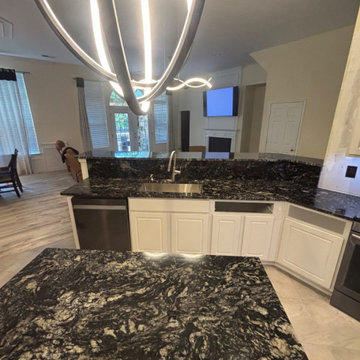
Blue Fantasy granite is one of those stones that stops people in the kitchen doorway. It's got that deep blue-gray base with soft movement running through it, flecks of white and darker gray scattered across the surface, and enough depth to it that it reads different depending on the light hitting it. In this Irmo kitchen it works as the anchor for the whole room, the kind of stone that doesn't need anything else dressing it up.
Granite like this comes out of the ground with real mineral variation, and that's part of why we like working with it. Every slab has its own character, so when we template a kitchen like this one we're not just measuring cabinets, we're looking at how the pattern will fall across the counters and figuring out where the seams need to land so the movement in the stone keeps flowing instead of getting chopped up at a corner. That's the part of the job that takes patience more than anything else.
Blue Fantasy is a hard, dense granite, and that's exactly what you want in a kitchen that gets used every day. It shrugs off heat, it resists scratching better than most surfaces you'll put a knife near, and it holds up to the kind of daily abuse a real kitchen dishes out. We sealed it before we left so it stays easy to wipe down and keeps its color from picking up any staining, and that's about the only maintenance it'll ever ask for. We kept the edge eased on this one, simple and clean, which lets the stone itself do the talking instead of competing with it.
Jobs like this are why we like working around Irmo and the rest of the Midlands. Every kitchen brings its own layout, its own light, its own slab pulled off the yard, and getting it right means paying attention to the details that don't show up in a photo, tight seams, a level install, an edge that doesn't fight the stone. This one came together the way we like to see them, a granite with real presence doing exactly what a kitchen counter should do for years to come.
 Rocky Tops Granite & Marble LLC
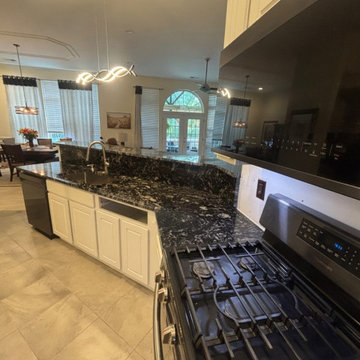
Blue Fantasy granite is one of those stones that stops people in the kitchen doorway. It's got that deep blue-gray base with soft movement running through it, flecks of white and darker gray scattered across the surface, and enough depth to it that it reads different depending on the light hitting it. In this Irmo kitchen it works as the anchor for the whole room, the kind of stone that doesn't need anything else dressing it up.
Granite like this comes out of the ground with real mineral variation, and that's part of why we like working with it. Every slab has its own character, so when we template a kitchen like this one we're not just measuring cabinets, we're looking at how the pattern will fall across the counters and figuring out where the seams need to land so the movement in the stone keeps flowing instead of getting chopped up at a corner. That's the part of the job that takes patience more than anything else.
Blue Fantasy is a hard, dense granite, and that's exactly what you want in a kitchen that gets used every day. It shrugs off heat, it resists scratching better than most surfaces you'll put a knife near, and it holds up to the kind of daily abuse a real kitchen dishes out. We sealed it before we left so it stays easy to wipe down and keeps its color from picking up any staining, and that's about the only maintenance it'll ever ask for. We kept the edge eased on this one, simple and clean, which lets the stone itself do the talking instead of competing with it.
Jobs like this are why we like working around Irmo and the rest of the Midlands. Every kitchen brings its own layout, its own light, its own slab pulled off the yard, and getting it right means paying attention to the details that don't show up in a photo, tight seams, a level install, an edge that doesn't fight the stone. This one came together the way we like to see them, a granite with real presence doing exactly what a kitchen counter should do for years to come.
4