
Search results for "Shrugged" in Home Design Ideas
 Fidelity General Contractors Inc.
Mid-century modern white tile claw-foot bathtub photo in Los Angeles with a pedestal sink

 Rocky Tops Granite & Marble LLC
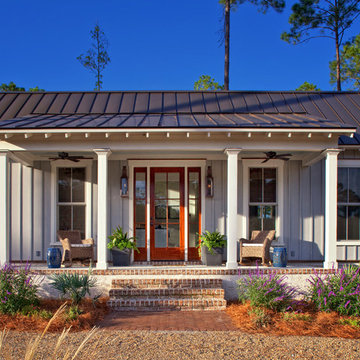
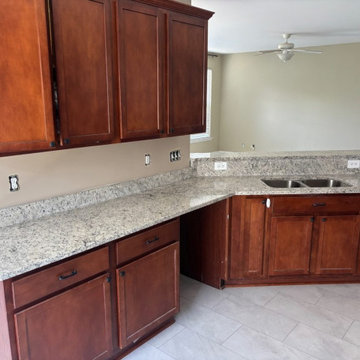
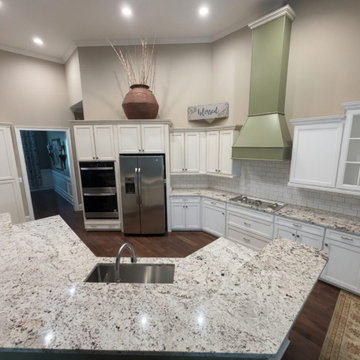
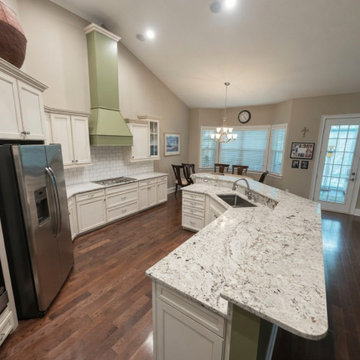
Dallas White granite is a good, honest choice for a kitchen that gets used every day. It's a granite with a light gray to white background and darker gray and black mineral flecks scattered through it, sometimes with a little movement in the pattern. It reads clean and bright in a kitchen without being flat or plain, and it works with just about any cabinet color you put it next to.
Granite is one of the hardest natural stones we fabricate, and that's what makes it a smart pick for a room where people actually cook. It shrugs off heat from a hot pan set down without thinking, it resists scratching from knives and everyday kitchen traffic, and it holds up to the daily wear a kitchen counter takes better than almost anything else we install. It does need to be sealed, and we take care of that at install so it's protected against staining from day one.
Getting a granite kitchen right comes down to the template and the layout at the shop. We lay out the slabs so the pattern falls where it should across the counters, keep seams tight where two pieces meet, and cut the openings for the sink and cooktop clean and square. The edge on this one is eased, a simple, smooth-rounded edge that's easy to keep clean and doesn't chip the way a sharp edge can over time.
This kitchen is in Lexington, part of the work we do across the Midlands where granite still holds up as one of the best all-around choices for a working kitchen. Dallas White gives the room a bright, durable surface that's going to look right for a long time, and it does the job every day without asking for much back.
Find the right local pro for your project
 Rocky Tops Granite & Marble LLC
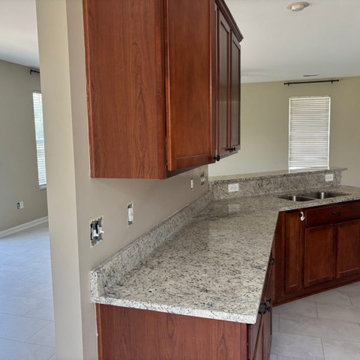
Dallas White granite is a good, honest choice for a kitchen that gets used every day. It's a granite with a light gray to white background and darker gray and black mineral flecks scattered through it, sometimes with a little movement in the pattern. It reads clean and bright in a kitchen without being flat or plain, and it works with just about any cabinet color you put it next to.
Granite is one of the hardest natural stones we fabricate, and that's what makes it a smart pick for a room where people actually cook. It shrugs off heat from a hot pan set down without thinking, it resists scratching from knives and everyday kitchen traffic, and it holds up to the daily wear a kitchen counter takes better than almost anything else we install. It does need to be sealed, and we take care of that at install so it's protected against staining from day one.
Getting a granite kitchen right comes down to the template and the layout at the shop. We lay out the slabs so the pattern falls where it should across the counters, keep seams tight where two pieces meet, and cut the openings for the sink and cooktop clean and square. The edge on this one is eased, a simple, smooth-rounded edge that's easy to keep clean and doesn't chip the way a sharp edge can over time.
This kitchen is in Lexington, part of the work we do across the Midlands where granite still holds up as one of the best all-around choices for a working kitchen. Dallas White gives the room a bright, durable surface that's going to look right for a long time, and it does the job every day without asking for much back.
 Rocky Tops Granite & Marble LLC
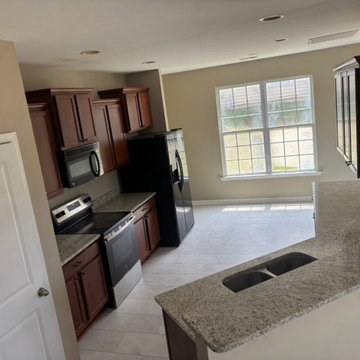
Dallas White granite is a good, honest choice for a kitchen that gets used every day. It's a granite with a light gray to white background and darker gray and black mineral flecks scattered through it, sometimes with a little movement in the pattern. It reads clean and bright in a kitchen without being flat or plain, and it works with just about any cabinet color you put it next to.
Granite is one of the hardest natural stones we fabricate, and that's what makes it a smart pick for a room where people actually cook. It shrugs off heat from a hot pan set down without thinking, it resists scratching from knives and everyday kitchen traffic, and it holds up to the daily wear a kitchen counter takes better than almost anything else we install. It does need to be sealed, and we take care of that at install so it's protected against staining from day one.
Getting a granite kitchen right comes down to the template and the layout at the shop. We lay out the slabs so the pattern falls where it should across the counters, keep seams tight where two pieces meet, and cut the openings for the sink and cooktop clean and square. The edge on this one is eased, a simple, smooth-rounded edge that's easy to keep clean and doesn't chip the way a sharp edge can over time.
This kitchen is in Lexington, part of the work we do across the Midlands where granite still holds up as one of the best all-around choices for a working kitchen. Dallas White gives the room a bright, durable surface that's going to look right for a long time, and it does the job every day without asking for much back.
 Rocky Tops Granite & Marble LLC
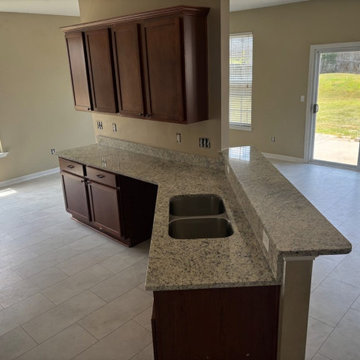
Dallas White granite is a good, honest choice for a kitchen that gets used every day. It's a granite with a light gray to white background and darker gray and black mineral flecks scattered through it, sometimes with a little movement in the pattern. It reads clean and bright in a kitchen without being flat or plain, and it works with just about any cabinet color you put it next to.
Granite is one of the hardest natural stones we fabricate, and that's what makes it a smart pick for a room where people actually cook. It shrugs off heat from a hot pan set down without thinking, it resists scratching from knives and everyday kitchen traffic, and it holds up to the daily wear a kitchen counter takes better than almost anything else we install. It does need to be sealed, and we take care of that at install so it's protected against staining from day one.
Getting a granite kitchen right comes down to the template and the layout at the shop. We lay out the slabs so the pattern falls where it should across the counters, keep seams tight where two pieces meet, and cut the openings for the sink and cooktop clean and square. The edge on this one is eased, a simple, smooth-rounded edge that's easy to keep clean and doesn't chip the way a sharp edge can over time.
This kitchen is in Lexington, part of the work we do across the Midlands where granite still holds up as one of the best all-around choices for a working kitchen. Dallas White gives the room a bright, durable surface that's going to look right for a long time, and it does the job every day without asking for much back.
 Inhabit | Space
Whon Photography
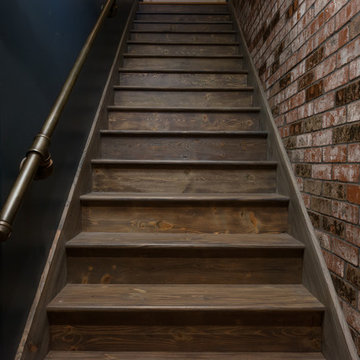
Large urban underground carpeted staircase photo in Indianapolis with gray walls and no fireplace
Large urban underground carpeted staircase photo in Indianapolis with gray walls and no fireplace
 Rocky Tops Granite & Marble LLC
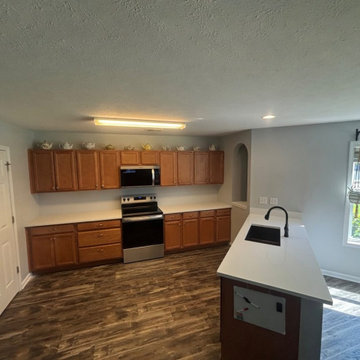
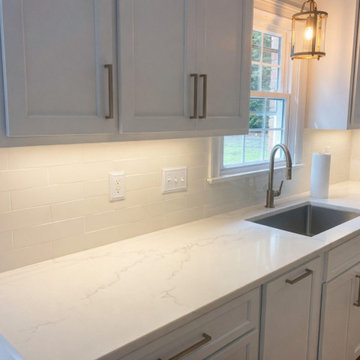
This kitchen in Elgin came together in engineered quartz, Calacatta Viraldi, and it's the kind of stone that does a lot of the work in a room without shouting about it. The white background stays clean and bright, and the veining moves through it in soft grays and golds. For a kitchen that gets used every day, that's the whole point.
Quartz is engineered stone, ground quartz mixed with resin under pressure, so it comes out of the plant with a consistent pattern from slab to slab. That consistency matters when you're templating a kitchen. We can match the veining across a seam or carry it around a corner without hunting for the right spot on the slab, because the pattern's already built in that way. Calacatta Viraldi reads soft and bright in a kitchen, which is exactly why it gets picked for spaces where people actually cook.
Getting a countertop like this in is still a craft even with a manufactured material. We template the kitchen precisely, cut the slabs to fit the cabinets and the sink cutout, and dress the edges by hand. Here we kept the edge eased, a clean, simple detail that lets the stone itself stay the focus instead of the profile. Seams get set tight and leveled so your eye reads the counter as one continuous surface, not pieced-together sections.
Day to day, this is a low-maintenance surface. Quartz doesn't need sealing, since the resin already closes it off from stains, and it resists scratches and everyday acids from cooking better than a lot of other surfaces. It handles the daily bumps of a real kitchen without much fuss. Heat's the one thing to watch, a hot pan straight off the stove can shock the resin, so a trivet's a smart habit, but that's a small price for a counter that otherwise shrugs off wine, coffee, and citrus without a second thought.
It's a good look for Elgin and for the kind of Midlands kitchens we build these for, bright, durable, and built to actually get used instead of just looked at.
 Moderne Builders
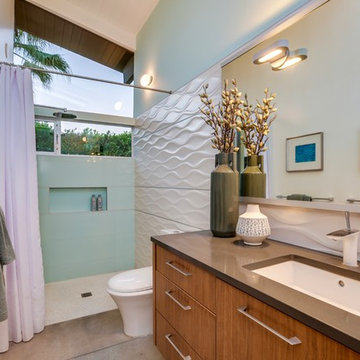
Gorgeous master bath with dramatic retro "wave" tile. Peak Photography
Example of a 1950s bathroom design in Los Angeles
Example of a 1950s bathroom design in Los Angeles
 Moss Yaw Design studio
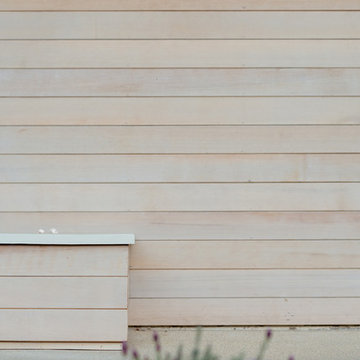
Engineered cedar siding creates beautiful gray-blue tones at the exterior of the home, while adding a textural element to activate the simple exterior design.
 Rocky Tops Granite & Marble LLC
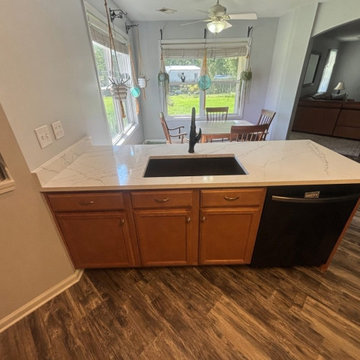
This kitchen in Elgin came together in engineered quartz, Calacatta Viraldi, and it's the kind of stone that does a lot of the work in a room without shouting about it. The white background stays clean and bright, and the veining moves through it in soft grays and golds. For a kitchen that gets used every day, that's the whole point.
Quartz is engineered stone, ground quartz mixed with resin under pressure, so it comes out of the plant with a consistent pattern from slab to slab. That consistency matters when you're templating a kitchen. We can match the veining across a seam or carry it around a corner without hunting for the right spot on the slab, because the pattern's already built in that way. Calacatta Viraldi reads soft and bright in a kitchen, which is exactly why it gets picked for spaces where people actually cook.
Getting a countertop like this in is still a craft even with a manufactured material. We template the kitchen precisely, cut the slabs to fit the cabinets and the sink cutout, and dress the edges by hand. Here we kept the edge eased, a clean, simple detail that lets the stone itself stay the focus instead of the profile. Seams get set tight and leveled so your eye reads the counter as one continuous surface, not pieced-together sections.
Day to day, this is a low-maintenance surface. Quartz doesn't need sealing, since the resin already closes it off from stains, and it resists scratches and everyday acids from cooking better than a lot of other surfaces. It handles the daily bumps of a real kitchen without much fuss. Heat's the one thing to watch, a hot pan straight off the stove can shock the resin, so a trivet's a smart habit, but that's a small price for a counter that otherwise shrugs off wine, coffee, and citrus without a second thought.
It's a good look for Elgin and for the kind of Midlands kitchens we build these for, bright, durable, and built to actually get used instead of just looked at.
 Rocky Tops Granite & Marble LLC
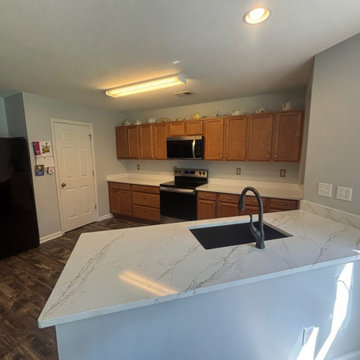
This kitchen in Elgin came together in engineered quartz, Calacatta Viraldi, and it's the kind of stone that does a lot of the work in a room without shouting about it. The white background stays clean and bright, and the veining moves through it in soft grays and golds. For a kitchen that gets used every day, that's the whole point.
Quartz is engineered stone, ground quartz mixed with resin under pressure, so it comes out of the plant with a consistent pattern from slab to slab. That consistency matters when you're templating a kitchen. We can match the veining across a seam or carry it around a corner without hunting for the right spot on the slab, because the pattern's already built in that way. Calacatta Viraldi reads soft and bright in a kitchen, which is exactly why it gets picked for spaces where people actually cook.
Getting a countertop like this in is still a craft even with a manufactured material. We template the kitchen precisely, cut the slabs to fit the cabinets and the sink cutout, and dress the edges by hand. Here we kept the edge eased, a clean, simple detail that lets the stone itself stay the focus instead of the profile. Seams get set tight and leveled so your eye reads the counter as one continuous surface, not pieced-together sections.
Day to day, this is a low-maintenance surface. Quartz doesn't need sealing, since the resin already closes it off from stains, and it resists scratches and everyday acids from cooking better than a lot of other surfaces. It handles the daily bumps of a real kitchen without much fuss. Heat's the one thing to watch, a hot pan straight off the stove can shock the resin, so a trivet's a smart habit, but that's a small price for a counter that otherwise shrugs off wine, coffee, and citrus without a second thought.
It's a good look for Elgin and for the kind of Midlands kitchens we build these for, bright, durable, and built to actually get used instead of just looked at.
 Rocky Tops Granite & Marble LLC
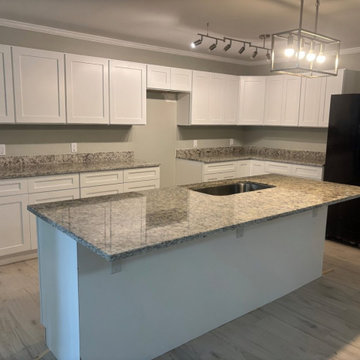
This kitchen came together with Ornamental White granite on the counters. No waterfall, no fancy backsplash story here, just solid granite doing what granite does best, holding up to real cooking and real life in a busy South Carolina kitchen.
We finished the edges with an eased profile, which is the detail people don't think about until they're leaning on the counter every day. An eased edge takes the sharp corner off the slab and rounds it just enough so it's comfortable to work against, without adding a bunch of extra machining that can chip or crack down the line. It's a clean, classic look that doesn't fight with the granite's natural pattern, and it wears well over years of use.
Granite is still one of the best choices you can put in a kitchen. It's hard, it's heat resistant, and you can set a hot pan on it without worrying. It'll take a knife dragged across it by accident and shrug it off. Every slab has its own movement in the stone, its own crystal structure catching light differently depending on where you stand, and templating a kitchen like this means matching that pattern at the seams so it reads like one continuous piece instead of two pieces bolted together.
Day to day, this countertop is going to earn its keep. Granite seals up easily and, once it's sealed, it resists staining from wine, oil, coffee, whatever gets set down on it. It doesn't scratch from normal kitchen use, and it doesn't dull over time the way some softer stones can. That's why we keep coming back to it for kitchens that actually get used, not just looked at.
We fabricate and install jobs like this all over the Midlands, and it's the same story every time: good stone, cut right, set level, edges finished clean. That's what makes a countertop last for decades instead of years, and that's what you're getting here.
 Rocky Tops Granite & Marble LLC
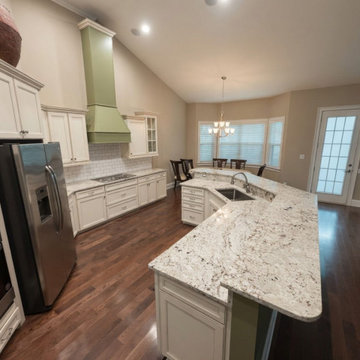
This kitchen in Lexington came together in BSI Zurich granite, and it's the kind of stone that does a lot of the work in a room just by sitting there. Zurich has a cool gray background with movement that breaks up into darker flecks and softer crystal patches, so it reads calm from across the room but keeps your eye busy up close. That range makes it easy to live with next to most cabinet colors, whether the boxes are painted white, a soft gray, or a warmer wood tone.
Granite like this is quarried in big blocks and cut into slabs, and no two slabs come out exactly the same. That's part of why we template each kitchen on site instead of working off a generic plan. We measure the actual cabinets, account for the sink and cooktop cutouts, and lay out the slabs so the veining and pattern flow the way they should across the island and the runs of counter, especially where two pieces meet at a seam. Getting that seam tight and matched so it disappears into the pattern takes a steady hand and slabs picked with the layout in mind from the start.
Granite is one of the toughest countertop materials you can put in a kitchen. It shrugs off hot pans, resists scratching from everyday knife work, and holds up to the kind of daily traffic a real kitchen sees, dishes, coffee, kids doing homework at the island, all of it. It does need to be sealed, and staying on top of that keeps it looking like day one for years. We finished this one with an eased edge, clean and simple, which is the right call for a stone with this much going on in the surface. It doesn't need extra shaping to look finished.
Lexington's seen a lot of kitchens go through updates like this one, and granite remains a favorite around the Midlands because it holds up to how people actually cook and live. This Zurich kitchen is a good example of why: a stone with real character, installed tight and clean, that's going to keep earning its keep for a long time.
 Rocky Tops Granite & Marble LLC
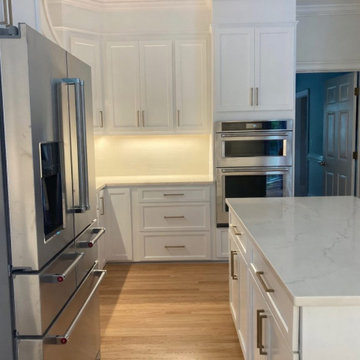
Spectrums Indulgence quartz, manufactured right here in Latta South Carolina, went into this kitchen in Columbia, and it's the kind of stone that works quietly hard in a room people actually cook and live in. It's engineered quartz, so what you're looking at is a mix of ground quartz and resin, blended and pressed to give a background that stays consistent slab to slab. That matters more than people think when you're trying to keep a kitchen looking pulled together across a run of cabinets, an island, and a backsplash.
The color reads as a soft, workable background with movement in it, enough character to give the room some depth without turning into something that fights with the cabinets or the floor. That's the appeal of a pattern like this one. It's not a plain solid, but it's not so busy that it limits what else goes in the space. Kitchens live a long time with the same countertop, and a stone that holds up visually over the years is worth choosing over something flashier that gets tiring.
Quartz like this is also just practical for a working kitchen. It doesn't need sealing the way natural stone does, it resists staining from wine, oil, and citrus, and it shrugs off the daily scratches from knives and pans that would show on a softer stone. Heat is the one thing we tell people to respect, a hot pan straight off the stove can shock the resin, so a trivet is the smart habit to build. Otherwise it's about as low-maintenance a surface as you can put in a kitchen.
We set the edge as eased, which is the clean, simple choice that lets the stone itself do the talking instead of the profile. Templating and fabrication on a job like this comes down to getting the seams tight and matching the pattern across the island and the runs so it reads as one continuous piece even where the slabs meet.
Jobs like this are what we like doing around Columbia and the rest of the Midlands, where a kitchen remodel means getting the material, the layout, and the fit all right in a space a family's going to use every single day.
 Rocky Tops Granite & Marble LLC
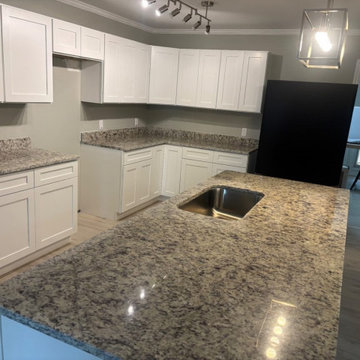
This kitchen came together with Ornamental White granite on the counters. No waterfall, no fancy backsplash story here, just solid granite doing what granite does best, holding up to real cooking and real life in a busy South Carolina kitchen.
We finished the edges with an eased profile, which is the detail people don't think about until they're leaning on the counter every day. An eased edge takes the sharp corner off the slab and rounds it just enough so it's comfortable to work against, without adding a bunch of extra machining that can chip or crack down the line. It's a clean, classic look that doesn't fight with the granite's natural pattern, and it wears well over years of use.
Granite is still one of the best choices you can put in a kitchen. It's hard, it's heat resistant, and you can set a hot pan on it without worrying. It'll take a knife dragged across it by accident and shrug it off. Every slab has its own movement in the stone, its own crystal structure catching light differently depending on where you stand, and templating a kitchen like this means matching that pattern at the seams so it reads like one continuous piece instead of two pieces bolted together.
Day to day, this countertop is going to earn its keep. Granite seals up easily and, once it's sealed, it resists staining from wine, oil, coffee, whatever gets set down on it. It doesn't scratch from normal kitchen use, and it doesn't dull over time the way some softer stones can. That's why we keep coming back to it for kitchens that actually get used, not just looked at.
We fabricate and install jobs like this all over the Midlands, and it's the same story every time: good stone, cut right, set level, edges finished clean. That's what makes a countertop last for decades instead of years, and that's what you're getting here.
 Rocky Tops Granite & Marble LLC
This kitchen in Lexington came together in BSI Zurich granite, and it's the kind of stone that does a lot of the work in a room just by sitting there. Zurich has a cool gray background with movement that breaks up into darker flecks and softer crystal patches, so it reads calm from across the room but keeps your eye busy up close. That range makes it easy to live with next to most cabinet colors, whether the boxes are painted white, a soft gray, or a warmer wood tone.
Granite like this is quarried in big blocks and cut into slabs, and no two slabs come out exactly the same. That's part of why we template each kitchen on site instead of working off a generic plan. We measure the actual cabinets, account for the sink and cooktop cutouts, and lay out the slabs so the veining and pattern flow the way they should across the island and the runs of counter, especially where two pieces meet at a seam. Getting that seam tight and matched so it disappears into the pattern takes a steady hand and slabs picked with the layout in mind from the start.
Granite is one of the toughest countertop materials you can put in a kitchen. It shrugs off hot pans, resists scratching from everyday knife work, and holds up to the kind of daily traffic a real kitchen sees, dishes, coffee, kids doing homework at the island, all of it. It does need to be sealed, and staying on top of that keeps it looking like day one for years. We finished this one with an eased edge, clean and simple, which is the right call for a stone with this much going on in the surface. It doesn't need extra shaping to look finished.
Lexington's seen a lot of kitchens go through updates like this one, and granite remains a favorite around the Midlands because it holds up to how people actually cook and live. This Zurich kitchen is a good example of why: a stone with real character, installed tight and clean, that's going to keep earning its keep for a long time.
 Rocky Tops Granite & Marble LLC
This kitchen in Lexington came together in BSI Zurich granite, and it's the kind of stone that does a lot of the work in a room just by sitting there. Zurich has a cool gray background with movement that breaks up into darker flecks and softer crystal patches, so it reads calm from across the room but keeps your eye busy up close. That range makes it easy to live with next to most cabinet colors, whether the boxes are painted white, a soft gray, or a warmer wood tone.
Granite like this is quarried in big blocks and cut into slabs, and no two slabs come out exactly the same. That's part of why we template each kitchen on site instead of working off a generic plan. We measure the actual cabinets, account for the sink and cooktop cutouts, and lay out the slabs so the veining and pattern flow the way they should across the island and the runs of counter, especially where two pieces meet at a seam. Getting that seam tight and matched so it disappears into the pattern takes a steady hand and slabs picked with the layout in mind from the start.
Granite is one of the toughest countertop materials you can put in a kitchen. It shrugs off hot pans, resists scratching from everyday knife work, and holds up to the kind of daily traffic a real kitchen sees, dishes, coffee, kids doing homework at the island, all of it. It does need to be sealed, and staying on top of that keeps it looking like day one for years. We finished this one with an eased edge, clean and simple, which is the right call for a stone with this much going on in the surface. It doesn't need extra shaping to look finished.
Lexington's seen a lot of kitchens go through updates like this one, and granite remains a favorite around the Midlands because it holds up to how people actually cook and live. This Zurich kitchen is a good example of why: a stone with real character, installed tight and clean, that's going to keep earning its keep for a long time.
 Rocky Tops Granite & Marble LLC
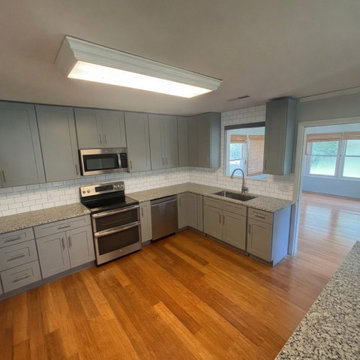
This West Columbia kitchen got new countertops in White Alpes granite, a stone with a light background scattered through with dark speckling and mineral flecks that catch the light differently depending on where you stand. It's the kind of pattern that reads calm from across the room and gets more interesting up close, which is exactly what you want on a surface you're going to be looking at every day.
Granite like this is quarried and cut into slabs, then polished to bring out that natural fleck and depth. It's dense, heat resistant, and about as tough a countertop material as you can put in a kitchen. You can set a hot pan on it without worrying, and it shrugs off the daily knife-and-cutting-board traffic that wears down softer stones. With a good sealer applied at install, it resists staining from wine, oil, and the usual kitchen spills for years before it needs to be redone.
We templated the space to fit around the existing gray shaker cabinets and stainless appliances, cutting the sink opening for the stainless steel sink and squaring up the seams so the pattern in the granite carries through cleanly from one run to the next. That's the part of the job that doesn't show up in a photo: getting the slab cut so the speckling doesn't look choppy at the seam, and getting the sink cutout dialed in so the reveal is even all the way around.
With the backsplash area still open, the countertop is doing a lot of the visual work right now, and it's holding its own. The light background of the White Alpes plays well against the gray cabinetry, and it'll give whatever backsplash goes in next a neutral, textured surface to build off of.
We do a lot of this kind of granite work around West Columbia and the rest of the Midlands. Kitchens like this one are a good reminder of why granite has stayed a go-to choice for so long: it looks good, it holds up, and it doesn't ask much of the homeowner once it's in.
 Rocky Tops Granite & Marble LLC
Spectrums Indulgence quartz, manufactured right here in Latta South Carolina, went into this kitchen in Columbia, and it's the kind of stone that works quietly hard in a room people actually cook and live in. It's engineered quartz, so what you're looking at is a mix of ground quartz and resin, blended and pressed to give a background that stays consistent slab to slab. That matters more than people think when you're trying to keep a kitchen looking pulled together across a run of cabinets, an island, and a backsplash.
The color reads as a soft, workable background with movement in it, enough character to give the room some depth without turning into something that fights with the cabinets or the floor. That's the appeal of a pattern like this one. It's not a plain solid, but it's not so busy that it limits what else goes in the space. Kitchens live a long time with the same countertop, and a stone that holds up visually over the years is worth choosing over something flashier that gets tiring.
Quartz like this is also just practical for a working kitchen. It doesn't need sealing the way natural stone does, it resists staining from wine, oil, and citrus, and it shrugs off the daily scratches from knives and pans that would show on a softer stone. Heat is the one thing we tell people to respect, a hot pan straight off the stove can shock the resin, so a trivet is the smart habit to build. Otherwise it's about as low-maintenance a surface as you can put in a kitchen.
We set the edge as eased, which is the clean, simple choice that lets the stone itself do the talking instead of the profile. Templating and fabrication on a job like this comes down to getting the seams tight and matching the pattern across the island and the runs so it reads as one continuous piece even where the slabs meet.
Jobs like this are what we like doing around Columbia and the rest of the Midlands, where a kitchen remodel means getting the material, the layout, and the fit all right in a space a family's going to use every single day.
3