
Search results for "Slow pavers" in Home Design Ideas

 Carmichael Environmental
We build using techniques that always make Mother Nature happy. When moving stormwater away from buildings and parking areas we use vegetated swales and rain gardens that will allow the water to slow, spread, and sink into the earth to recharge groundwater basins. Doing this not only looks better than using pipes with asphalt and concrete basins but doesn’t carry pollutants into our creeks, lakes, or oceans as the plants will treat the water before it flows away.

 LA Studio
Stucco clad changing room near the pool
Outdoor patio shower - small mediterranean backyard concrete outdoor patio shower idea with no cover
Outdoor patio shower - small mediterranean backyard concrete outdoor patio shower idea with no cover
 Carmichael Environmental
We build using techniques that always make Mother Nature happy. When moving stormwater away from buildings and parking areas we use vegetated swales and rain gardens that will allow the water to slow, spread, and sink into the earth to recharge groundwater basins. Doing this not only looks better than using pipes with asphalt and concrete basins but doesn’t carry pollutants into our creeks, lakes, or oceans as the plants will treat the water before it flows away.
Find the right local pro for your project
 Carmichael Environmental
We build using techniques that always make Mother Nature happy. When moving stormwater away from buildings and parking areas we use vegetated swales and rain gardens that will allow the water to slow, spread, and sink into the earth to recharge groundwater basins. Doing this not only looks better than using pipes with asphalt and concrete basins but doesn’t carry pollutants into our creeks, lakes, or oceans as the plants will treat the water before it flows away.

 Dibello Architects, PLLC
The thick arched stone opening connecting from arcade to courtyard frames a view of the stone fountain, bell tower, and hill beyond.
Terra-cotta flooring in the arcade. Brick pavers in the courtyard.
We organized the casitas and main house of this hacienda around a colonnade-lined courtyard. Walking from the parking court through the exterior wood doors and stepping into the courtyard has the effect of slowing time.
The hand carved stone fountain in the center is a replica of one in Mexico.
Viewed from this site on Seco Creek near Utopia, the surrounding tree-covered hills turn a deep blue-green in the distance.

 Exterior Designs, Inc. by Beverly Katz
Another angle of the traditional New Orleans courtyard complete with a brick-paved pool.
Exterior Designs, Inc. by Beverly Katz
New Orleans Landscape Designer

 Earth Art Landscapes Inc.
Regine Marsh
Design ideas for a mid-sized traditional shade side yard concrete paver garden path for summer.
Design ideas for a mid-sized traditional shade side yard concrete paver garden path for summer.


 ZeroEnergy Design
Lincoln Farmhouse
LEED-H Platinum, Net-Positive Energy
OVERVIEW. This LEED Platinum certified modern farmhouse ties into the cultural landscape of Lincoln, Massachusetts - a town known for its rich history, farming traditions, conservation efforts, and visionary architecture. The goal was to design and build a new single family home on 1.8 acres that respects the neighborhood’s agrarian roots, produces more energy than it consumes, and provides the family with flexible spaces to live-play-work-entertain. The resulting 2,800 SF home is proof that families do not need to compromise on style, space or comfort in a highly energy-efficient and healthy home.
CONNECTION TO NATURE. The attached garage is ubiquitous in new construction in New England’s cold climate. This home’s barn-inspired garage is intentionally detached from the main dwelling. A covered walkway connects the two structures, creating an intentional connection with the outdoors between auto and home.
FUNCTIONAL FLEXIBILITY. With a modest footprint, each space must serve a specific use, but also be flexible for atypical scenarios. The Mudroom serves everyday use for the couple and their children, but is also easy to tidy up to receive guests, eliminating the need for two entries found in most homes. A workspace is conveniently located off the mudroom; it looks out on to the back yard to supervise the children and can be closed off with a sliding door when not in use. The Away Room opens up to the Living Room for everyday use; it can be closed off with its oversized pocket door for secondary use as a guest bedroom with en suite bath.
NET POSITIVE ENERGY. The all-electric home consumes 70% less energy than a code-built house, and with measured energy data produces 48% more energy annually than it consumes, making it a 'net positive' home. Thick walls and roofs lack thermal bridging, windows are high performance, triple-glazed, and a continuous air barrier yields minimal leakage (0.27ACH50) making the home among the tightest in the US. Systems include an air source heat pump, an energy recovery ventilator, and a 13.1kW photovoltaic system to offset consumption and support future electric cars.
ACTUAL PERFORMANCE. -6.3 kBtu/sf/yr Energy Use Intensity (Actual monitored project data reported for the firm’s 2016 AIA 2030 Commitment. Average single family home is 52.0 kBtu/sf/yr.)
o 10,900 kwh total consumption (8.5 kbtu/ft2 EUI)
o 16,200 kwh total production
o 5,300 kwh net surplus, equivalent to 15,000-25,000 electric car miles per year. 48% net positive.
WATER EFFICIENCY. Plumbing fixtures and water closets consume a mere 60% of the federal standard, while high efficiency appliances such as the dishwasher and clothes washer also reduce consumption rates.
FOOD PRODUCTION. After clearing all invasive species, apple, pear, peach and cherry trees were planted. Future plans include blueberry, raspberry and strawberry bushes, along with raised beds for vegetable gardening. The house also offers a below ground root cellar, built outside the home's thermal envelope, to gain the passive benefit of long term energy-free food storage.
RESILIENCY. The home's ability to weather unforeseen challenges is predictable - it will fare well. The super-insulated envelope means during a winter storm with power outage, heat loss will be slow - taking days to drop to 60 degrees even with no heat source. During normal conditions, reduced energy consumption plus energy production means shelter from the burden of utility costs. Surplus production can power electric cars & appliances. The home exceeds snow & wind structural requirements, plus far surpasses standard construction for long term durability planning.
ARCHITECT: ZeroEnergy Design http://zeroenergy.com/lincoln-farmhouse
CONTRACTOR: Thoughtforms http://thoughtforms-corp.com/
PHOTOGRAPHER: Chuck Choi http://www.chuckchoi.com/
 Carmichael Environmental
We build using techniques that always make Mother Nature happy. When moving stormwater away from buildings and parking areas we use vegetated swales and rain gardens that will allow the water to slow, spread, and sink into the earth to recharge groundwater basins. Doing this not only looks better than using pipes with asphalt and concrete basins but doesn’t carry pollutants into our creeks, lakes, or oceans as the plants will treat the water before it flows away.
 Athyrium Design
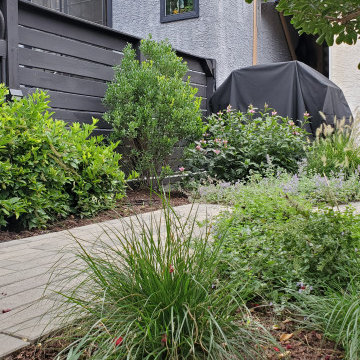
Clean lines create a contemporary oasis in this Philadelphia backyard. Permeable pavers and a small rain garden slow stormwater runoff to neighboring properties, while a native and non-native plants provide seasonal interest in these urban conditions. The intimate seating arrangements work just as well for entertaining small groups as they do for enjoying coffee al fresco.
 Carmichael Environmental
We build using techniques that always make Mother Nature happy. When moving stormwater away from buildings and parking areas we use vegetated swales and rain gardens that will allow the water to slow, spread, and sink into the earth to recharge groundwater basins. Doing this not only looks better than using pipes with asphalt and concrete basins but doesn’t carry pollutants into our creeks, lakes, or oceans as the plants will treat the water before it flows away.
Sponsored
Columbus, OH
Free consultation for landscape design!

Peabody Landscape Group
Columbus' Reliable Landscape Design & Contracting


 Harmony Design Northwest
The gently sloping natural stone and river rock stream bed replaced a traditional retaining wall and french drains. The use of different size stones, from boulders to small pebbles, creates texture and interest.
The plants soften the stone and create movement.
Photo credit: Lisa Meddin, Harmony Design Northwest
 Carmichael Environmental
We build using techniques that always make Mother Nature happy. When moving stormwater away from buildings and parking areas we use vegetated swales and rain gardens that will allow the water to slow, spread, and sink into the earth to recharge groundwater basins. Doing this not only looks better than using pipes with asphalt and concrete basins but doesn’t carry pollutants into our creeks, lakes, or oceans as the plants will treat the water before it flows away.
Sponsored
Columbus, OH

Structural Remodeling
Franklin County's Heavy Timber Specialists | Best of Houzz 2020!
 Carmichael Environmental
We build using techniques that always make Mother Nature happy. When moving stormwater away from buildings and parking areas we use vegetated swales and rain gardens that will allow the water to slow, spread, and sink into the earth to recharge groundwater basins. Doing this not only looks better than using pipes with asphalt and concrete basins but doesn’t carry pollutants into our creeks, lakes, or oceans as the plants will treat the water before it flows away.
4