
Search results for "Templates" in Home Design Ideas
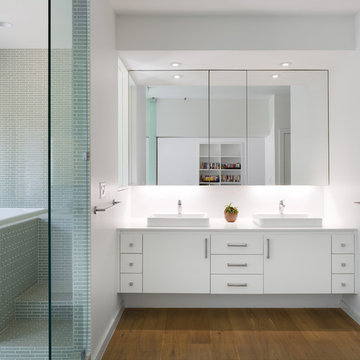
 Milgard Windows & Doors
The Kiguchi family moved into their Austin, Texas home in 1994. Built in the 1980’s as part of a neighborhood development, they happily raised their family here but longed for something more contemporary. Once they became empty nesters, they decided it was time for a major remodel. After spending many years visiting Austin AIA Home Tours that highlight contemporary residential architecture, they had a lot of ideas and in 2013 were ready to interview architects and get their renovation underway.
The project turned into a major remodel due to an unstable foundation. Architects Ben Arbib and Ed Hughey, of Arbib Hughey Design were hired to solve the structural issue and look for inspiration in the bones of the house, which sat on top of a hillside and was surrounded by great views.
Unfortunately, with the old floor plan, the beautiful views were hidden by small windows that were poorly placed. In order to bring more natural light into the house the window sizes and configurations had to be addressed, all while keeping in mind the homeowners desire for a modern look and feel.
To achieve a more contemporary and sophisticated front of house, a new entry was designed that included removing a two-story bay window and porch. The entrance of the home also became more integrated with the landscape creating a template for new foliage to be planted. Older exterior materials were updated to incorporate a more muted palette of colors with a metal roof, dark grey siding in the back and white stucco in the front. Deep eaves were added over many of the new large windows for clean lines and sun protection.
“Inside it was about opening up the floor plan, expanding the views throughout the house, and updating the material palette to get a modern look that was also warm and inviting,” said Ben from Arbib Hughey Design. “Prior to the remodel, the house had the typical separation of rooms. We removed the walls between them and changed all of the windows to Milgard Thermally Improved Aluminum to connect the inside with the outside. No matter where you are you get nice views and natural light.”
The architects wanted to create some drama, which they accomplished with the window placement and opening up the interior floor plan to an open concept approach. Cabinetry was used to help delineate intimate spaces. To add warmth to an all-white living room, white-washed oak wood floors were installed and pine planks were used around the fireplace. The large windows served as artwork bringing the color of nature into the space.
An octagon shaped, elevated dining room, (named “the turret”), had a big impact on the design of the house. They architects rounded the corners and added larger window openings overlooking a new sunken garden. The great room was also softened by rounding out the corners and that circular theme continued throughout the house, being picked up in skylight wells and kitchen cabinetry. A staircase leading to a catwalk was added and the result was a two-story window wall that flooded the home with natural light.
When asked why Milgard® Thermally Improved Aluminum windows were selected, the architectural team listed many reasons:
1) Aesthetics: “We liked the slim profiles and narrow sightlines. The window frames never get in the way of the view and that was important to us. They also have a very contemporary look that went well with our design.”
2) Options: “We liked that we could get large sliding doors that matched the windows, giving us a very cohesive look and feel throughout the project.”
3) Cost Effective: “Milgard windows are affordable. You get a good product at a good price.”
4) Custom Sizes: “Milgard windows are customizable, which allowed us to get the right window for each location.”
Ready to take on your own traditional to modern home remodeling project? Arbib Hughey Design advises, “Work with a good architect. That means picking a team that is creative, communicative, listens well and is responsive. We think it’s important for an architect to listen to their clients and give them something they want, not something the architect thinks they should have. At the same time you want an architect who is willing and able to think outside the box and offer up design options that you may not have considered. Design is about a lot of back and forth, trying out ideas, getting feedback and trying again.”
The home was completely transformed into a unique, contemporary house perfectly integrated with its site. Internally the home has a natural flow for the occupants and externally it is integrated with the surroundings taking advantage of great natural light. As a side note, it was highly praised as part of the Austin AIA homes tour.

 Granite Countertops by Mogastone
Luxury Calacatta Viola Marble Kitchen with Bookmatched Backsplash | Cary, NC
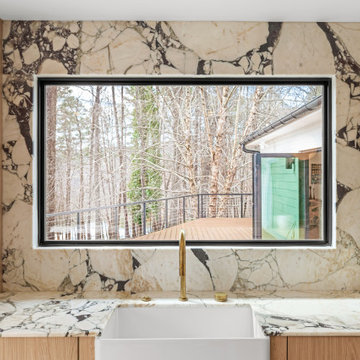
This luxury kitchen project in Cary, North Carolina showcases the power of natural stone as a true architectural centerpiece. Designed with a refined balance of modern minimalism and bold material expression, the space is defined by a dramatic installation of Calacatta Viola marble, expertly fabricated and installed by Mogastone.
The focal point of the kitchen is the full-height, bookmatched marble backsplash, where large-format slabs create a continuous, symmetrical composition. The bold veining and rich contrast of Calacatta Viola transform the cooking area into a statement feature, elevating the entire space with a gallery-like presence.
A custom waterfall island extends the same marble throughout the kitchen, reinforcing continuity and visual impact. The island’s sculptural form highlights the natural movement of the stone while providing a functional centerpiece for gathering, preparation, and entertaining.
Warm white oak cabinetry introduces a soft, organic contrast to the expressive marble, creating a balanced material palette that feels both modern and inviting. Integrated lighting beneath the cabinetry and island enhances the floating effect while adding depth and ambiance to the space.
The kitchen is further elevated by architectural elements including a curved archway, skylight, and open-concept layout, allowing natural light to interact with the stone surfaces throughout the day. This interplay of light highlights the depth, texture, and variation within the marble, emphasizing its natural beauty.
Every detail of this project reflects precision craftsmanship and advanced fabrication techniques. From digital templating to CNC and waterjet cutting, Mogastone ensured seamless installation, tight tolerances, and a flawless finish across all surfaces.
This project is a perfect example of how premium natural stone, when paired with thoughtful design and expert execution, can transform a kitchen into a timeless luxury environment.
Project Details:
• Material: Calacatta Viola Marble
• Application: Full-height backsplash, waterfall island, countertops
• Cabinetry: Custom white oak
• Location: Cary, North Carolina
• Fabrication & Installation: Mogastone
Find the right local pro for your project
 Rocky Tops Granite & Marble LLC
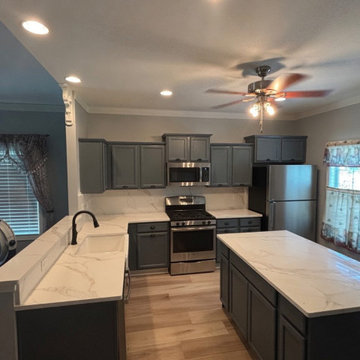
This kitchen with full height backsplash in Gaston came together in Calacatta Lilly, an engineered quartz from AG Stones that gives you that bright white background with soft gray and gold veining moving through it.
We used the same stone into the bathroom vanities too, so the whole house reads consistent without repeating the same room twice. Quartz like this is manufactured under controlled conditions, so the veining pattern is engineered to look natural while staying more predictable slab to slab than a lot of natural stone.
That consistency matters most in a kitchen, where the counters are doing the real work every day. Calacatta Lilly holds up to knives, hot pans, and the general chaos of cooking without needing much babying. It's non-porous, so there's no sealing schedule to keep track of, no worrying about a glass of wine sitting too long or lemon juice etching a ring into the surface. You wipe it down and move on with your life.
Getting the look right across a kitchen this size takes some care at the template stage. We're matching veining direction across the island, the perimeter, and working out where the seams fall so they land somewhere quiet, not right in your line of sight. With a manufactured stone like this, the pattern repeats in a way that actually helps us keep that continuity, but it still takes a careful eye to lay it out so the kitchen looks like one continuous piece rather than a handful of slabs pieced together.
In the bathroom, that same white and gray palette does something different. Vanities don't take the abuse a kitchen counter does, so the quartz there is more about keeping a clean, bright look day after day with almost zero maintenance. We finished both spaces with an eased edge, simple and clean, letting the stone itself carry the room instead of the edge detail.
Gaston sits right in that stretch of the Midlands where we do a lot of our work, and it's always good to get out there and put a stone like this into a house. Calacatta Lilly gives this kitchen and bath a bright, cohesive look that's going to hold up fine to daily life for a long time to come.
 Rocky Tops Granite & Marble LLC
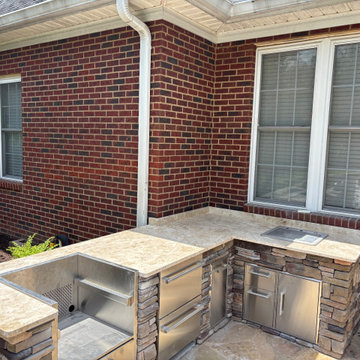
This outdoor kitchen in Lexington is built around 3cm unfilled travertine, and that's a material choice that says a lot about what this space is meant to do. Unfilled travertine keeps its natural pits and texture instead of having them smoothed over with resin, which means the surface reads as raw and organic rather than polished. Out here, under open sky and full sun, that texture works in the stone's favor. It doesn't glare back at you at midday and it doesn't get slick when a hose or a rain shower hits it.
The layout is an L-shaped countertop set over a stacked stone veneer base, with stainless steel drawers and cabinets tucked underneath and a built-in grill anchoring one leg of the L. There's a cutout in the counter for a sink or a cooler, which is the kind of detail that takes real planning at the template stage. You can't cut that opening freehand on site and expect clean lines. We measure twice, dry-fit the appliance or basin, and cut the stone to match before it ever leaves the shop.
Travertine outdoors is a practical call as much as a good-looking one. It handles heat well, which matters right next to a grill, and it won't crack or discolor the way some engineered materials can when they take direct sun for years. Unfilled travertine in particular breathes a little more than the filled version, so it doesn't trap moisture the way a sealed slab might. We finished the edges eased, which keeps the whole thing feeling soft and unfussy, no sharp lines to bang a hip on when you're moving between the grill and the prep space.
Outdoor kitchens take a beating that indoor ones never see: pollen, humidity, the occasional hard freeze here in the Midlands, direct sun for months at a stretch. Travertine's been used outdoors for centuries for exactly that reason, it ages instead of failing. Sealing it now and then keeps water from sitting in the pits, but even bare it holds up. This one in Lexington is set up to be used hard, grilled on, gathered around, and to look better for the wear rather than worse.
 Rocky Tops Granite & Marble LLC
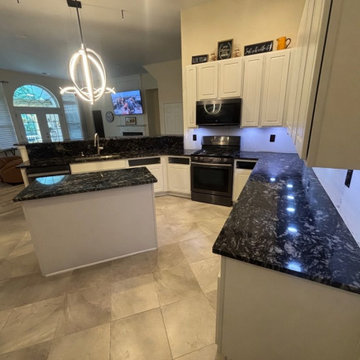
Blue Fantasy granite is one of those stones that stops people in the kitchen doorway. It's got that deep blue-gray base with soft movement running through it, flecks of white and darker gray scattered across the surface, and enough depth to it that it reads different depending on the light hitting it. In this Irmo kitchen it works as the anchor for the whole room, the kind of stone that doesn't need anything else dressing it up.
Granite like this comes out of the ground with real mineral variation, and that's part of why we like working with it. Every slab has its own character, so when we template a kitchen like this one we're not just measuring cabinets, we're looking at how the pattern will fall across the counters and figuring out where the seams need to land so the movement in the stone keeps flowing instead of getting chopped up at a corner. That's the part of the job that takes patience more than anything else.
Blue Fantasy is a hard, dense granite, and that's exactly what you want in a kitchen that gets used every day. It shrugs off heat, it resists scratching better than most surfaces you'll put a knife near, and it holds up to the kind of daily abuse a real kitchen dishes out. We sealed it before we left so it stays easy to wipe down and keeps its color from picking up any staining, and that's about the only maintenance it'll ever ask for. We kept the edge eased on this one, simple and clean, which lets the stone itself do the talking instead of competing with it.
Jobs like this are why we like working around Irmo and the rest of the Midlands. Every kitchen brings its own layout, its own light, its own slab pulled off the yard, and getting it right means paying attention to the details that don't show up in a photo, tight seams, a level install, an edge that doesn't fight the stone. This one came together the way we like to see them, a granite with real presence doing exactly what a kitchen counter should do for years to come.
 Rocky Tops Granite & Marble LLC
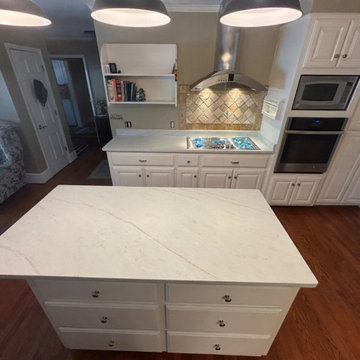
Spectrum Quartz Splendid went into this kitchen in West Columbia, and it's the kind of stone that does a lot of the work in a room without shouting about it. It's an engineered quartz, so what you're looking at is a mix of ground quartz and resin, pressed and cured until it's hard, dense, and consistent from one end of the slab to the other. The background reads soft and light, with a scatter of movement through it that keeps the surface from looking flat under kitchen lighting.
We templated the counters the way we do every job, laser measuring the base cabinets so the slabs come back from the shop cut to the exact lines of that kitchen. With quartz, that precision matters a lot, because the pattern repeats in a controlled way and you can plan your layout and your seams instead of chasing anything. That's part of why quartz suits a working kitchen so well. What you see in the showroom is what you get on the counter, corner to corner, with the pattern lining up the way it should.
Day to day, this material is about as forgiving as it gets. It doesn't need sealing, ever, because it's non-porous straight out of the fabrication shop. Wine, coffee, tomato sauce, none of it soaks in if you wipe it up in a reasonable time. It stands up to knives and daily wear better than most kitchen surfaces, though we still tell folks to use a trivet, since quartz doesn't love direct heat from a hot pan sitting right on it. Scratches aren't something you have to worry about with normal use in a busy kitchen.
We set the counters with an eased edge, clean and simple, which is what most of our customers land on once they see it doesn't take anything away from the stone itself.
Jobs like this one are what keep us busy across the Midlands. West Columbia kitchens see a lot of quartz these days, and Spectrum Quartz Splendid is a slab that holds up to real cooking and real family life while still looking sharp enough to notice the first time you walk into the room.
 Rocky Tops Granite & Marble LLC
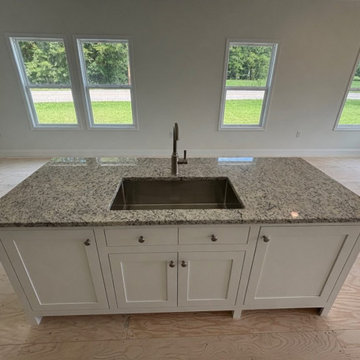
This kitchen in Bamberg came together in Dallas White granite, a stone that reads clean and bright without going stark. The background carries soft grays with subtle movement through it, enough character to keep the eye interested but calm enough to work with just about any cabinet color a builder picks for a spec house like this one. That's part of why it gets used so often in kitchens meant to show well and live well at the same time.
Granite's still one of the best choices you can make for a kitchen countertop, and Dallas White in particular holds up the way granite's supposed to. It's dense, it resists heat, and you can set a hot pan on it without worrying about scorching. Scratches aren't a concern with normal use, and the surface takes a polish that lasts for years. We seal it going in and that's about all the maintenance it ever needs.
Getting a granite slab like this into a kitchen right takes more than just cutting to size. We template the space first to make sure the seams land where they won't draw attention, usually tucked near the sink or stove, and any countertop longer than about 8 to 9 feet is going to need one. Matching the pattern across a seam so it reads as one continuous piece is where the work actually happens. The edge here is eased, a clean, simple line that lets the stone itself do the talking instead of competing with it.
Day to day, this is the kind of countertop that just works. Wipe it down, don't worry about it, and it'll look the same ten years from now as it does today. That durability is exactly what a spec house kitchen needs, something that shows well to a buyer walking through and keeps performing long after they've moved in.
We do a lot of work through the Midlands, and Bamberg jobs like this one are a good example of what granite still does better than almost anything else on the market. It's a straightforward material that never stops earning its keep in a kitchen, and this one turned out exactly the way it should.
 Rocky Tops Granite & Marble LLC
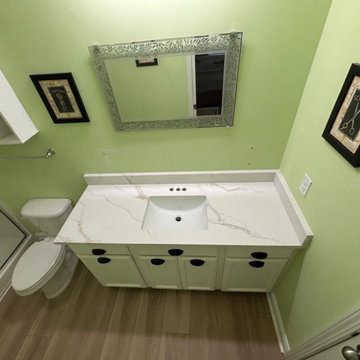
This kitchen with full height backsplash in Gaston came together in Calacatta Lilly, an engineered quartz from AG Stones that gives you that bright white background with soft gray and gold veining moving through it.
We used the same stone into the bathroom vanities too, so the whole house reads consistent without repeating the same room twice. Quartz like this is manufactured under controlled conditions, so the veining pattern is engineered to look natural while staying more predictable slab to slab than a lot of natural stone.
That consistency matters most in a kitchen, where the counters are doing the real work every day. Calacatta Lilly holds up to knives, hot pans, and the general chaos of cooking without needing much babying. It's non-porous, so there's no sealing schedule to keep track of, no worrying about a glass of wine sitting too long or lemon juice etching a ring into the surface. You wipe it down and move on with your life.
Getting the look right across a kitchen this size takes some care at the template stage. We're matching veining direction across the island, the perimeter, and working out where the seams fall so they land somewhere quiet, not right in your line of sight. With a manufactured stone like this, the pattern repeats in a way that actually helps us keep that continuity, but it still takes a careful eye to lay it out so the kitchen looks like one continuous piece rather than a handful of slabs pieced together.
In the bathroom, that same white and gray palette does something different. Vanities don't take the abuse a kitchen counter does, so the quartz there is more about keeping a clean, bright look day after day with almost zero maintenance. We finished both spaces with an eased edge, simple and clean, letting the stone itself carry the room instead of the edge detail.
Gaston sits right in that stretch of the Midlands where we do a lot of our work, and it's always good to get out there and put a stone like this into a house. Calacatta Lilly gives this kitchen and bath a bright, cohesive look that's going to hold up fine to daily life for a long time to come.
 Rocky Tops Granite & Marble LLC
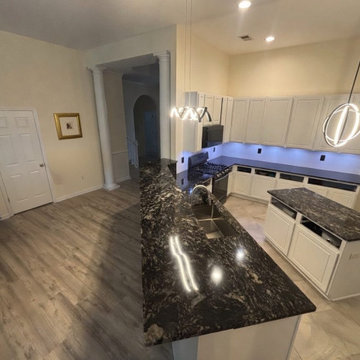
Blue Fantasy granite is one of those stones that stops people in the kitchen doorway. It's got that deep blue-gray base with soft movement running through it, flecks of white and darker gray scattered across the surface, and enough depth to it that it reads different depending on the light hitting it. In this Irmo kitchen it works as the anchor for the whole room, the kind of stone that doesn't need anything else dressing it up.
Granite like this comes out of the ground with real mineral variation, and that's part of why we like working with it. Every slab has its own character, so when we template a kitchen like this one we're not just measuring cabinets, we're looking at how the pattern will fall across the counters and figuring out where the seams need to land so the movement in the stone keeps flowing instead of getting chopped up at a corner. That's the part of the job that takes patience more than anything else.
Blue Fantasy is a hard, dense granite, and that's exactly what you want in a kitchen that gets used every day. It shrugs off heat, it resists scratching better than most surfaces you'll put a knife near, and it holds up to the kind of daily abuse a real kitchen dishes out. We sealed it before we left so it stays easy to wipe down and keeps its color from picking up any staining, and that's about the only maintenance it'll ever ask for. We kept the edge eased on this one, simple and clean, which lets the stone itself do the talking instead of competing with it.
Jobs like this are why we like working around Irmo and the rest of the Midlands. Every kitchen brings its own layout, its own light, its own slab pulled off the yard, and getting it right means paying attention to the details that don't show up in a photo, tight seams, a level install, an edge that doesn't fight the stone. This one came together the way we like to see them, a granite with real presence doing exactly what a kitchen counter should do for years to come.
 Rocky Tops Granite & Marble LLC
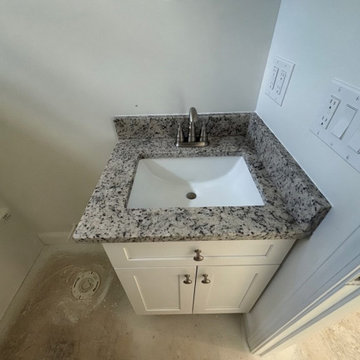
This kitchen in Bamberg came together in Dallas White granite, a stone that reads clean and bright without going stark. The background carries soft grays with subtle movement through it, enough character to keep the eye interested but calm enough to work with just about any cabinet color a builder picks for a spec house like this one. That's part of why it gets used so often in kitchens meant to show well and live well at the same time.
Granite's still one of the best choices you can make for a kitchen countertop, and Dallas White in particular holds up the way granite's supposed to. It's dense, it resists heat, and you can set a hot pan on it without worrying about scorching. Scratches aren't a concern with normal use, and the surface takes a polish that lasts for years. We seal it going in and that's about all the maintenance it ever needs.
Getting a granite slab like this into a kitchen right takes more than just cutting to size. We template the space first to make sure the seams land where they won't draw attention, usually tucked near the sink or stove, and any countertop longer than about 8 to 9 feet is going to need one. Matching the pattern across a seam so it reads as one continuous piece is where the work actually happens. The edge here is eased, a clean, simple line that lets the stone itself do the talking instead of competing with it.
Day to day, this is the kind of countertop that just works. Wipe it down, don't worry about it, and it'll look the same ten years from now as it does today. That durability is exactly what a spec house kitchen needs, something that shows well to a buyer walking through and keeps performing long after they've moved in.
We do a lot of work through the Midlands, and Bamberg jobs like this one are a good example of what granite still does better than almost anything else on the market. It's a straightforward material that never stops earning its keep in a kitchen, and this one turned out exactly the way it should.
 Rocky Tops Granite & Marble LLC
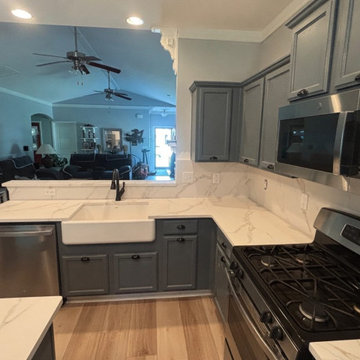
This kitchen with full height backsplash in Gaston came together in Calacatta Lilly, an engineered quartz from AG Stones that gives you that bright white background with soft gray and gold veining moving through it.
We used the same stone into the bathroom vanities too, so the whole house reads consistent without repeating the same room twice. Quartz like this is manufactured under controlled conditions, so the veining pattern is engineered to look natural while staying more predictable slab to slab than a lot of natural stone.
That consistency matters most in a kitchen, where the counters are doing the real work every day. Calacatta Lilly holds up to knives, hot pans, and the general chaos of cooking without needing much babying. It's non-porous, so there's no sealing schedule to keep track of, no worrying about a glass of wine sitting too long or lemon juice etching a ring into the surface. You wipe it down and move on with your life.
Getting the look right across a kitchen this size takes some care at the template stage. We're matching veining direction across the island, the perimeter, and working out where the seams fall so they land somewhere quiet, not right in your line of sight. With a manufactured stone like this, the pattern repeats in a way that actually helps us keep that continuity, but it still takes a careful eye to lay it out so the kitchen looks like one continuous piece rather than a handful of slabs pieced together.
In the bathroom, that same white and gray palette does something different. Vanities don't take the abuse a kitchen counter does, so the quartz there is more about keeping a clean, bright look day after day with almost zero maintenance. We finished both spaces with an eased edge, simple and clean, letting the stone itself carry the room instead of the edge detail.
Gaston sits right in that stretch of the Midlands where we do a lot of our work, and it's always good to get out there and put a stone like this into a house. Calacatta Lilly gives this kitchen and bath a bright, cohesive look that's going to hold up fine to daily life for a long time to come.
 Rocky Tops Granite & Marble LLC
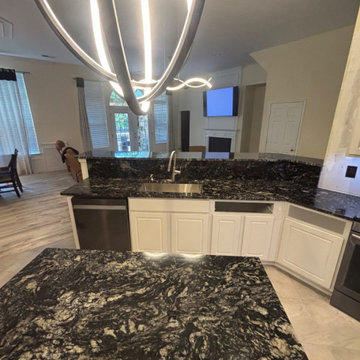
Blue Fantasy granite is one of those stones that stops people in the kitchen doorway. It's got that deep blue-gray base with soft movement running through it, flecks of white and darker gray scattered across the surface, and enough depth to it that it reads different depending on the light hitting it. In this Irmo kitchen it works as the anchor for the whole room, the kind of stone that doesn't need anything else dressing it up.
Granite like this comes out of the ground with real mineral variation, and that's part of why we like working with it. Every slab has its own character, so when we template a kitchen like this one we're not just measuring cabinets, we're looking at how the pattern will fall across the counters and figuring out where the seams need to land so the movement in the stone keeps flowing instead of getting chopped up at a corner. That's the part of the job that takes patience more than anything else.
Blue Fantasy is a hard, dense granite, and that's exactly what you want in a kitchen that gets used every day. It shrugs off heat, it resists scratching better than most surfaces you'll put a knife near, and it holds up to the kind of daily abuse a real kitchen dishes out. We sealed it before we left so it stays easy to wipe down and keeps its color from picking up any staining, and that's about the only maintenance it'll ever ask for. We kept the edge eased on this one, simple and clean, which lets the stone itself do the talking instead of competing with it.
Jobs like this are why we like working around Irmo and the rest of the Midlands. Every kitchen brings its own layout, its own light, its own slab pulled off the yard, and getting it right means paying attention to the details that don't show up in a photo, tight seams, a level install, an edge that doesn't fight the stone. This one came together the way we like to see them, a granite with real presence doing exactly what a kitchen counter should do for years to come.
 Rocky Tops Granite & Marble LLC
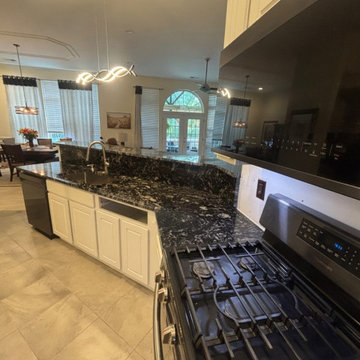
Blue Fantasy granite is one of those stones that stops people in the kitchen doorway. It's got that deep blue-gray base with soft movement running through it, flecks of white and darker gray scattered across the surface, and enough depth to it that it reads different depending on the light hitting it. In this Irmo kitchen it works as the anchor for the whole room, the kind of stone that doesn't need anything else dressing it up.
Granite like this comes out of the ground with real mineral variation, and that's part of why we like working with it. Every slab has its own character, so when we template a kitchen like this one we're not just measuring cabinets, we're looking at how the pattern will fall across the counters and figuring out where the seams need to land so the movement in the stone keeps flowing instead of getting chopped up at a corner. That's the part of the job that takes patience more than anything else.
Blue Fantasy is a hard, dense granite, and that's exactly what you want in a kitchen that gets used every day. It shrugs off heat, it resists scratching better than most surfaces you'll put a knife near, and it holds up to the kind of daily abuse a real kitchen dishes out. We sealed it before we left so it stays easy to wipe down and keeps its color from picking up any staining, and that's about the only maintenance it'll ever ask for. We kept the edge eased on this one, simple and clean, which lets the stone itself do the talking instead of competing with it.
Jobs like this are why we like working around Irmo and the rest of the Midlands. Every kitchen brings its own layout, its own light, its own slab pulled off the yard, and getting it right means paying attention to the details that don't show up in a photo, tight seams, a level install, an edge that doesn't fight the stone. This one came together the way we like to see them, a granite with real presence doing exactly what a kitchen counter should do for years to come.
 Rocky Tops Granite & Marble LLC
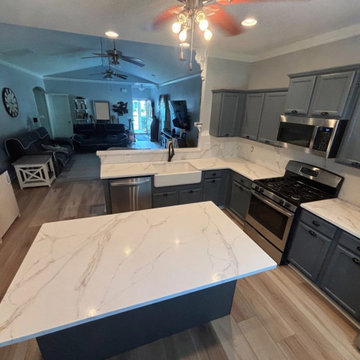
This kitchen with full height backsplash in Gaston came together in Calacatta Lilly, an engineered quartz from AG Stones that gives you that bright white background with soft gray and gold veining moving through it.
We used the same stone into the bathroom vanities too, so the whole house reads consistent without repeating the same room twice. Quartz like this is manufactured under controlled conditions, so the veining pattern is engineered to look natural while staying more predictable slab to slab than a lot of natural stone.
That consistency matters most in a kitchen, where the counters are doing the real work every day. Calacatta Lilly holds up to knives, hot pans, and the general chaos of cooking without needing much babying. It's non-porous, so there's no sealing schedule to keep track of, no worrying about a glass of wine sitting too long or lemon juice etching a ring into the surface. You wipe it down and move on with your life.
Getting the look right across a kitchen this size takes some care at the template stage. We're matching veining direction across the island, the perimeter, and working out where the seams fall so they land somewhere quiet, not right in your line of sight. With a manufactured stone like this, the pattern repeats in a way that actually helps us keep that continuity, but it still takes a careful eye to lay it out so the kitchen looks like one continuous piece rather than a handful of slabs pieced together.
In the bathroom, that same white and gray palette does something different. Vanities don't take the abuse a kitchen counter does, so the quartz there is more about keeping a clean, bright look day after day with almost zero maintenance. We finished both spaces with an eased edge, simple and clean, letting the stone itself carry the room instead of the edge detail.
Gaston sits right in that stretch of the Midlands where we do a lot of our work, and it's always good to get out there and put a stone like this into a house. Calacatta Lilly gives this kitchen and bath a bright, cohesive look that's going to hold up fine to daily life for a long time to come.
 Rocky Tops Granite & Marble LLC
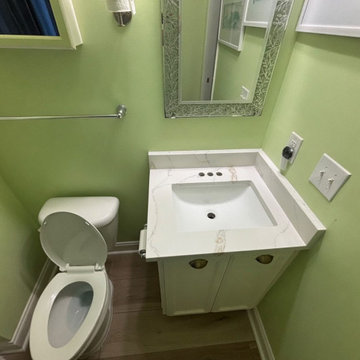
This kitchen with full height backsplash in Gaston came together in Calacatta Lilly, an engineered quartz from AG Stones that gives you that bright white background with soft gray and gold veining moving through it.
We used the same stone into the bathroom vanities too, so the whole house reads consistent without repeating the same room twice. Quartz like this is manufactured under controlled conditions, so the veining pattern is engineered to look natural while staying more predictable slab to slab than a lot of natural stone.
That consistency matters most in a kitchen, where the counters are doing the real work every day. Calacatta Lilly holds up to knives, hot pans, and the general chaos of cooking without needing much babying. It's non-porous, so there's no sealing schedule to keep track of, no worrying about a glass of wine sitting too long or lemon juice etching a ring into the surface. You wipe it down and move on with your life.
Getting the look right across a kitchen this size takes some care at the template stage. We're matching veining direction across the island, the perimeter, and working out where the seams fall so they land somewhere quiet, not right in your line of sight. With a manufactured stone like this, the pattern repeats in a way that actually helps us keep that continuity, but it still takes a careful eye to lay it out so the kitchen looks like one continuous piece rather than a handful of slabs pieced together.
In the bathroom, that same white and gray palette does something different. Vanities don't take the abuse a kitchen counter does, so the quartz there is more about keeping a clean, bright look day after day with almost zero maintenance. We finished both spaces with an eased edge, simple and clean, letting the stone itself carry the room instead of the edge detail.
Gaston sits right in that stretch of the Midlands where we do a lot of our work, and it's always good to get out there and put a stone like this into a house. Calacatta Lilly gives this kitchen and bath a bright, cohesive look that's going to hold up fine to daily life for a long time to come.
 Rocky Tops Granite & Marble LLC
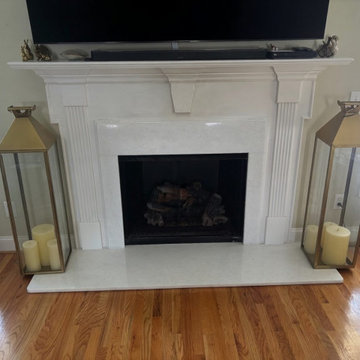
Hanoi White marble makes a fireplace surround the centerpiece of a room instead of just a backdrop for the TV. This one went into a home in Blythewood, and it's the kind of stone that earns that spot. White marble with soft gray veining has been the go-to for fireplaces for a reason: it catches light off to either side of the mantel and gives the whole wall a calm, finished look that paint or tile just can't match.
Marble takes a mellower polish than a lot of other stones, and the veining moves in loose, natural patterns that give it a warmer feel to the eye even though the stone itself stays cool to the touch. For a surround, we're not dealing with knife cuts or hot pans, so the wear concerns people sometimes bring up with marble in a kitchen don't really apply here. It's decorative and structural at the same time, built to frame a firebox and take the heat that comes off it without any trouble.
Fabricating a surround like this means getting the slab selection right before anything else. You want the veining to read well across the face and up the legs, not fight itself at the seams. We templated this one to the fireplace opening and cut it so the pattern carries through cleanly, then set it with an eased edge, simple and out of the way so the stone itself stays the focus. That's really the right call on a piece like this. Anything fussier on the edge would just compete with what the marble's already doing.
Day to day, a surround like this asks for very little. It's not a work surface, so scratching isn't a real concern, and a light sealing keeps it looking the way it did on install day for years. It'll take the ambient heat from the firebox fine, it wipes clean, and it holds up as the kind of feature you don't think about, you just enjoy.
Jobs like this are why we like doing this kind of work around Blythewood and the rest of the Midlands. A fireplace wall is one of the first things people see walking into a room, and Hanoi White marble with an eased edge gives this one a quiet, finished presence that's going to hold up for a long time.
 Rocky Tops Granite & Marble LLC
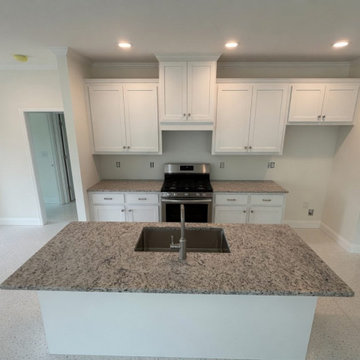
This kitchen in Bamberg came together in Dallas White granite, a stone that reads clean and bright without going stark. The background carries soft grays with subtle movement through it, enough character to keep the eye interested but calm enough to work with just about any cabinet color a builder picks for a spec house like this one. That's part of why it gets used so often in kitchens meant to show well and live well at the same time.
Granite's still one of the best choices you can make for a kitchen countertop, and Dallas White in particular holds up the way granite's supposed to. It's dense, it resists heat, and you can set a hot pan on it without worrying about scorching. Scratches aren't a concern with normal use, and the surface takes a polish that lasts for years. We seal it going in and that's about all the maintenance it ever needs.
Getting a granite slab like this into a kitchen right takes more than just cutting to size. We template the space first to make sure the seams land where they won't draw attention, usually tucked near the sink or stove, and any countertop longer than about 8 to 9 feet is going to need one. Matching the pattern across a seam so it reads as one continuous piece is where the work actually happens. The edge here is eased, a clean, simple line that lets the stone itself do the talking instead of competing with it.
Day to day, this is the kind of countertop that just works. Wipe it down, don't worry about it, and it'll look the same ten years from now as it does today. That durability is exactly what a spec house kitchen needs, something that shows well to a buyer walking through and keeps performing long after they've moved in.
We do a lot of work through the Midlands, and Bamberg jobs like this one are a good example of what granite still does better than almost anything else on the market. It's a straightforward material that never stops earning its keep in a kitchen, and this one turned out exactly the way it should.
 Rocky Tops Granite & Marble LLC
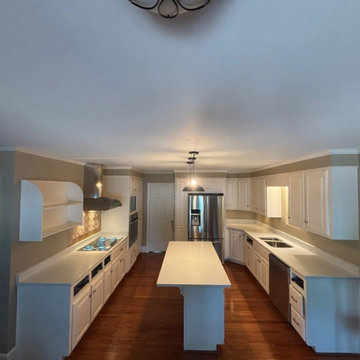
Spectrum Quartz Splendid went into this kitchen in West Columbia, and it's the kind of stone that does a lot of the work in a room without shouting about it. It's an engineered quartz, so what you're looking at is a mix of ground quartz and resin, pressed and cured until it's hard, dense, and consistent from one end of the slab to the other. The background reads soft and light, with a scatter of movement through it that keeps the surface from looking flat under kitchen lighting.
We templated the counters the way we do every job, laser measuring the base cabinets so the slabs come back from the shop cut to the exact lines of that kitchen. With quartz, that precision matters a lot, because the pattern repeats in a controlled way and you can plan your layout and your seams instead of chasing anything. That's part of why quartz suits a working kitchen so well. What you see in the showroom is what you get on the counter, corner to corner, with the pattern lining up the way it should.
Day to day, this material is about as forgiving as it gets. It doesn't need sealing, ever, because it's non-porous straight out of the fabrication shop. Wine, coffee, tomato sauce, none of it soaks in if you wipe it up in a reasonable time. It stands up to knives and daily wear better than most kitchen surfaces, though we still tell folks to use a trivet, since quartz doesn't love direct heat from a hot pan sitting right on it. Scratches aren't something you have to worry about with normal use in a busy kitchen.
We set the counters with an eased edge, clean and simple, which is what most of our customers land on once they see it doesn't take anything away from the stone itself.
Jobs like this one are what keep us busy across the Midlands. West Columbia kitchens see a lot of quartz these days, and Spectrum Quartz Splendid is a slab that holds up to real cooking and real family life while still looking sharp enough to notice the first time you walk into the room.
 Rocky Tops Granite & Marble LLC
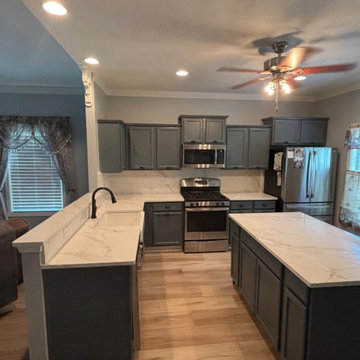
This kitchen with full height backsplash in Gaston came together in Calacatta Lilly, an engineered quartz from AG Stones that gives you that bright white background with soft gray and gold veining moving through it.
We used the same stone into the bathroom vanities too, so the whole house reads consistent without repeating the same room twice. Quartz like this is manufactured under controlled conditions, so the veining pattern is engineered to look natural while staying more predictable slab to slab than a lot of natural stone.
That consistency matters most in a kitchen, where the counters are doing the real work every day. Calacatta Lilly holds up to knives, hot pans, and the general chaos of cooking without needing much babying. It's non-porous, so there's no sealing schedule to keep track of, no worrying about a glass of wine sitting too long or lemon juice etching a ring into the surface. You wipe it down and move on with your life.
Getting the look right across a kitchen this size takes some care at the template stage. We're matching veining direction across the island, the perimeter, and working out where the seams fall so they land somewhere quiet, not right in your line of sight. With a manufactured stone like this, the pattern repeats in a way that actually helps us keep that continuity, but it still takes a careful eye to lay it out so the kitchen looks like one continuous piece rather than a handful of slabs pieced together.
In the bathroom, that same white and gray palette does something different. Vanities don't take the abuse a kitchen counter does, so the quartz there is more about keeping a clean, bright look day after day with almost zero maintenance. We finished both spaces with an eased edge, simple and clean, letting the stone itself carry the room instead of the edge detail.
Gaston sits right in that stretch of the Midlands where we do a lot of our work, and it's always good to get out there and put a stone like this into a house. Calacatta Lilly gives this kitchen and bath a bright, cohesive look that's going to hold up fine to daily life for a long time to come.
60