Software
Houzz Logo Print
marc555

How high to prune newly planted apple whip?

15 years ago

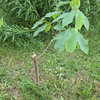
Just moved from the garden to the orchard some apple trees I budded in August 2009 (G30 rootstock). Actually pretty exciting to produce my own trees. One Yellow Delicious had some side branches at 23" high, which I stubbed to 1" to balance the small root ball. The leader is 60" high. I'm wondering how high to prune the leader. All the trees I planted 6 years ago I cut at 30", based on Penn State's recommendations. I was fairly happy with the outcome, except that some of the lowest laterals were a bit low. I'm now considering cutting these new trees at 36" high (that's what Cummins recommends).

If I cut this tree at 36", and the first whorl is starting at 23", will the next laterals start just under 36" (not what I want)? If I want 30" between whorls, should I cut the leader slight above 53" (23+30)?

Thanks for ideas,

Marc

Comments (7)

  • 15 years ago

    OK, you have branches at 23" already and they're staying, and you want the next branches to be at 53". Got it.
    Cummins suggests you head the tree at 36", and they probably know what they're talking about, but that doesn't mean you have to establish a whorl there.
    If you cut the leader at 36" you will get some undesirable branching going on there. You will get several upright branches just below the heading cut competing for dominance. You could simply select one of those and remove the rest, leaving a single central leader.
    Then you can take one of two approaches:
    1) As that leader grows longer, buds lower down will break out into branches with better angles of attachment. You aren't in total control of that situation but you can simply select the best suited ones and remove the rest. You can also encourage selected buds to branch by notching above them to block the auxin flow from the leader.
    2) You can dormant head the leader next year or later when it is sufficiently thick at 53" and train the subsequent branches horizontally leaving one upright leader.

    The advantage in my mind of establishing branches at heading cuts is that the branching is very predictable. The downside is that they tend to be upright and have to be subordinated.

  • 15 years ago

    TC, thank you for your thoughtful response. If I did prune now at 53", do you think I would get any worthy branching near that height? Seems like I would "speed up" things by a year if that would work. I have used the clothes pin technique and it works quite well to establish good angles of attachment.

    On the other hand, now I'm wondering if I do this, will the 1" stubs at 23" languish....maybe I'm overthinking this.

    Many thanks,
    Marc

  • 15 years ago

    There's some good reasons Cummins said to head it down low. One is that your tree's roots are significantly damaged from the digging process. Heading it down low brings the tree into better balance while it gets established in its new home. Secondly, I'm guessing your whip is a bit thin at the 53" mark. You probably don't want it to branch there this year. You want the trunk to be strong wherever you induce branching. Don't be in a hurry.
    The 1" stubs at 23" should grow out as long as you left some buds behind your cuts. Let them grow out while your new leader grows up. Haste makes waste.

  • 15 years ago

    Actually, I don't think it's so cut and dried, whatever cummins may have said. You're not really doing any of this to balance roots to the top, necessarily- that theory has been assaulted by researchers like C Whitcomb. At best, it's on shaky ground, I think. I do think heading can help real poor transplanters like pears, though. Not backed by specific research on that but I'd bet the farm on it against even odds.

    I tend to let trees grow up as high as I want them as long as the trunk is rigid enough to stay straight. You can usually put branches where you want them in young wood by notching above a node (at least on apples and pears). Heading is good for stiffening branches and the leader- making them stouter but the advice here about managing vigorous shoots behind stub cuts is important and correct IME.

    I'm always rushing to get trees above the browse line of deer so I don't do much of heading back a trees leader in early development in my nursery. Works out fine.

  • 15 years ago

    This is a good question and probably where listening to local experience might be better than all the cooperative extention binders, u-tube videos and volume of books. As a bright-eyed "noobie" I have 40 similar age 1-2 year sticks that I have absolutely "spoiled, protected and fathered-to-death" from day 1 when lovingly planted them. After reading and watching literally everything, a few weeks ago I took my new felco shears, chose my 1st tier scaffolds using the 1/3 and spacing rules, headed the central leaders on apples and "open vased" the stone fruits. If you look across my field of "pets", it looks like a "tree-troll massacre". We'll see what happens in the coming months. (I think I might even change my user name to "tree troll".) In hindsight, I sort of wish I would have let them alone for another year.

  • 15 years ago

    Notching... I wish I had the confidence that it would work. I have three new 50" whips in my yard right now. One of them has the leader tip intact, not headed. Maybe I'll leave that tip unheaded and try some notching with a small saw blade. Nothing ventured, nothing gained.

  • 15 years ago

    Notching so easy and risk free. You can use a hack saw or a knife and just make a shallow cut above a node that is no where near deep enough to weaken the branch. Do it when vegetative wood first starts to grow or when spur wood begins to flower. I have found it even works when done sooner during dormancy.

    I do it much more aggressively on older wood with a pruning saw.