Software
Houzz Logo Print
commgardener11

Vegetables under fruit trees?

15 years ago

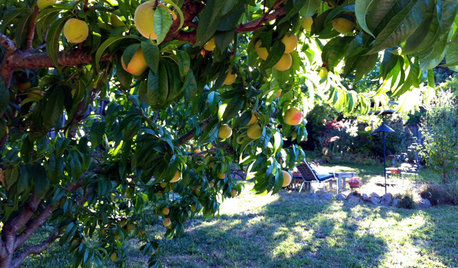
We just moved into a home that has most of the available space taken up by small (young and dwarf) fruit trees. Is it possible to grow vegetables in the spaces between the trees w/o damaging the trees/roots?

If so, does anyone have any resources or advice on what will grow well with plum, apricot, fig, apple, and kiwi? Any veggies I should keep away from these fruits?

Thanks for the feedback.

Comments (16)

  • 15 years ago

    You CAN, but do you want to? How will you tend to the trees without stepping on your bounty, provided you have bounty in the shade?

    Dan

  • 15 years ago

    I find interplanting a necessity in my small backyard, and, for the most part everything seem to be happy. Two recent challenges I'm dealing with are mulching and fertilizing.
    I always apply thick layer of mulch, but recently I learned that trees prefer to have the "flares" exposed. Ever since I pulled away some mulch from the trees they seem much happier.
    Not knowing better, I setup a nice pole bean trellis next to some citrus trees. Citrus are heavy feeders needing a lot of nitrogen, which make my bean leaves drop. :(

  • 15 years ago

    Very do-able, IMHO, because I have been doing it for a number of years.

    Agreed. You just have to think.

    Dan

  • 15 years ago

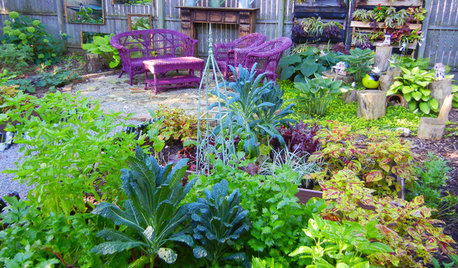
    It works just fine for me. Take a look at my garden. Click on the picture and you will be taken to my gallery where you can see more of my garden.

    {{gwi:92614}}

  • 15 years ago

    I prefer to plant perennials near the trees like strawberries, rhubarb, onion, garlic, & herbs that don't mind mulch. I throw in a mix of flowers for accents like snapdragons, calendula, zinnia, marigold, bedding dahlias, alyssum, etc. The annuals don't get in the way when I change things around the next year or when I put on fall manures. Our trees are dwarf apples, semi dwarf pear & cherry trees along our gravel driveway. The trees have loved the extra manures in fall & do fine.

    I plant other things in the larger pockets between them. Just look up & plant beyond the canopy. In spring it's easy to plant too closely under the tree & once the trees leaf out there's more shade & of course competition for nutrients.

    Last year I planted 6 zucchini between the pear trees & 2 were shaded; however it worked out okay because those were slower to mature & had a later harvest when the other ones were pretty much done cropping. I have determinate tomatoes in cages there this year, but didn't go as close to the larger pear tree to avoid the shade & when tomatoes go in the leaves are out so you can see the shade.

    Spring crops of peas do really well because the trees aren't leafed out yet & the harvest time lasts a bit longer because of the extra shade in early summer.

    Keep away:
    deep digging shovels, rotatillers, .... for obvious reasons

    large stakes & fence posts to avoid damaging tree roots

    root crops esp. potatoes or Jerusalem artichokes so you don't damage trees during harvest

    anything that you need to dig a deep hole such as tomatoes or peppers

    When I plant between the trees I like to use supports to grow up rather than out, so I give the trees their own space.

    Remember to water enough for the trees & the veggies because both need summer water. When it rains your plants under the trees might not get enough water, so you still need to hand water them. Bury bottomless coffee can, 2 liter or milk jugs with 1-2" showing near the large veg. plants to fill while watering & not wash away the soil. Some years I set up soaker hoses, but need to have it on for at least 3 hours. Anything you can do to get enough water for both plants works.

  • 15 years ago

    According to Carrots Love Tomatoes, (the best companion planting book ever) there are some things you can grow at the bottom of your fruit trees that actually benefit. Apparently nasturtiums will help repel aphids. And I know that anything in the allium family (onion, chive, garlic etc) has ant-ifungal properties. They help keep black spot from roses when interplanted. I wonder if they could benefit fruit trees in a similar manner?

  • 15 years ago

    Nasturtiums have been banished to the extra-wild part of my garden.
    Snails really, really love them and I really, really hate snails!

  • 15 years ago

    snail pellets? Cory's slug and snail death.

  • 15 years ago

    Goggle 'permaculture forest garden' for loads of things that thrive under trees and the best ways to grow them.
    Trishcuit,
    Relatively low-toxicity Slug/snail pellets is the only poison I use in my garden.
    I really don't like using it, so my best option is to keep nasturtiums (aka gastropod icecream) out of there!
    Sorry OP, wandered OT!

  • 15 years ago

    I have planted peanuts in the mulch under our fruit trees. I figure that the peanuts, a legume, add nitrogen to the soil, and help keep weeds at bay.

  • 15 years ago

    Thanks for all the replies, pictures, & bits of information.

    Only living in this house for a few weeks, I've been scoping out the gardening areas more, and can't wait to get started on fall crops like peas & broccoli! The owner of the home loves her fruit trees, but hasn't been able to take the best care of them the past couple of years, so hopefully I'll be able to help them out a bit while growing veg there too...

    Feijoas~I'm glad you mentioned snails loving nasturtiums. I really like growing nasturtiums for their versatility, but CA (I'm in zone9b) is notorious for their snails & slugs, so I'll keep that in mind when growing them from now on.

    Now I find myself wishing it'd cool of so I can get growing for fall/winter!

  • 15 years ago

    Look up permaculture. Mixed plantings of different heights are the very basis of this sustainable method.

  • 15 years ago

    Oops. I meant SAFERS slug and snail bait. I just checked my own box. IT is safe for pets and people.

  • 15 years ago

    You don't mention how far apart the trees are, but strips of plantings between the trees should be do-able. Just remember that the root systems of fruit trees tend to be near the surface, and they spread out beyond the dripline of the tree.

    Corrine's suggest of 'growing upward' is excellent. The best ones would probably be the ones that look like very wide ladders, made from (relatively) cheap 1x2s, or even long branches. Build them flat for simple storage, and tie the tops together for use and spread the bottoms for stability. If you live in a windy area, get some sandbags and fill them halfway with sand (or dirt or rocks) and tie them, leaving the top half for a handle, and set them on the bottom of the frame.

    Or use metal cattle panels (usually 54" x 16'), which can also be bent into arches. There are ones called 'hog panels', but the openings are very narrow on one long edge, a pain for reaching through and picking, & they're more expensive (more metal in them).

    The link below is a GW thread from last year, all about trellises.

    Any of the iron phosphate-based snail/slug killers (Safer's, Sluggo, Worry-free, etc) are safer than the older metaldehyde-based stuff (Ortho Bug-Geta, Corry's, etc) that kill mammals and small children.

    Someone always screams that iron phosphate isn't perfect, either, and it isn't, there is some toxicity there WHEN INGESTED IN LARGER AMOUNTS. That means don't dump it by the pound, just scatter it lightly, the slugs will find it; and don't make neat little piles that a pet or young child will gobble up. Use some sense and you'll be fine.

    It is rated by OMRI (Organic Materials Review Institute) as okay for organic operations. And it works better than any of the stuff that is often recommended, like egg shells and coffee grounds.

    Ducks love slugs and snails.

    Sue

    Here is a link that might be useful: Show Me Your Trellis

  • 15 years ago

    I want to own ducks one day.

Sponsored
Hope Restoration & General Contracting
Average rating: 4.7 out of 5 stars35 Reviews
Columbus Design-Build, Kitchen & Bath Remodeling, Historic Renovations