Software
Houzz Logo Print
mwiehn

Fruit Growing Beginner Questions

16 years ago

I am new to growing fruit trees. I have done a lot of reading online and in books to better understand what's required to be successful. So far I have grown mostly ornamentals, plus the annual tomatoes, peppers, zuchini, etc. However,I would like to try and grow peaches and maybe plums in my backyard. I live in the suburbs north of Indianapolis, about one acre, fairly good soil, mostly loamy clay soil that has been amended for years with lots of grass clippings, leaves and other organic mulch. I rarely spray any chemicals and try to go the organic route as much as possible. Keeping bees also limits what I want to spray in my yard. I am pretty experienced in growing most things well, with the exception of orchids, total failure there.

Anyways, I want to have one or two small peach trees and maybe one or two plum trees. Ideally I would love to espalier the trees, but I read that both plum and peach are not ideal for that growing method. I have several questions. I am looking for very disease resistant varieties, realizing that both peaches and plums will still require some protection from pests and diseases. I also would like my trees on small rootstock, that is nonetheless adapted to my soil conditions. What varieties are fairly disease resistant, winter hardy and still taste like peaches? Is there a good website with such information? I tried my extension website, but they seem to cater very much to the professional grower. They also don't seem to consider alternatives to traditional chemical spraying programs. Can you please guide a fruit tree beginner to the rights sources of information?

Thanks in advance.

Marc

Comments (8)

  • 16 years ago

    Helps a lot to know what state you are in. I keep bees and they thrive with a regular spray schedule. Nothing during bloom.

  • 16 years ago

    Indianapolis is in Indiana.

  • 16 years ago

    I can buy sacks of my favorite apple Macintosh, cheap.
    But I cannot buy a fully tree ripened Peach or plum. Most people have never had tree ripe stone fruit. The Arkansas extension gives the most basic information. My advice, where you live you can grow almost any peach or plum that is not California dry climate selected. In general Peaches and asian plums are all the same for disease resistance. Right now most fruit tree varieties are sold out. Your best bet to look for dwarf trees is Stark Nursery in Missouri. I'd look for an early and a late ripening varieties of plum and peach. All types of home orchard practices have been covered thoroughly on this website that can be read.

  • 16 years ago

    Hi, Marc! Here are the basics that will lead you to a nice harvest of organic peaches. This need not be difficult.

    1. Two outstanding, disease-resistant, varieties for your area are Redhaven(yellow) and Belle of Georgia(white). These are both available from Stark Bros. on dwarfing rootstock, and I think they are still making spring shipments to your area, but don't delay. 800-325-4180.
    2. While you are awaiting receipt, dig holes about 15" deep and 3' in diameter. Break up the soil you dig and set it aside. Plant the trees upon arrival and water well. Neither amend nor fertilize until the trees are in leaf.
    3. Once in leaf, control for aphids, stink bugs and the like with insecticidal soap, etc., just as you do with other plants in your garden.
    4. After leaf fall, spray the trees with Lime Sulphur to control for Peach Leaf Curl.
    5. Spray the trees with oil emulsion at delayed dormancy(when the buds swell) to control for over-wintering insects.
    6. Exclude pests from the fruits by tying nylon footies--available from friendly shoe stores or on-line--around your peaches.
    7. Exclude borers from the trunks and main scaffolds by wrapping these with aluminum foil about the first of June each year, beginning with the first year.
    8. If your fruits suffer from Brown Rot, then break bad and spray the trees with a fungicide like Captan about three weeks before harvest. It won't hurt the bees.
    9. This is the minimal program. You may need to introduce other chemicals, but I think this will provide an acceptable level of fruit quality and tree health.

    E-mail me if you need to discuss. Misterbaby.

  • 16 years ago

    Thank you for your responses. I tried to update my profile so it shows my location.

    Misterbaby, thank you very much for your advice. I will try those varieties and the pest control methods that you mentioned. Thanks again.

  • 16 years ago

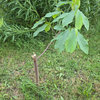
    Okay, marcindy, here are pics you might find instructive. This is a dwarf White River in its 5th leaf:
    {{gwi:104827}}

    And here is an Early White Giant dwarf in its 3rd leaf:
    {{gwi:104828}}

    I expect each to yield over a half bushel.

    Best Wishes, Misterbaby.

  • 16 years ago

    Mr. Baby,

    How do you like White River? How would you compare it to other white peaches?

    I had a White River once. The first year it fruited (about 50 peaches) there were extremely heavy rains. It was in too wet a spot, collapsed and died. The peaches were about the size of the ones in your photo. Always wondered how those peaches would have tasted.

    It was an easy tree to grow (no bac. spot). However, I do recall it bloomed about a week earlier than my other peaches, so I decided not to replace it for that reason.

  • 16 years ago

    Olpea, I think it is a fine cultivar. It's my wife's favorite peach of all time. It works well in this area as it's an Arkansas hybridization. Misterbaby.