Software
Houzz Logo Print
john_yeoman_gw

An overlooked use for runner beans?

16 years ago

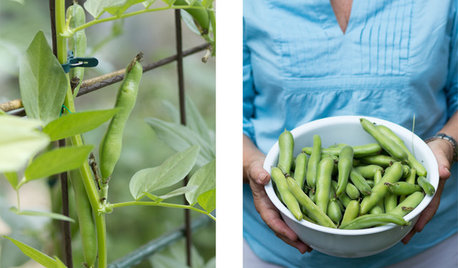
Now that we're harvesting the last of the runner beans, a good use I've found for a glut is to dry the pods on the vines then store the seeds for use in casseroles.

We often dry the seeds of other bean varieties (Phaseolus vulgaris) but rarely, it seems, of runners (P. coccineus). Yet those big meaty runner bean seeds are as tasty as broad beans, I find, and even fastidious cooks don't need to skin them!

Here is a link that might be useful: The Gardening Guild

Comments (10)

  • 16 years ago

    Pushing a book John?

    Curt

  • 16 years ago

    I agree, runner beans are tasty (fresh or dried), and a darn showy plant to boot.

    John, probably you won't be back here, but I'll ask you anyway. Regarding the statement on your website that nature has tons of experience as a gardener: I wonder how long it would have taken her to come up with the scarlet runner bean? Good thing we humans didn't sit around holding our breath, aye?

  • 16 years ago

    'How long would it have taken Nature to come up with the scarlet runner bean?'

    Well, without getting too Darwinian here (always dangerous :)), I'd say around 100 years or less. I've been astonished of late just how fast a plant mutation can appear and stabilise itself.

    In 2003, I noticed some green pods appear on my Cherokee Trail of Tears beans. They had white seeds. The conventional pods are purple with jet black seeds. Out of curiosity, I saved the white seeds and grew them on. I rogued out the purple pods and saved just the white seeds from the green pods, year after year.

    Some seven years later, the new variety of ToTs appears to have stabilised: 100% green pods with white seeds.

    I reckon new varieties, with radically new characteristics, are appearing all around us largely unseen and within a human lifetime. It doesn't need geological eras.

    BTW: Curt, truly, I am not pushing a book. There'd be no point. They're all sold out :)

    Here is a link that might be useful: The Gardening Guild

  • 16 years ago

    Glad to hear it John.

    Curt

  • 16 years ago

    The point is that we humans are part of the nature. For instance, bears in Kazahkstan put selection pressure on apples by browsing for the sweetest ones; humans did the same but dispersed the results of bear and human and otherwise- selected apple trees all over the globe. Without those kinds of selection pressures apples stay crabs. Horticultural beans wouldn't have come into existence without humans - selection pressure from creatures who aren't able to cook food would have a different result.

    I find the glib implications that nature is apart from humans and does 'things' better on her own to be silly.

  • 16 years ago

    In fact, I agree with you, pnbrown. I misunderstood your earlier point. Certainly, if I hadn't noticed the green pod mutation on my Cherokee ToTs, and grown it out, the mutation would have died. Except by a fluke, Nature would not have preserved it.

    The point I was trying to make, badly, was that the 'development' times for new plant varieties is often shorter than we think. It can happen in historic, not geological, times - and sometimes in a few years.

    I've often wondered how the Brussels sprouts and savoy varieties of cabbage evolved, around the 17th century, from out of the common cos cabbage. Presumably, a mutation appeared. A wily farmer isolated that plant in a muslin cage to prevent cross-contamination of the seed. Or more likely he transplanted it to a field a mile or so away. And he kept saving the seed in that way. The variety was stabilised, it seems, in just a few decades. With human help.

    Without human intervention, we would never have had the vast diversity of varieties we know today.

    That said, can we always say that old 'heirloom' varieties were lovingly selected and grown out by human agency, from a common progenitor? I'd guess that many evolved by accident and stabilised themselves. Sometimes, I suspect, Nature can do the trick, all by herself :)

    Here is a link that might be useful: The Gardening Guild

  • 16 years ago

    Certainly, breeding can be lightening-quick. That inedible super-sweet corn, for example. Didn't exist commonly until what, 30 years ago? And of course the super-grains developed in the 1960's for the 'green revolution'. In the case of the brassicas there has been spectacular radiation over a few centuries (rather similar to the radiation of dogs). I believe the variation has largely to do with the region of eurasia that a landrace developed, whether southern europe vs northern europe for the Olereacas; northern central europe for the Napus kales; asia for the mustards, etc.

    Regarding the assertion on your website that nature is a 'better' gardener than humans (that is effectively what you are asserting, correct?), the flaw with that reasoning is that Nature is not a gardener. Copying nature slavishly will be like the chess neophyte trying to copy the expert move-for-move in a game. It looks semi-reasonable to someone who doesn't understand chess. Suddenly the neophyte is check-mated.

    Why do the 'wild' plants around us do seemingly so well with no help from us, while the garden plants sometimes fail despite lots of help? Because established wild plants are perfectly adapted to the local conditions. The key to 'easy' gardening then is to select the best-adapted crop plants to one's climate and soil. The difference can be huge. Take a look at my dry garden photos. This garden is perilously close to being 'natural'. Animals wreak havoc whenever they feel like it. It gets bone dry in summer. Yields overall are absurdly low by gardening standards (that is the simple result of no irrigation and little fertilizer). Yet it is astounding to see what well-adapted plants can deal with. Certain root crops, leaf crops and legumes can produce a surprising amount in such near-natural conditions. It is completely about crop choices, not gardening skill.

  • 16 years ago

    Regarding the assertion on your website that nature is a 'better' gardener than humans (that is effectively what you are asserting, correct?), the flaw with that reasoning is that Nature is not a gardener.

    Anthropomorphizing is rarely satisfying after close inspection. Or even casual inspection in many instances.

    Dan

  • 16 years ago

    True, and yet... I would defend the assertion, albeit too loosely phrased, that 'Nature is a better gardener than humans'. Whenever humans interfere, the law of unintended consequences sometimes comes - disastrously - into play. Nature has had aeons to iron out those problems. We don't.

    The terms Nature and 'natural gardening' are rhetoric, of course. (Who would ever be so brave as to promote 'unnatural' gardening? :)) The philosophy of my site is that of the old-time allotment gardeners, who relied upon experience and ingenuity rather than shop-bought products and mass-media advice.

    That's also essentially the philosophy of permaculture and organic gardening, once we clear away the New Age dogma. Moderation in all things. I have no qualms about mixing a smidgen of Growmore into a cold compost heap to kickstart it. But that's a world away from destroying the soil structure by mixing it lavishly into the garden in lieu of compost!

    Here is a link that might be useful: The Gardening Guild

  • 16 years ago

    I think we probably agree that doing less would benefit the average gardener. Except for hand weeding! Few over-do that.

    Dan, correct, it's the anthropomorphy that I object to.