Software
Houzz Logo Print
bart1_gw

Bees eating Shiro Plums

16 years ago

My Shiro plums are ripening and I've noticed a lot of them have been attacked (eaten, or half eaten) by something. Then I saw the culprit...bees.

I sprayed the previous week with carbaryl but the bees didn't seem to care. Is this a common problem with plums? What can be done about it? I have 20 or 30 in cloth bags so hopefully they'll be ok, but is there anything that can be done for the rest of them to stop the bees?

Comments (15)

  • 16 years ago

    These?

    http://en.wikipedia.org/wiki/Vespula_germanica

    They were stinging my Alderman plums last summer and eating them. They are MEAN. Last year my nephew walked near their nest and got stung a bunch of times and had to take off running! Haven't noticed them in the yard yet, last year it was August before i saw them.

  • 16 years ago

    Bart,

    I know it is common to call any small, stinging insect a bee. This drives beekeepers like myself nuts (ok, even more nuts), but it is worth making some distinctions between types of 'bees' in this broad sense.

    It is probable that your plums are being attacked by wasps, probably yellow jackets. It is highly unlikely they are being attacked by honey bees, since honey bees cannot break the skin, but if the skin is already open honey bees might be on them, since we are now in a nectar dearth and honeybees will take any sugar source they can get.

    As for spraying, if you have honey bees on your plums, I suspect it might be illegal to spray carbaryl (i.e. Sevin) on them.

    I had a similar problem with wasps and (worse)hornets on my Stanley plums last September but no honey bees (despite three hives close by). Wasps and hornets can be pretty destructive. My suspicion is that they were in cohorts with birds, whose pecking opened the fruit, thereby attracting wasps and hornets, though wasps and hornets are certainly capable of opening the fruit themselves. You have to be pretty adventurous picking fruit with your bare hands never knowing if a hornet is on the other side! I would suggest instead of spraying that you try traps designed to catch these insects. You can either buy them or find plenty of web sites explaining how to make them out of plastic milk containers.

  • 16 years ago

    Trapping works. I bait with 50-50 apple juice concentrate and water.

  • 16 years ago

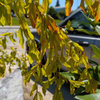
    Here's what the "bee" looks like:

    {{gwi:119232}}

    {{gwi:119233}}

    Thanks for the trapping tips. But isn't there a nearly endless supply of bees/wasps/hornets/etc?

  • 16 years ago

    Bart,

    Ok, that's not a wasp. Wasps have shiny bodies with a narrow waist. Nor is it a honey bee. Looks like a bumblebee of some kind. Fortunately, bumblebees are not aggressive. You might check your plums to see if they have been pecked by birds; if so, stopping the birds in the first place might be the way to go, since I suspect the bumblebees are only there because the fruit's skin is already broken. If the tree is small it can be netted; some put up flash tape. Birds can be a real problem.

  • 16 years ago

    Looks like a carpenter bee to me. I have tons of those and they never go after my plums. He doesn't look like he is eating in a bird-pecked spot because birds almost always peck on the top.

    I don't have any bright ideas on what to do. If your plum tree is young and you have only a few fruits, just wait and there will be so many that only a small portion will be damaged. The birds are really taking care of my young plums, every fruit has some pecks in it. The bigger trees its just noise for.

    Scott

  • 16 years ago

    You might be right about the carpenter bee Scott. Distinguishing native bees is not one of my strengths and requires some skill given the surprisingly large number of species to be found (every year the USDA here in Beltsville has a display of local native bees at its open house and there is a huge number of species). But in any event, these native bees, bumble bees or carpenter bees, are good guys in the animal kingdom if you are a gardener, and I would not be spraying carbaryl on them.

  • 16 years ago

    Twice in 5 years, my honeybees pierced(??) into ripe grapes as well as plums.
    We could not figure out why, but possibly drought conditions.
    I have not read this elsewhere, but I am positive these were my own bees.

  • 16 years ago

    I've read that honeybees are incapable of intitially piercing the skin of fruit but that they are drawn to the sugar during drought. I'm not surprised carpenter bees could easily accomplish this since they can drill into wood.

    My main pollinators are carpenter bees and I've never seen one do this to my Shiros or any other plum. I would be very reluctant to eliminate the car. bees on my property because they are such an asset, being the earliest and strongest bees I got going- and I've got lots of other buzzers. They're out there in the spring in my fruit trees when it's too cool and wet for most anything else.

    You can go after their nests in various ways. If that's your intention, just do a little search on the internet. If subsequently you have difficulty with pollination you'll probably regret going after them, however.

  • 16 years ago

    Thanks folks.

    I wasn't spraying the carbaryl to kill the bees, I was spraying it to stop all the other bugs that do damage like the Plum Curculio.

    Which brings me to my next question. Is there a point in the season where you can stop spraying? I've been harvesting some Shiro Plums in the last few weeks and expect to harvest more in the next few weeks. At this point in the year is it safe to stop spraying for the normal type of bugs that attack plums and peaches?

  • 16 years ago

    Plant some sort of flowering plant that bees like that will be in flower at the same time your fruit ripens.

    Part of our orchard program is to "feed the bees" and we are planting an assortment of flowers and flowering shrubs, planned carefully to provide flowers for the bees from spring through the fall.

    Wasp traps work well and you can often find the wasp nest by following the wasps home. The cans of wasp and hornet spray work really well and can be used to kill the nest.

    That looks like some sort of bumble bee to me and the hole in the fruit looks like it is bird pecked to open the fruit up. I suggest that you are careful to not kill any of the bumble bees (or any other bees). Without them, you wouldn't have that plum in the first place.

  • 16 years ago

    Spraying regimen is based on local conditions. I only have to spray twice here in southeastern NY to control most of my insect problems. Once at petal fall and once about 2 weeks later. Further south it takes more spraying but you shouldn't have to spray nearly ripe fruit.

  • 15 years ago

    i see marks that look to be made by either a squirrel or some other rodent as carpenter bees do not bother fruit until it is broke open by some other critter

  • 15 years ago

    There are clearly beak marks on the plums such as might be made by crows or other birds. Crow will rake their beaks back and forth causing similar marks. I had crow damage to my Asian pears for a long time until I figured out what was causing the peculiar looking marks on the fruit. I would say you definitely have some sort of animal damage. The only bee that I have that has caused damage to perfect fruit is the European hornet. They will damage skin on apples that have no previous damage. They hornets usually appear here after the Shiros have been picked.

  • 4 years ago

    The honeybees are eating all fallen plums that are left on the ground..I am lesving them,as the bees really need the nourishment..

    There sre plenty oi share and I want to support their survival..

    We don't spray our Santa Rosa plums at all..

    I usually clean up the fruit to be tidy,so had no idea they would want the fruit,until this year when I wad very busy when the plums started to fall.

    I hope you have a good harvest in spite of hungry bees,and let us all hope the spray doesn't poison them.

    CCC