Software
Houzz Logo Print
mahuirong

Growing Mung Bean Plants

18 years ago

I'm starting a science fair topic on the effect of different fertilizers/water on mung bean plant growth.I'm going to use egg shells, tea leaves, fruit skins, and chemical fertilizer as the different types of fertilizer and tap water, mineral water, and distilled water as the different types of water.

I was wondering if anyone knew how many seeds should I put in each pot and how much water I should water the mung bean plants with.

Also, I know that loamy soil is the best type of soil to use for plants, but would it still be okay to use Miracle Brand potting soil?

And, it's getting cold over here in California, so I was wondering where I should keep the plants in the house, and would there be something I have to do to make sure that the plants are kept warm.

Please guide me to grow these plants. ^___^

-Jenny

Comments (3)

  • 18 years ago
    last modified: 11 years ago

    All beans are warm-weather plants, and most aren't very cold-tolerant.

    I would start two or three beans per pot, then, depending on how big they will be at the time of the fair, maybe pinch out two of them, leaving the largest. But all three would produce a fuller pot. You could also sprout the beans on moist paper towels in a plastic bag to control exactly how many germinate, then plant them in your various medias.

    MiracleGro potting soil (and many others that don't say so on the label) has chemical fertilizer in it, and would probably throw off your experiments. You would probably be better off using something fairly basic, like a combination of plain peat moss mixed with sand, then add your various extra ingredients for the experiment. Neither peat moss nor sand have much nutrient content.

    If you are including pH ranges in your experiment, you could get some pH dipsticks from the pharmacy. Real peat moss (there are several kinds, plus mixes) has a very acidic pH of 3 to 4, so you would probably want to show how it is after you add lime or something to raise the pH. Beans prefer a pH of 6 or higher.

    You could compare how they grow in different types of soil, like loamy soil (if you don't have any, add some compost to your soil), clay soil (with & without compost added), sandy soil (with and without compost), plus soils amended with the list you showed. And you could show a set with chemical fertilizers, but the visual on the plants wouldn't show how the chemicals damage the environment. (Chemicals don't just evaporate after they're used, they go somewhere. Even DDT, which has been outlawed in the U.S. for many years is still out there in the environment.)

    Below is a site with info on bush beans in general.

    Good luck with your project!

    Sue

    Here is a link that might be useful: Growing bush beans

  • 18 years ago
    last modified: 11 years ago

    Jenny, beans need a strong light source; under most artificial lighting (such as fluorescent) beans will quickly become leggy, topple, and die. The Vignas (including Vigna radiata, the green mung bean) are particularly sensitive. You might have better results growing a cool-weather legume that can safely be placed outside in the sun. Besides, most mung beans sold commercially grow to become large sprawling plants, poorly suited to pot culture. If you intend to grow beans, I would recommend adzuki beans instead, since they are usually a smaller bush... but remember, like most beans, they will need protection on cold nights.

    Are you using the plants to observe their early growth, or will they be grown to maturity? If growing to maturity, you might be better off trying a cool-weather legume for your experiment, such as favas, garbanzos, or peas. They can all take a light frost.
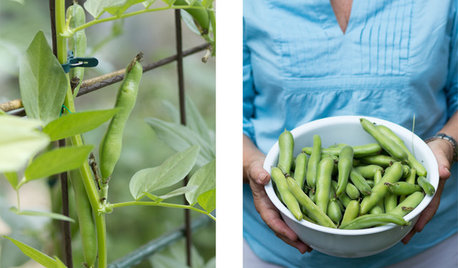
    - Favas are tall plants, so depending upon the pot size, you might want only 1 or 2 per pot. They are interesting, though, with black & white flowers. If you will be observing immature plants, they might be the best choice for strong Winter growth.
    - Garbanzos are a short bush, and are attractive pot plants with feathery foliage; so for observing mature plants, they might be a good choice.
    - If using peas, be sure to grow a short variety.

    Decide how large you want your plants to be at the conclusion of your experiment, and plan your planting time accordingly. Many of us here on GW can help you with that, as can your local Master Gardeners, who would be especially knowledgeable about growing beans (and the others above) during California winters.

    To answer the question accurately about how many seeds per pot, I would need to know the size of the pots. Beans have large root systems, so they will need larger pots if grown to maturity; I would recommend 12 inch pots, although I realize that might not be practical. In that case, you might grow 1 fava, 2 or 3 garbanzos, or 4 or 5 peas. For beans, 2 or 3 per pot.

    As a rule, for smaller pots, plant less; if the plants will be used immature, plant more. And plant a few extra in each pot in case some fail to germinate, then thin to the number you want... otherwise, a few dead seeds could ruin the experiment.

    I agree with Sue's comments regarding Miracle Grow potting soil. It contains fertilizer, so if your experiment is to test the effects of different fertilizers, it will influence the results. It would be better to use a potting soil without fertilizer, or a soil-less mix.

    "Plug mix" often comes in large bulk bags, and since it is already pH balanced, there is no need to add lime. It is also sterile, so you are unlikely to have disease problems. You can get it from some of the larger nurseries or garden stores... and if you tell the manager about your experiment, they might even be willing to sponsor you.

    As for the fertilizers, I would like to make a few suggestions. Sue's suggestion about pots with- and without compost is a good one, so you would have 2 for each fertilizer tested. It just depends upon how many pots you intend to grow... especially if you intend to try different waters as well. If you want to limit the number of pots to a smaller number, you might drop the water tests, or use compost in all pots but one (see the "control" comments below).

    Technically, the egg shells, fruit skins, and tea leaves would need to be composted before they would be considered to be a fertilizer. They will break down very little during your experiment. In addition to the chemical fertilizer, I would make the following suggestions:
    - A balanced organic fertilizer, mixed in before planting. I would _not_ recommend "Milorganite", which is composted sewage waste, and could contain chemical contaminants.
    - Composted manure, mixed into the soil before planting, OR...
    - Manure tea, made by soaking composted manure (_NOT_ raw manure!) in a large tub of water. You would measure this solution & dilute it with a gallon of water to feed the plants.
    - Kelp/sea weed emulsion, diluted as per instructions.
    - Vegetable teas, made by boiling a plant (such as green grass, alfalfa, spinach, or Swiss chard) and straining the juice. Like the manure tea, you would measure the amount you add to each gallon of water, preferably using the same amount.
    - Coffee grounds, which require very little composting, could be mixed into the soil.
    - Corn meal, or soy meal, mixed into the soil.

    Note that both the manure tea & vegetable tea should be kept as cool as possible to retard spoilage. They can be boiled - outside! - if they begin to spoil before your experiment is over, or you can just make a fresh batch. For all solutions, use small quantities (perhaps a tablespoon or two per gallon) every time you water the plants chosen for them.

    Remember to have 2 plants with no fertilizer (one with compost, one without) as your "controls", to compare with the fertilized plants.

    Good luck with your project! If you have a hard time finding seeds, email me through my member page, or contact me through this thread, as I probably have what you need (except for the favas).

  • 18 years ago
    last modified: 11 years ago

    Maybe I should have been a bit more clear about the project.
    I was thinking of just using plastic cups for the experiment. The size for the cups, I would not know. I'm not going to test out the different types of water since there's no nutritional value in water for plants according to my teacher.

    In order for this experiment to not be confounded, I would need 10 seeds in each type of fertilizer.
    I'm not sure about the plant I'm using yet. I was going to measure the height of the plants, the number of leaves (live and dead), and the length and width of the leaves and observe the color of the leaves.
    I only have about less than 4 months to do this experiment, so it's highly probable that the plant will be immature.

    I'm very surprised that I would have to compost the eggshells, fruit skins,and tea leaves before beginning my experiment. I would usually just dump them on the plants I have outside in my backyard when I was little, and it seemed to work.

    Why would I need to have two with no fertilizer (w/ and w/o compost)? I still don't get it. And I don't understand the w/ and w/o compost for the different fertilizers.
    I guess I'm going to have to change the soil to soil-less mix.

    Let's see... What else do I need to tell about the experiment. Well, I think that's about it unless you want to know that I would only keep the artificial light on for 14 hours a day.