Software
Houzz Logo Print
franktank232

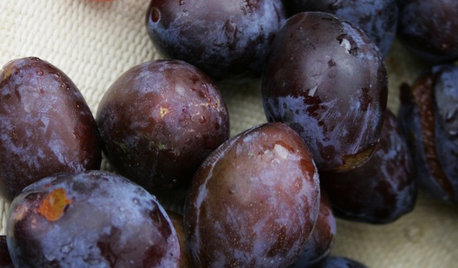
All my plums split

17 years ago

So we've been in a drought and now we get 3.5 inches of rain in 24hrs... They all look to have split.

Any options? Are they toast? They are just turning color (some are already purple). Ants look to be enjoying some of them.

Any way to prevent this in the future? Does it mean i wasn't watering them enough?

Plums are a pain to grow!

Comments (22)

  • 17 years ago

    Frank: Just get a greenhouse, best growing system around. I had way more great fruit this yr in the GH than in 40 yrs outside.

    But back to your question. They are toast unless you can eat them soon. Watering more probably wouldn't have made any difference and could have lowered quality if it hadn't rained.

    All stone fruit are difficult to grow.

    The Fruitnut

  • 17 years ago

    I agree on the stonefruit. I'm starting to think i should have stuck with apples and pears!

  • 17 years ago

    Cherries are easy.

    Make plum wine and jelly.

  • 17 years ago

    Oh, stop whining and provide some info. What varieties are split? Some are much more susceptable than others and all are more likely to split with a big rain event just as they are ripening so a sequenced harvest period provides a much better chance dodging the bullets from the sky. Smaller varieties tend to be less susceptable as well. Santa Rosa doesn't seem to split much at all, as well as closely related plums.

    If the plums split while still green a spray of Orbit or Indar may provide rescue. Someone posted that the generic version of Orbit is called Bumper 418 EC.

    Plums are worth the battle if they are doable where you are. I get bumper crops most years of many varieties here in Southeastern NY. We had double digit inches of rain in both June and July and very little sun. Methely performed well and Shiro's coming through after a lot of cracking and rotting of earliest fruit. Current fruit is tastey and later ripening fruit will be fine if weather holds. Fortune has some cracking as does Elephant Heart but I'm not too worried. Satsuma should be OK not much cracking there and it's almost ripe. As I said, Santa Rosa and an early version called Summer Majic didn't crack at all.

    In the Euros, Castleton cracked but had some decent fruit.
    Oullins didn't crack but was kind of russetted but still delicious although there was much too little fruit to draw conclusions.

    The later Euros like Valor, Victory and Italion plum should be fine if, as I said, the weather doesn't become completely rediculous again.

    Oh, and try to plant them where they get early morning sun and keep them pruned very open. Also, remove any rotting fruit immediately.

  • 17 years ago

    About 25% of my superior plums split. I removed them and expect the ones still on the tree to get larger. No big deal. My Flavor King has set just 5 plums but none have cracked and they are sizing up. Flavor king reportedly cracks badly. I am happy with FK so far. I'll see what they taste like in another month. The Superior should be ripe in like a couple weeks. A couple early ripening Superior plums were very good. The Spring satin plumcots didn't crack and were good. Six varieties of peaches have/are pulled through an unusually wet season. The peaches with cracking and rot get thinned so the others get sweet and size up. The scab is bad but is just a skin blemish. I was hoping Immunox was the magic bullet for scab. The Asian pears are perfect.

  • 17 years ago

    Immunox is the silver bullet for apple scab at least where resistance hasn't developed as it has for many commercial growers in the Hudson Valley (says Cornell). Immunox has no purpose for the protection of my stonefruit- it is only labled for protection from the very earliest stage of brown-rot which hasn't occured here in the 20 years I've been watching.

    The problem with peach scab is when it opens things for brown rot as I believe it does. Am I right?

    Anyway I use Orbit or Indar to combat peach scab and brown rot on all stone fruit. Save the Immunox for your apples and grapes where it's actually useful.

  • 17 years ago

    After reading fact sheets I had the impression myclobutanil (Immunox)was a more active chemical. I have been using the propiconazole (Monterry Fungi Fighter) upstate on plums and myclobutanil on LI to control peach Brown rot in this monsoon weather. The peach scab doesn't really show on a Redhaven that is ripe and colored fully. I have not sprayed the Redhavens in a month. The JH Hale peaches are on deck next and also have peach scab. The scarlet pearl peach didn't have scab it seem to have started later this season. You say don't use myclobutanil just propiconazole on peaches. Alright I'll do that next season.

    Here is a link that might be useful: propiconazole (Monterry Fungi Fighter)

  • 17 years ago

    You can go on line and read the Cornell Pest Management Guidelines for Commercial Tree-Fruit Production. This is where I've gotten specific info about most-affective pesticides for years. What I had to learn by myself was what I didn't need and how to get by with the least possible spray input.

    I now believe that it is safe on most any season here to wait until mid-July for the first brown-rot spray. If the season is reasonably dry that just may be all you need. This year a couple extra sprays at 14 day intervals seem useful. I stopped spraying almost 2 weeks ago and am hoping that I'm through for the season althoug I worry about the late Euro-plums.

  • 17 years ago

    I've looked at the Commercial guidelines several times before. The Peach scab Spores come from bark lesions and are active at shuck split. Guidelines recommend chlorothalonil(Bravo)at shuck spit for scab. I'll do the dormant copper spray in late fall. Chlorothalonil in late winter through shuck split for scab.

    BTW the Immunox label says 7 times every 14 days for brown rot. Commercial labels for Myclobutanil say only 2. I think they don't want to build up a resistant fungus strain. Cornell commercial guidelines says Orbit not for use on peaches until 3 weeks before harvest.

    Here is a link that might be useful: Peach scab/Cornell guidelines

  • 17 years ago

    My Euros:
    Early Laxton-more than half cracked but only just as they finished ripening so didn't have time to rot; extra juicy this year, but still tasty
    Green Gage (just a few first time this year)-all cracked early, just a couple made it to ripening
    Seneca-virtually no cracking Started ripening first of the month, majority still to go Nice large plums
    Italian-virtually no cracking, but many dropped off last month couldn't tell why. Not ripening yet.

    I've not used any fungicides including coper and sulfer. Brown rot occurs, but it hasn't yet been a serious problem; I check the tees daily and cut off any that show it. This year no more than five or six peaches affected. Peach scab, if that's what it is, is just a cosmetic issue. I might have to change my mind if the CAR keeps getting worse, though. If there were just a spray for squirrels :-(.

  • 17 years ago

    I start with the guidelines and then tinker. I have hundreds of scabless peach trees (at least most of the peaches are scabless) in many different sites that recieved no fungicide until the first week of July when I applied Indar. Forget the Bravo, get some Indar and follow my advice and you'll have no regrets. I've used this program for years. Bravo fulfills my def. of nasty stuff.

  • 17 years ago

    I couldn't find Indar for sale. Indar is fenbuconazole. Where do get Indar for your use.

    You know Bravo is chlorothalonil. This is the first time I heard it is nasty. Chlorothalonil can only be used until shuck split. I want to try the fenbuconazole for scab on growing peaches.

  • 17 years ago

    I didn't spray them with anything. A little mold growth in the cracks, but its been dry and sunny now and they are really ripening fast.

    Ate a couple today... These things blow those Reliance peaches out of the water. The juice, the texture, the flavor... Little piece of heaven. Saw my neighbor staring at me while Alderman plum juice was running down my face :)

    They may be a pain to grow, but I shouldn't talk, the Superior plum was never sprayed with a thing, even with PC, Chafers, Jap Beetles.. Next year i hope to spray regularly with surround.

  • 17 years ago

    Unfortunately, Indar is only available from agricultural suppliers. You probably have a Crop Production Systems outlet nearby or some other seller to the ag business in Long Island. You can google CPS

    Orbit is said to work almost as well and if Bumper is the same thing it will surely be much cheaper. Indar costs about $120 for what would be a several life-time supply for you. I go through that much in a little over a season.

    Bravo is just extremely caustic so you must be very careful not to get it in your eyes.

  • 17 years ago

    I started using Bumper this season. It has the same percentage active ingredient as Orbit/Tilt. It has the exact same label. As I recall, it can be used 3 times in early season for blossom blight, and, as Ace states, twice in the late season to control brown rot. Costs $225/gal. Propiconazole is also labeled for many cereal grain crops, so any chemical supply that sells to row crop farmers, should carry it.

    Ace, for an Indar source close to you, you might check Schlabach's Nursery. I believe they used to sell Indar. You have to call for a free catalog. I don't have the number in front of me, but I imagine you can find it by Googling. Since you're already using propiconazole, be advised, rotating to Indar is the same class of fungicide, and really doesn't count as a rotation. Propiconazole is not labeled for pomes, Indar is.

  • 17 years ago

    In my opinion, rotation of pesticide is generally only for commercial growers. The odds of developing resistance when you are only spraying a few trees is very small based on my experience (you know, "many trees many sites" but all smallish orchards).

    You spray thousands of trees of the same species within a few feet of each other and you're bound to get some mutation or genetic adaptation from those rapidly reproducing badies. I wish some researcher would develop a formula for the expotential increase of resistance based on the relative acreage of the monoculture. It might end up being another argument for the small farm model.

    You can only buy Bumper by the gallon? That would kindof suck.

  • 17 years ago

    You're probably right Hman, at least it makes logical sense that small operations wouldn't have near the populations of disease organisms for resistant pests to arise. So as a practical matter there doesn't seem to be much of a worry, which is probably why homeowner formulations of things like propiconazole aren't as restrictive about rotation.

    However, to quote from a distinguished legal philosopher, "the label is the law." Yes, I'm only quoting the first part of said philosopher's proverb. The second part is not as relevant to this discussion, I think. Additionally, it is speculated the second part of the philosopher's dictum may be partially motivated by the admission on the philosopher's part, in a certain discussion regarding Imidan, getting ones fruit takes precedence over submission to bureaucrats.

    Therefore, as a good citizen, will cling to the philosopher's proverb, do my best to heed the law, and will even fear the bureaucrats.

  • 17 years ago

    Peach scab is my last hurdle to getting disease and pest free orchard. Squirrels, OFM, PC, rust, mildew are virtually non existent. I was hoping the peach scab would be controlled with systemic fungicide but the ps is just like when I used just the captan. So I think Chlorothalonil dormant through shuck split should get the spores as they exit bark lesions. Then I'll rotate the myclobutanil and propiconazole (and try to find some fenbuconazole). I'll do a kocide nufilm-17 spray at leaf fall. Using the right stuff and timing is the ket to breaking the pests cycle.
    Unfortunately I'll never be sure what application works on ps.

  • 17 years ago

    Ace, if you're ever upstate a bit (I'm in Putnam county) during most of summer, I can show you how a 3 or 4 sprays of Indar, and presumably Orbit are all you need for pristine peaches.

    I used to allow some scab because it didn't matter to me as long as peaches were wonderful eating, but as I began to grow more rot sensitive cultivars and in order to impress my customers I increased my Indar input. I give the majority of my fruit away to these customers and the prettier it looks the more likely they are to order more trees.

    I'm thinking of bringing out the Bravo again to help control black-knot. I need to compare recurrance of cut-out knots from sprayed and unsprayed wounds.

    Olpea, Indar doesn't have anything on the label about rotating materials that I remember.

  • 17 years ago

    Hman,

    Orbit/Bumper does have resistance management instructions on the label, but I suppose they are written in such a way to offer various interpretations.

    Regardless of resistance, I'm still not sure why one would want to use two different DMIs with the same mode of action as a fungicide program. It's basically like spraying the same thing.

  • 17 years ago

    Ace, I am in the same situation, peach scab is my only significant disease issue on the stone fruits this year. I have been using Serenade which is rated for every major peach disease except scab. It has done me very well this year except for the scab; it does need very regular sprays however, I have been putting some in about every tank. In previous years I was happy to get any peach scab or no, but now that I am getting lots of peaches I would like to increase the scab control. Not sure what I will do yet, I may try sulphur next spring and see how that works.

    Scott

  • 17 years ago

    Olpea, that's not what I was suggesting. I would use Pristine as my alternate if I was trying to delay resistance or maybe even Captan which I tank mix with myclobutanyl for my apple program. Interestingly these 2 have been my only apple fungicides for most of the orchards I manage and I've yet to see any resistance from CAR after these many years. It certainly isn't the Captan that has delayed resistance.

    Scott, it is when your trees get older that these fungus issues really become much harder to control. It will be interesting to see if you continue to rely on your soft program 5 years from now. Hopefully some good materials will be coming down the pike as Serenade has not shown itself to be at all reliable in the tests Cornell has done with it. They say it's more affective on the West coast. The sulfur is a nasty material that, as you know, has to be reapplied after every rain.