Software
Houzz Logo Print
pezzuti9

what should i do

19 years ago

Hi all,

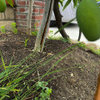
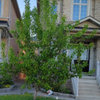
It's been awhile since I posted anything on here but I need your help once again. Below are two photos of different type pear trees that I grafted this past spring. I planted them in my back yard around the first week of August. They have not grown all that much but otherwise look healthy. That has me concerned as wellÂthe apples I grafted took off like rockets.

My question deals with the yellow fig, the photos are labeled. Above the graft it has formed a "y" branch. Should I cut one of the branches off at the present time or let the both of them grow until next spring then cut one off? Or should I leave the both branches alone on the yellow pear.

If youÂre wondering why I placed heavy-duty aluminum foil on both of the tree trunks - to keep the mice and other small pest from eating the bark off.

Thanks for any advice.

Lou NE., PA

{{gwi:125413}}

{{gwi:125414}}

Comments (12)

  • 19 years ago

    I assume you used a new root stock for the pears? If so it would explain the slow growth, it normal for 1st year pears to get off slow. They'll catch up to the apples next year.

  • 19 years ago

    I would wait until early spring when the tree is still dormant, but I would definately take that branch off your Yellow pear.

  • 19 years ago

    On the Yellow Pear is the young branch of the Y on the left side from below the graft union or is it from the scion? In other words, is it from the rootstock, or is it the Yellow Pear that you want.

    It looks to me like most of the right side of the branch is just the original scion that put on almost no growth.

    If the part on the left is from the rootstock (which I'm it looks like)I would either cut it off or leave it and cut off the other branch of the Y and regraft to the left side in the spring.

    If the part on the left is the variety you want, I would cut off the right portion of the Y and train up the left side as your whip/trunk/leader.

  • 19 years ago

    Hi Murky,
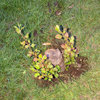
    Below is a new photo showing the graft union on the yellow pear tree shown in the photos above.
    As I hope you can see that the both branches look like they came from the scion I used. The one is much thicker than the other and we did have one frost morning a little while back.

    Appleman66 both tree are on new rootstock. I hope what you say is true about apples being faster growers than pears.

    Storkace now which branch should I cut off of the tree in early spring?

    I did graft three more of the yellow pear. One I planted in my son's yard. Another one I attached to my 25-year-old pear tree in my yard and the other I gave away to a person who owns a small orchard.
    Thinks
    Lou NE., PA
    {{gwi:125415}}

  • 19 years ago

    Hi Lou-

    It's great to see your success with your Dad's pear. Good work!

    Best,

    M

  • 19 years ago

    Thanks for the closer picture. How long was the scion you used? Did it have

    The reason I ask is because it looks to me like the thicker fork of the Y IS the scion you used (that's why its still wrapped) and the thinner one that is now on the right in the new picture is essentially all of the growth from this season.

    If that is 16" or so like it looks, that doesn't seem too shabby for a first season's growth.
    If that is in fact the case I would probably try to train the new growth fork to more verticle and treat it as your new trunk. One way to do that would be to gently bend it towards and tie it to the thicker side of the fork.

    I just give the disclaimor that my fruit tree experience has only begun accruing in the last few years.

  • 19 years ago

    Pezzuti:

    1. The first thing I would do is to remove the rest of that plastic wrap or whatever you used on the graft and scion. That should have been done as soon as the graft closed up and the scion began to grow. I don't know for sure that the plastic contributed to the poor performance of your scion, but the adventitious branch without it is doing much better. Leaving the plastic wrap on all season certainly didn't seem to help your original scion. Screen wire around the base of the trees would be better for deterring rodents than aluminum foil.

    2. You still have not mentioned the source of the pear rootstock for your trees -- whether they were specially purchased rootstocks for grafting, or whether they were seedlings, or recycled trees that failed to grow properly before. If you happen to have planted fully dwarfing pear rootstocks, growth of the scions can be very, very slow. My experience with fully dwarfed pears has been negative since I learned through experience that they have a short life span compared with semi-dwarfing rootstocks.

    3. One other thing that caught my eye is the fact that your grafts appear to be pretty high on the rootstock stems. Whip-and-tongue grafts are normally done at about 2-4 inches above ground level, but yours appear to be 10 inches or more above grade. The degree of dwarfing control of a rootstock is affected by the length of the rootstock stem. When a substantial length of a dwarfing rootstock stem is exposed above ground, the degree of dwarfing conferred will be greater, and growth consequently slower.

    4. I think I would just get the rest of that plastic off and leave the little trees alone for now until they become better established. Eventually, you may want to choose between one or the other of the branches on the forked tree depending on their relative performance, but give your vertical scion another chance before removing it.

    Don Yellman, Great Falls, VA

  • 19 years ago

    jellyman the pear rootstock I ordered was from an on line nursery -- well known. They where the semi dwarfing type
    subital for my planting area. I did not know that the length that one left the rootstock could determine the size of the tree when fully grow. I also was instructed that the grafting tape I used could be left on because it stretches very easily and in time degrades. I removed it all--It just flaked off.

    I have decided to let he trees as they are for this winter. Also I grow fig tress and tried a few outside. The voles and the moles had no trouble tunneling under the small hole screen that I had them surrounded with. I used the aluminum foil on other trees I have grown since living here and find it to work well.

    Thanks guys for all your support.
    Lou NE., PA

  • 19 years ago

    Lou, if I remember correctly that rootstock you used was an Old Home-Farmingdale cross, but I don't remember which one.

    The Joe Pezzuti scions you sent me have taken well, but one is a little less vigorous than the other. Nothing dynamic, but both healthy. I've seen pear grafts sulk for the first season and then really take off the next, and I'm comfortable with these.

    Best,

    M

  • 19 years ago

    Lou, if that wrap is parafilm, which it sounds like from your description, then there wasn't any harm in leaving it on for the summer. I do it frequently as do other more experienced posters in this forum.

    They both look like they're doing OK to me.

    For your Yellow Pear, what I see is that you planted a small bench grafted tree where the top half was wrapped in parafilm. The lowest bud that grew resulted in one fork of the Y and is essentially what will grow into your tree. The other fork in the Y is just the original scion (still wrapped in parafilm in the picture) with a few leaves that have grown on it.

    I'd try to get your one growing limb, the skinny one on the left, trained more vertical because it will be the trunk of your tree. The sooner you do that the easier it will be.

  • 19 years ago

    Are these "growth" issues brought about from grafting too long of scion? I thought you were supposed to limit the scion to 2 or 3 buds.

    I think at this point, I personally would let them grow another year as is and do some dormant pruning thereafter (Fall '08) to shape the tree.

  • 19 years ago

    I predict that, if let be, the one growing branch there will send out side branches and you'll have either a leaning trunk, or a zigzag if you let one of its buds become the leader.