Software
Houzz Logo Print
dogsdogs77

Building up Clay for Patio

12 years ago
Hello All,
SO glad I found all of you soil experts!
I read all about Clay and beds/gardens, but my circumstance is a little different.

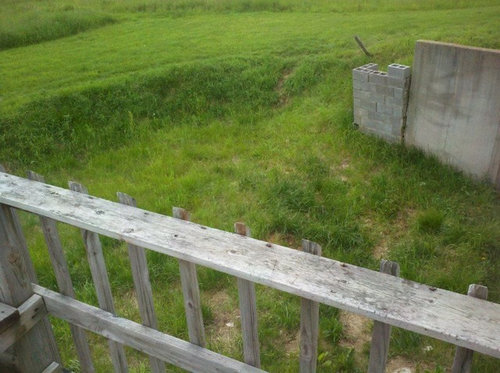
I have a "sunken bowl" that I want to be a patio of large pavers.
To explain, when they built my house they wanted a walkout basement and there wasnt the grade available for a walkout, so they basically dug a hole.
When I bought the house last fall I was ecstatic with this area, thinking "ohhh, the banks can be beautiful flower beds and the flat area out of the slider an be an amazing patio, with pond and fireplace"
Well, SHOOT, its ALL CLAY! its disgusting! Its either rock hard or sopping wet.
I have dug out one area of the bank for flowers, but its just gross clay. I put down landscape fabric and will fill in with good dirt, so Im not too concerned about that...but the bottom, for my patio is just gross. Its wet, its impossible to work with and Im at a loss.

I have about 4" to work with before it would butt up to the slider door.

What do I do? I need it to be 1-level and 2-dry.

Everyone I talk to says that no matter what I add or take away, it will still be wet.
Its a huge battle at home between the man and I. He works in concrete, so he says just put a concrete pad down. But others say that clay moves and will just end up cracking concrete.

My opinion... Till the clay, add organic material til some more then roll and level.

THOUGHTS please? Its finally warm (above 50) and I am ready to get my beautiful plan in motion.

HOW do I get this area to stay dry so I can put down my patio pavers?

Comments (16)

  • 12 years ago

    Here is another pic showing the banks of clay I was working on last fall.

  • 12 years ago

    Your first post and it's an engineering can of worms issue??? First off this is more a construction and drainage problem than soil amendment consideration. Water allways runs into the lowest place available which in your case is a hole. Holes in the earth hold water,they have names like pond,pool,mud hole,basin and lake. Sounds like your man has the answer. Are the people saying his concrete will crack concrete experts? Regardless what is done with the lower level,planting the walls will require bed retainers of some sort to prevent loose dirt and mulch flowing onto the walking surface,be it stone,clay or concrete.

  • 12 years ago

    CRAPPY huh? :)
    Yes, the 'walls' will be retained with about 10" bricks, to hold up the flowerbed walls (which may get a tier or two). I have the bricks for that already.

    The water table is very low we have learned. :( even a spot out in our field could easily be a pond (ie breeding farm for 'skeeters and toads).

    Concrete guys say minimum of 6" of concrete. thats a lot of $$.

    You're saying Im screwed for patio pavers? :( DANGIT!

  • 12 years ago

    This may be bigger than it looks, but in the end it's only dirt, and dirt can be whipped into shape by Mr. Dump Truck and Ms. Ditch Witch.

    You say "building up clay". The answer may be the opposite direction: cutting into the ground even more.

    The picture appears to be somewhat of a hillside, and that implies an easy-ish drainage solution involving crushed rock, pea gravel, and lots of big cheap plastic pipes full of lots of little holes buried in that rock and gravel, with drainage lines leading off to lower parts of the property.

    >> I have about 4" to work with before it would butt up to the slider door.

    There's nothing stopping you from taking it down a little more.

  • 12 years ago

    "You would need some space between pavers with porous (gravel or sand) filler between, not concrete."

    If the table is low,that is a good plan. If the table is high,concrete with a sump basin might be the best option. My reasoning is that the large amount of water retained by gravel could potentialy increase hydrolic pressure on basement walls. This is definatly something that needs to be looked into by an expert before going foward. I was under the false impression the owner was in the concrete business which regularly works hand in hand on drainage and hydraloic considerations. Not to mention cost control due to being in the business. I don't intend to be aurgumentive but instead incourage thinking it through. The results can be costly to correct if improperly done.

  • 12 years ago

    Suggest you consult a soil engineer rather than guess what might work.

  • 12 years ago

    If you think that is crappy soil, you really need to come and meet my rocks. It looks like quite presentable soil from here.

    Yes, the real problem is that the previous owners built a pond right next to the house. Somehow the ground has to be recontoured so the water flows away from the house and into a stream, which goes into a river, which goes into something, that goes into something else, that ends up in an ocean. Otherwise, there is always going to be that too big storm that will saturate the soil.

    Be careful of any solution that involves electricity unless you have a generator to run it. Half the houses in my development have generators to run the sump pumps.

  • 12 years ago

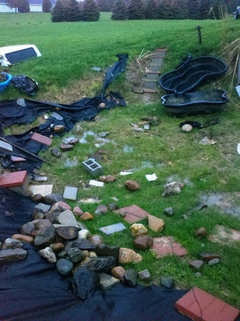
    Follow up pic taken at 630 this morning after a night of rain. UGH!
    Pardon the mess, I got a load of rocks and plants this weekend.

    May show better how badly of a bowl it is. AND how wet it is. Last evening before the rain came it was almost dry! UGH!

    Someone had asked how far away a lower spot is..and Id say about 200 yards into the back field. :(

    I have a call into a Landscape Engineer. Maybe they can help.
    I REALLY dont want to dig a trench way the heck out back.

    We talked last night about maybe just sinking footers and making the whole area a wooden deck to raise above the wetland.

  • 12 years ago

    I would dig a test hole a few feet deep around where the middle of the patio would be and see what kind of soil is there and if you hit water. I'm guessing it might not be as bad as you may think, especially if you never had water flood in your house through the sliding door.
    If that last picture shows the effects of "a night of rain" I would picture more standing water than what appears especially if the ground all around slopes that way and it is all clay.
    Dig the hole and you just may be pleasantly surprised to find decent drainage and a much lower water table than expected.
    Has water ever come inside the house?

  • 12 years ago

    Good thoughts and advice in the last several posts which I have little to add to. I get your problem with reaching a lower area - that's too far to have to go.

    Does the house have any foundation drains?

    How old is the house?

    Another thought after reading the above posts is that you might be able to add a patio here that actually lies above or level with your patio door, as long as you have a dam of some sort so that if water collects (and can't soak in fast enough) it doesn't come under the door. I have a friend with a basement door that has several steps UP to the back yard. It has a curb at the top, so if the back yard floods (which it does temporarily in very heavy rains), the water can't come down the steps into that pit and towards the door.

  • 12 years ago

    It's a possibility Tox but before doing that I'd like to know about the water table and makeup of the soil before doing that.
    If they've never had water in the house I doubt she has a problem.

  • 12 years ago

    dogsdogs77 any update on what you are doing or did?

  • 12 years ago

    I'm still interested in what you did

  • 12 years ago

    I am still interested in what you are doing or did.

  • PRO
    11 years ago

    I've used the following procedure, to good effect, for paver patios, concrete patios and flagstone as well:


    Wait until a a really dry week, if possible, then dig down a good foot or so and then lay a couple inches of gravel and lightly tamp. Then lay (dry) gravel and clay soil mixed, in 4 inch lifts. Each lift gets raked out and lightly tamped. The top 6 inches or so you'll want to lay just gravel, road base aka modified. By the time you get to the top, it should feel firm underfoot. If not, then let the area dry for a week (tarp it on rain days, leave it exposed on sunny days) then re-tamp it again.

    More of this is explained here:

    http://www.devineescapes.com/flagstone-what-to-use-sand-cement-or-gravel/


    The 24th comment at the bottom of the page explains my method in a bit more detail.


    Good luck!