Software
Houzz Logo Print
garett_gw

is this tree ok, and can i move it?

18 years ago

i am in the 2nd year of our new construction home. we had one tree that came with the house. last spring the tree never did leaf out so we determined it to be did. dug it out. when we pulled it out there was a lot of water in the hole and the root ball was still a perfect root ball. i have learned that all that water was probably the cause of this.

we replaced it with a cleveland select and we dug a bigger hole and used some top soil. i have read to just use native soil, but i was hoping the top soil would help with some of the drainage problem. it didnt take long for the majority of the leaves to fall off the tree. also for some reason it tried to flower in the beginning of the fall season.

here we are now, and the pear trees in my area are in full bloom. ours has nothing so far. temperatures are ranging from 50's to 70's.

for those of you who dislike pear trees, i understand now that we chose the wrong tree. unfortunatly, my wife has decided she wants to keep it anyway if possible, but we want to move it to a different part of the yard. we also know now that we did not have enough mulch around the tree.

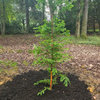
so my questions are, is my tree still salvagable? and if so, is now a good time to move it? here are a couple of pics:

{{gwi:337039}}

{{gwi:337043}}

Comments (13)

  • 18 years ago

    You planted it in the same place as the other tree that died? If poor drainage was a problem that caused the death of the other tree, digging a larger planting hole and filling with imported soil did nothing to improve that - it likely just resulted in a larger, wet pocket of soil. If poor drainage is an issue in this location, any other tree you select for this area will need to be very tolerant of those conditions or you need to plant it high. Dig a wide but shallowly dished planting hole and plant so that the top of the root ball is several inches above the existing soil level. You can gradually mound your imported soil up to this point or use mulch. Keep the lawn well away from the base of the tree - provide at least a 3' diameter or larger. And water deeply but not too frequently (maybe once a week, weather depending) during the growing season.

    It's hard to tell from the photos, but it looks like there may be some buds developing here and there on the pear. Pears are generally a bit more tolerant of wet soils than many other species so the poor drainage may not have been fatal. Scratch the bark on one of the twigs. If there is succulent, light colored wood underneath, there's still some hope. It sounds like it might have undergone some transplant shock last season and to avoid repeating that if you want to move it, do it promptly.

  • 18 years ago

    gardengal,

    thanks for the helpful information, and the very helpful attitude.

    my lawn is bermuda. unlike my tree, i maintain it pretty good keeping it short and mowed at least twice a week :)
    is there a kind of mulch that is better to use for keeping the bermuda away? last year we used cedar. it was a pain to keep the lawn from overtaking the mulch around the tree. i had to remulch a few times last year. i know that it will always be a problem with bermuda, but any tips would be greatly appreciated.

  • 18 years ago

    Next time fill the planting hole with virgin soil, then build up the bed about 12-18 inches and either stack large flat stones around the edges of the bed, or spread the bed large enough that you can simply taper the sides to make a gentle slope which blends at the edge with the virgin ground level.

    Then plant your next chosen tree at a size which is only 6-7 feet tall, and that comes from a nursery in a nursery pot which is no larger than 5 gallons. Before purchasing though check the root flare of the tree, and make sure that none of the roots are wrapping around the trunk, or growing in a manner which could cause strangulation of the root system at a later date. If you see such problems with the root flare, do not purchase that tree, but search for one which has a better root ball stucture.

    Plant the tree in your raised bed and stake it by pounding into the ground around the tree three "T" stakes, and then tie the tree to the stakes with special cording which will not damage the tree's bark. You will need to leave just enough slack in the ties, so that the tree can still sway slightly with the wind.

    Check the ties periodically to ensure the tension is maintained correctly, and to adjust them whenever you see the trunk has expanded and that the ties need to be enlarged.

    If your wife insists on a fowering pear tree, next time try to purchase the slightly less prone to branch failure, 'Cleveland' pear, cultivar instead of the 'Bradford.' There are other ornamental flowering trees that are just as pretty as the Bradford, and which do not have stinky flowers like the Bradford pears have.

    Check out the ornament cherry trees, and also the ornamental peach trees.

  • 18 years ago

    For the existing tree, even though it seems to be dead, try a "scratch test" - using a fingernail or a knife - very carefully - lightly scratch the bark from a few branches. If there is a greenish l;ayer under the bark - the cambium layer - then the tree is alive at that point. If it is pale, yellowish, it might still do or more likely, will die back further. And if it is woody, brown and dry looking, then that part of the tree is dead. I hate to say it, but it does SEEM as though the tree is dead.

    I agree with Katrina's advice in the above posting - the only additions I would make are to loosen the ties as the time goes on - see if the tree is able to manage without them after next summer and remove them altogether in the following year, if not then - this is NOT a permanent addition to your landscape.

    Yes, use mulch, even though you have a drainage problem; mulching will help keep the roots cooler, and will keep the raised bed moister. As it breaks down, it will help improve your soil. Use almost any organic (in the sense of breaking down over time, not in the sense of certified) mulch, as widely as you can, no deeper than 4", and put no mulch in the inch or two next to the trunk.

    As far as the Bermuda grass goes, it is a constant problem keeping it out of places you don't want it. May I suggest you use a "trench edging" - I think there is a name for it, but it escapes me for now - around the tree area? It has the advantage of letting you quickly see and clear away the encroaching grass. At the appropriate spacing - 3-4' out from the trunk - use a sharp-edged spade and cut around the circle. Go back around your circle, and dig up and remove a section of grass and soil, about 3" deep and about 3-4" wide, using the picked-up sod to use to fill in any holes or low spots in your lawn, or to let dry out and compost. Keep the trench edge on the lawn side sharp, and let the side toward the tree slope up to the soil. Try not to let it fill with mulch, as you want the open area to see the grass as it grows into it. If you pull back the grass every time you see it, then it's easier than having to make a concerted, morning or hours-long effort several times a year!

    Good luck getting a tree both you and your wife like.

  • 18 years ago

    Round-up twice a year with minimal hand pulling between those times, keeps Bermuda out of my beds.

  • 18 years ago

    you guys are all great. i dont think i will be doing the RU thing, my lawn is on an organic program.

    would it be too late to plant a yoshino? i guess if you havent noticed i am having a hard time figuring out when it is ok to plant trees. i dont want have another tree go through what my other one did.

  • 18 years ago

    I'm in a similar situation as you. New construction, not real good drainage, Bermuda etc. Depending upon your soil type Gypsium (natural mineral) may be of some help of assisting the grass/tree roots in penetrating the soil underneath. Also limit your watering somewhat of the grass to encourage the roots to "dig" into the soils underneath, which will help drainage and compaction, and therefore establishment of trees. Don't bag your grass clippings as they will help with the soil and add organic matter, also resulting in better drainage etc. This will also reduce the need for fertilization of the grass/tree(s). Lastly, I understand wanting to use organic means, but standard Roundup (not the extended kind)is destroyed very quickly once applied, and degrades to completely to absolutely harmless compounds. Also remember that just because it's "natural" or "organic" does not mean that it's good for you or the plants. Malaria, botulism, and mushroom poisoning are all natural and organic, but that does not make them desirable. Same thing goes with the Bermuda (imported from the Eurasia if I remember correctly) overgrowing your new tree that is artificially selected and propagated, and planted into un-natural soil and subject to natural diseases that you are trying to prevent. I'm not criticizing you or anyone else for not wanting to use many chemicals, I'm just saying you have to look at the full picture to make wise choices.

  • 18 years ago

    Gypsum won't help. Unfortunately, it's not magic.

    And Yoshino cherry is even more susceptible to wet soil that the trees that have previously died.

  • 18 years ago

    another thing, the spot tree is located is right by our water meter. i dont know if this has anything to do with the problem or not. i dont know why the builders put the tree there in the first place, and i dont know why i replanted there. to me, the water meter is also acting like a mini well, just collecting all the rain water and storing it. my neighbors have the same kind of soil that i have and thier trees are doing well.

  • 18 years ago

    Round up does cause some damage to the soil biology. You'd have to apply compost to the area applied every time you use Round up. All the talk about Round up being safe in the ground is a complete BS.

    Always remember this motto - Whatever doesn't kill anything quickly is good enough for the chemical companies. They only care about profits. Ever notice how chemicals come and go after they've discovered that they do cause damage but took a long time to figure that out? Kinda like smoking cigarettes. They said it's perfectly safe back in the old days and now we know better...

  • 18 years ago

    As far as Roundup goes, the active ingredient is Glyphosate which binds very strongly to the soil. So not going to a great deal once it contacts the soil. Here is a quote from the EPA.

    "Glyphosate adsorbs strongly to soil and is not expected to move vertically below the six inch soil layer; residues are expected to be immobile in soil. Glyphosate is readily degraded by soil microbes to AMPA, which is degraded to carbon dioxide."

    Since it is "degraded by soil microbes", that also means that it feeds those soil microbes as a carbon (energy) source. Anything that is added will change soil biology, and that includes the plants, the grass, compost/organic matter, the mower, and you walking on it, and the dog walking down the street that stops for a....... visit. Not all changes are insignificant, but very few changes are disaster either. Glyphosate also has very low effect on other organisms except for those targeted (plants). Which is true of most everything, including water, vitamins, amino acids, and nearly anything else, though glyphosate is more toxic than these, but it is low. With that said, it also should not be applied in excess, near water, to soil that will get into a waterway, or to surface water. By all means, do not do something that is NOT needed. But you are needing specific point control, and as far as chemical controls go, there are far far worse than glyphosate (Roundup).

    I disagree with Lou on this one, though much of the other items that I originally wrote, Lou has espoused many many times before I came along to this forum. Some of which I had not considered until I read them from him.

    Here is a link that might be useful: PDF from the EPA on Glyphosate

  • 18 years ago

    btw ark, im still trying to figure out what malaria and botulism has to do with me spreading SBM on my lawn instead of Scotts. lol :)

  • 18 years ago

    garett,
    well, nothing directly......... :-)

    Just pointing out that "organic" and "natural" have limited meaning. :-)

    So what are you qualities are you looking for to plant? It seems you may be looking for something that is flowering????? Or shade and flowering????? Some of the red maple cultivars can handle a fair bit of water (thought not submerged), have small red flowers in spring (the local red maples are currently very attractive right now, thought not "COVERED" like a cherry/dogwood etc.), make great shade trees, and have excellent fall color if you are not too far south. Judging from your picture and the date (if accurate of if it was recent) and bermuda grass that you are zone 6 or 7. There are lots of plant savvy people here that will help you find something that fits.

    BTW, here is a link showing the breakdown pathways of glyphosate for those who might care to look.

    Here is a link that might be useful: {{gwi:337038}}