Software
Houzz Logo Print
viktoriag_gw

Leland and Arborvitae

18 years ago

Hello

I am a new member, and also new to gardening. We moved two years ago and put in a pool, and I've been really enjoying landscaping it; but at times, especially at first, I was clueless. We live in central NJ, and our soil is mixed with clay and sand.

Background for the two questions: we bought 7 arborvitae and 4 leland cypress for different parts of the yard, for quick privacy.

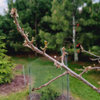
(1) The arborvitae: are "Green Giant" and are supposed to grow rapidly - they didn't grow much last year after planting in May, but maybe they will take off this month? However, two of them died, and I hacked off dead branches on one, and now it is a half a tree. Will it ever come back, or should I cut my losses, and take it out? It looks pretty bad.

(3) The four Lelands: are planted too close together and too close to the fence. Our landscaper planted them, so you would have thought he'd have known better. Now that I am more aware of their growing habits, I don't know what I should do this spring. They are presently about 5-6 feet tall and they look fine, in a year or two I think they will do exactly what I bought them for. However, beyond that, I have concerns.

I think Lelands look beautiful when they're full grown, but this space won't handle them, plus they are under a "tulip tree" and some maples. They do get light, just not all day.

Would it be smart to take two of them out and move them behind, to create two staggered rows? I would say the four trees are in a line about four feet apart from one another. And they are probably only two feet back from our fence.

Thanks, sorry to be rambling. I know many will say we made a poor choice, but there they are now, and what should we do next?

Comments (3)

  • 18 years ago
    last modified: 11 years ago

    (1) - probably best to replace the half-dead one.

    (2) - no harm in trying to move two of them, and they are pretty much doomed growing under the Tulip-tree canopy anyway. But survival will be risky.

    PS spellcheck: Leyland.

    Resin

  • 18 years ago
    last modified: 11 years ago

    Just one Leyland cypress tree has the potential to take over a midsized yard if it is not first overcome by pests. I wonder if your landscaper planted three so close together, on purpose to crowd them and limit each of their overgrowth potential.

    Concerning the Green Giants. These trees are much more resistant to pests. They do need good draining soil which is kept evenly moist, but not soggy, especially for the first year after planting.

    If your Green Giant tree's roots sat in saturated and soggy soil, that means the roots of those young trees were suffocating. and not long after suffering decay.

    If your Green Giants did not suffer from too wet of soil, then too dry of soil could have stressed them enough to make their needles begin to die.

    It takes about three years to get your Green Giants established well; That is, if you do not first kill them by to much care, over watering, or by neglect, letting their roots get too dry.

    Another thing that can cause the needles to yellow and die would be if a fairly large dog has been allowed to urinate for several months either on the folliage or even around the base of the tree.

    Additonally, you need to know that Green Giant trees, which have been stressed and are showing some lower branch needle death, will often if the stresser are removed and the tree begins to experience a proper invironment, begin to grow new needles on the earlier, dead looking branches, which were either covered with dead needles or bare looking from dropping all the needles.

    So, do not cut off any branches, even if they appear to have died. First wait even if it has to be till next year to see if the tree will begin to regrow healthy green needles on those branches.

    I say that, because any branch you cut off the tree, will not be replaced. If you want Green Giants, which branch fairly close to the ground, do not cut off any of the lower branches. If you do, no new branch will grow on the trunk to replace the ones you cut off.

    You can take all the dead needles that you desire off your Green Giants, because once healthy the tree will replace them. But believe me when I say, it is seldom ever a good thing to cut entire branches off all the way back to the trunk of the tree.

    If the branches you cut off the trees are as drastic as you described, It might be best to replace those trees. Just be certain that the trees you keep and any replacments you plant are planted in a well draining soil type of condition, and in an area where they will be fairly sheltered from the cold drying northwest winter winds.

    Then if those condtions are met, just be sure to water them with at least 1 inch of water a week, whenever the natual rains do not supply that. Drip watering is the best, but a soaker hose covered with mulch would also work. Even then, though, regularly check their root balls to make certain they are not sitting in soggy soil or too dry of soil.

    After their first year of growing in proper conditions, they will start becoming less sensitve to the issues I described above, and by the third year after they have become very well established they should begin to require even less special attention.

    Properly cared for Green Giant trees might grow only a foot or so the first year, 3 feet or so more the second year, and up to an additional 5 feet the third year. If your soil is not very fertile, and the new growth appears to be tall but very thin compared to the fullness of the bottom of the tree, then that could indicate your Green Giants would benefit from a feeding of slow release, not burning fertilizer. My Green Giants began filling their tops out much better after in the fall of their second growing season I began spreading Osmocote 3 month acting fertilizer underneath them.

    I planted these trees as an 18 inch tall one gallon potted size, and in a well draining soil situation 4 years ago. this spring they are 8 -9 feet tall, with a just barely 3 feet wide spread at the base.

    I chose not to fertilize them this spring, because late last winter we had almost a week of rain which coated the leaves and froze. The weather event was so bad that even my 25 feet tall shumard oak trees suffered from severe branch breakage.

    My Green Giants did not break, neither did they become uprooted, but the weight of the ice accumulation on them cause their tops to bend all the way to the ground. Even though they straighten themselves back up after the ice melted, and they currently look pretty straight, I can still see enough lean to know that they should not be fertilized to grow taller until they have a full growing season to completely right themselves up again.

    By this coming Fall in September, if any are still leaning I will consider staking them, and then giving them all a feeding of Osmokote again.

    Sorry my rely has turned out so long, I thought you might benefit from all this information, since you indicated that growing and caring for these trees is a new situation for you.

  • 18 years ago
    last modified: 11 years ago

    Thank you both for your replies! Katrina, yes your reply was most helpful. I am wondering if the soil did not drain well enough in that area. Two and a half of the arborvitae died on that side, while three out of four survived on the other side of the yard.

    I did replace the half tree, but we put in a purple leaf sand cherry instead. We had replaced one of the other arborvitae with a crepe myrtle in the form of a tree, so I decided to be done with evergreens on that side of the yard, which needs less privacy anyway.

    I had my husband dig up the half a tree and stick it in what I am calling the "island of lost plants", an area of overgrowth between our and the neighbors house. This way it can fight for its life if it wants to.

    I appreciate your giving my landscaper such credit re: planting the leylands to limit their growth; unfortunately I doubt this was the case. I was out on the day he came, and he also planted these four in a row by the gate, where I had them in their pots awaiting planting by my husband or myself: daylily, clematis, clematis, peony. However, if it does limit their growth, can I consider that a bonus, or will they die young?

    pineresin: thank you as well, and my apologies for my spelling ignorance. My brain is having a hard time learning all these new words, and I guess I put all my energy into spelling 'arborvitae' correctly.

    When you say "doomed" under the tulip tree, do you mean doomed to death or not to reach their full height? Because that would be OK. Although the tulip tree did beat one of the leylands in the fall, knocking off a branch or two with its own hard falling sticks.

    Thanks again - I'm learning!

    I may just leave the leylands alone for now. We have five to ten years before they become a problem; if moving them might upset them anyway.