Software
Houzz Logo Print
kenmarmi

Sourwood Bark/Trunk Problems

18 years ago

I planted an 8' Sourwood last October in my garden in Eastern Michigan. The tree was just starting to turn to its beautiful red folliage when it was planted - gave us a couple weeks of great color!

We had a rough winter here in Michigan, lots of cold weather and cold winds - so there were quite a few dead ends at the tips of the branches - which I trimmed off in the spring. The tree looks great, beautiful light green with white flowers all over it (and tons of honeybees flocking to it!)

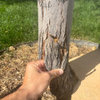
My BIG problem is that yesterday I found a cracked and curling bark barely attached near the base of the Sourwood. I peeled back the dead bark and found small greenish caterpillar worming its way under the bark, with quite a few ants running up and down the tree.

After talking to my neighbor who has more background with trees than I do, I peeled back the dead and rotting bark to the point where I found good attached bark which hasn't been impacted by the rot or insects. Problem is that the rot went about 2/3rds away around the trunk of the tree, and so there is ONLY 1/3 healthy bark attached. The rotted bark extended from its base at soil level, about one foot up the tree (to a point where I found that an old branch had been cut off, and the remaining portion of the branch (it didn't extend out past the bark) seemed like it was dry-rotted (broke up easily when flicked with a fingernail).

I have sprayed the tree and the area around the tree with insecticide to get rid of the ants and caterpillars. Now, I am wondering - will this beautiful tree with only 1/3 of its trunk with "live bark" be able to survive? Is there anything that I can do to protect the trunk where the bark has been rotted/removed? I have searched far and wide on the web with no information on this problem. Any suggestions?

Comments (8)

  • 18 years ago

    A damaged tree attracts boring and harvesting bugs and insects much more frequently.

    If you think your tree is still strong enough to survive, but even if the damage seems limited to the one branch and the damaged bark, it will avoid lots more potential stress to the tree, this Fall through next Summer, if you give your Sourwood a dose of the Tree & Shrub, Bayer Systemic insect and bug killer as soon as possible this week.

  • 18 years ago

    searched far and wide ??? hmmmm...

    where are you in MI????

    anyway.. ants only make me look for aphids.. which they 'milk' for their honeydew ... i wouldnt have wasted spray on them ... they are harmless to a tree ... if there is rot in the tree.. the ants neither created it.. nor impact it...

    no spray will impact the borers .. so you wasted spray ...

    if you have borers.. look into bayer systemic tree and shrub goo .. AND APPLY IT AS INSTRUCTED ...

    let me guess ..... your damage was either on the south side.. or east side of the tree.. its bark scald caused by winter sun on a recently transplanted tree ... there might be a better name for research purposes ... but it is escaping me now .... regardless.. its common.. and usually NOT fatal ... trees are magnificent at healing themselves.. EVERYTHING YOU CAN DREAM UP.. IS CONTRARY TO NATURE.... just keep it watered properly ....

    if your tree is warrantied ... you might want to discuss all this with the seller.. if its a reputable nursery .... borers do NOT pop out of nowhere.. they probably came with the tree... and are not related to the bark problem ...

    PLEASE... next time... get better info before spraying the environment ... i have no fear of chems... when used properly ... anyway.. off the soapbox ...

    good luck

    ken

    PS: ken marek adrian MI .. nice Gweb name ... i should have used it.. lol ...

  • 18 years ago

    Thanks Katrina and Ken!

    Ken, as you figured, I first noted the damage on the south side of the tree (looked to me like that was where it started) and what looked to be more recent damage continued along the east side.

    The tree is warrantied for one year (I planted it in October). Since the trunk at its base is "girdled", with no bark for the first foot or so up from the ground, it looks pretty serious to me. I am wondering if there is anything I can do in order to promote the process for this tree to heal.

    I am not sure if there are borers present. When I peeled back the rotted bark I found what looked to be a green/grey caterpillar that was about an inch long. It was located between the bark and the trunk. There may have been two or three others that were also there - I saw a couple scurry away into the dirt. And, from what I understand, usually borers will scar the wood on the surface of the tree - I can see no tell tale scar patterns that indicate this.

    So, should I consider using the Bayer Systemic goo with these indicators / under these conditions? I agree with you, I like to use more natural means to take care of the garden.

    AND since I have a number of other trees that I have transplanted this year (and last) are there other precautions that I might take to avoid "bark scald" or "sun scald" from happening to other trees? (This year's plantings include Persian Perotia, River Birch, Purple Prince Crabapple, Alaskan Cedar and a Fraser Fir - Last year's crop includes two London Planes, and a Kwanzan Cherry).

    Thanks Again!

    And back to Ken - Just off a couple of letters - I am Ken Mareski from St. Clair.

  • 18 years ago

    If the base of the trunk is completely girdled - no bark at all in the bottom foot or so - then I doubt the tree will survive. If, in fact, it does have bark on a third of the trunk, starting at the roots, then it MIGHT survive. BUT, since you have a guarantee, I think I might exercise it and get a replacement. Wait until fall, but do it before the year's up - say in Sept.? While the Sourwood MIGHT survive, it might not, as well. With an uneven bark placement, it will probably grow unevenly as well, which probably is not what you had planned for your landscaping.

  • 18 years ago

    i would talk with the seller.. and ask for replacement in october..

    and would be happy with a smaller one... the bigger the tree.. the harsher transplant is... i would bet a buck. that a 4 foot and an 8 foot.. transplanted at the same time.. the 4 footer will outgrow the 8 footer in 5 years .... because it will get established and thrive a couple years faster than the larger ...

    sometimes this is a good bargaining chip if the seller is moaning about giving it another year ...

    a caterpillar hiding in broken bark is not a plague.. you would have to ID it BEFORE SPRAYING ... or using a systemic .... its very expensive... i wouldnt bother unless you are sure there is a problem [i dont even know if sourwoods get borers]

    trees heal themselves.. i though i said that prior.. and you asked again ...

    i usually doesnt happen on conifers... but on bare trunk trees.. all you need is to shade the south side ... paper tree wrap .. burlap.. cardboard ... anything you can dream up to keep winter sun off the bark .... but not necessarily on the trunk ... just shade ...

    return it.. ken

  • 18 years ago

    That's sounds like a catepillar that will hatch to a boring insect, regardless it's gone, so pitch it and pick up a new one.

    Dax

  • 18 years ago

    can you tell me where you got your sourwood. i am in central michigan and have been looking for somewhere to get some that are at or near blooming size for my honeybees

    scot

  • 9 years ago

    My friend had a bug infested plum tree that was nearly dead in his Michigan front yard. He was actually going to remove it. I filled a spray bottle with a hand dish soap and water and sprayed the tree liberally. The tree made a great come back and is standing proudly and beautifully 8 years later:) Also, no wildlife was endangered by toxic chemicals. A great book to consult for non or very low toxin plant solutions ate any of the Jerry Baker gardening books. I found this site because I am interested in planting a Sourwood tree in Michigan for my bees.