Software
Houzz Logo Print
hzdeleted_19696490

How long do grafted roses live?

19 years ago

I read in an earlier thread that grafted roses don't live as long as own roots. Is this true and if so, how long do they generally live?

Also I have read that "standard" protocol is to plant with 1/3 sand, 1/3 native soil and 1/3 organic matter (compost or manure okay?). I wondered why there has never been a suggestion to mix in any potting soil, just because it is light and therefore more breatheable. What is the reason not to use potting soil?

Comments (20)

  • 19 years ago

    Well, Redsox, I guess I have been lucky then, as many of my grafted roses are 20yrs plus. But I remember one time picking up some roses at a popular nursery (now closed) and I was told that Weeks, Jackson & Perkins roses etc lasted about ten years and she was thinking that was good. I remember feeling very disappointed as most roses I purchased in those days where from those growers. So I think 20 years is pretty darn good.

    Our own planting mix is 1/3 compost, 1/3 peatmoss and 1/3 garden soil. Maybe we should be doing something different, but this has truly worked well for us, so I guess if it's not broken, don't fix it. :)
    Cheers!
    Pauline - Vancouver Island

  • 19 years ago

    I've lived in this house 16 years, and many of my HTs are that old. My dad planted some at my childhood home probably 25 years ago, and they are still doing well. They may have all gone "own root" by now, however. Whenever I have dug up a grafted rose to move it, most of the time there are roots coming from the graft. I would guess the reason potting soil is not suggested is strictly an expense issue. It would get very pricey to use.

  • 19 years ago

    15 years and counting for Lagerfeld, grafted on Dr. Huey. 14 years for many others.

    Not "standard protocol" for soil preparation for me. When you prepare yous soil for planting, you want to avoid the "bathtub" effect, where you create a nice hole, with friable soil and good drainage, but that hole is surrounded by denser soil, which holds in water (like a bathtub). What you want to do is to prepare an entire bed by amending with compost or composted manures (other additions as needed for clay or sandy soils) and to continue to build up the soil over time by top-dressing (applying more manure or compost or organic matter on top and around the plants) after planting. I don't mix anything in with my soil. I top dress every year (well, almost) with manure, I'll apply it in October. If my compost bin ever comes up with finished compost, then I'll apply that too.

  • 19 years ago

    Most potting soils have large part of peat moss. I learned to dislike peat moss whether it is part of a potting mix or added directly to the soil. On the one hand, it is difficult to wet peat, on the other hand, when it dries out it draws moisture from the plants. In my climate it is a bad idea because we usually have very wet weather and soil or very dry conditions like in the last two years - neither of these situations peat helps the plants. Consequently if I have to amend the soil with store bought products I buy soil conditioner (finely crushed pine bark), compost or topsoil if that is any good.

  • 19 years ago

    40+ years for the grafted roses I planted at Mom and Dad's back in 60s. Can't repeat the language my brother used describing digging the monsters up a couple years ago.

    digger

  • 19 years ago

    My grafted plant of Safrano is a bit over 40 years old - it lives in a pot and doesn't have a chance to go own-root but that doesn't keep it from growing and blooming.
    Properly cared for, a rose will live forever. That scuttlebutt about limited lifetimes is just another piece of fiction.

  • 19 years ago

    I was pondering this question the other day. If a rose is grafted shouldn't you really be asking how long a multiflora rose will live? Or how long does a Dr. Huey rose live? After all that's what the top graft is growing on. Multiflora for instance is a pretty tough rose, surviving all sorts of conditions in the wild. Given a rosarians care my guess is that it would have a very long life span in the garden (if it was suited to your soil etc etc). Now the life span of the variety on top of the root stock may be another thing entirely. Just like peoples longevity varies because of genes, perhaps so do different rose varieties. Maybe Chrysler Imperial grafted or not is just more long lived then say Double Delight. Someone with knowledge about roses and genetics might be able to shed some light on this subject. It sure makes me go hummmm....

  • 19 years ago

    Natural roses renew themselves by sending up basals from the underground crown, which renews itself by spreading sideways. Therefore the individual plants can live as long as the environment is suitable for roses. A rosebush can outlive an oak tree. If a grafted rose has the graft above ground, the whole plant is dependent on a single trunk. I suppose this trunk has a finite lifespan like trees do, but I have no idea how long it is. If the graft is at or under the grade, the plant will go ownroot and be potentially immortal.

  • 19 years ago

    Good thought about the "single trunk" Michael. I was also thinking that the graft itself may lead to a weakening of the rose over time, especially if it is exposed to the elements (ours are above ground in my zone). However, I still lean slightly towards grafted on HT's for a variety of reasons, some purely subjective I suppose. For one, the extra oomph it gives a newly planted roses is very appealing. Of course there are virus issues as well as graft compatability, and soil PH and other arguments for own root, and I've got those as well. But I've had grafted roses for 20+ years now and that's a good solid run in my book.

  • 19 years ago

    Depends on the quality of the rootstock. Grafting is an inexpensive way to mass-produce roses but if the rootstock is infected with RMW (rose mosaic virus) the plant will decline. Sometimes the characteristic yellow lightning bolts don't show up on the leaves for years. Virus-indexed rootstocks are available, and there is a heat treatment process to control crown gall disease. In general, you get what you pay for! Buy a quality plant, and avoid the bargains from the big box stores. US growers persist in shipping roses with RMV and often provide no replacement if it shows up--that's part of the reason for the popularity of the Canadian growers.

  • 19 years ago

    The 40+ year old roses at Mom's all had rmv. She liked the patterns on the leaves. Our 30+ year old Peace has rmv. Most, if not all, the roses I have grown in 40+ years have had rmv. Virus indexed roses haven't been around very long (as far as I know).

    digger

  • 19 years ago

    Depends on the understock and whether or not that particular understock is suited to your climate and or soil conditions. It also depends on whether the rose starts to go own-root, which most multiflora grafted roses end up doing here since they are planted anywhere between 2 to 6 inches below the soil line.

    For example, Dr. Huey understock is not at all suited to Ontario, Canada where I garden and frankly, most of Canada for that matter with the possible exception of the Pacific region. You will see a definitive decline in most Dr. Huey grafted roses within 2 to 3 years and typically plant failure within 5 to 8.

    Roses grafted on multiflora, on the other hand, are still going strong here after 25 years + in the garden. Granted, they are all probably own-root now anyway, but multiflora is far more suited to our climate and soil conditions.

  • 19 years ago

    I spoke with a rosarian who grafted several hundred H.T. cultivars onto rootstock, for a local public garden in California, and he suggested that " a grafted rosebush should be replaced after 15 years".
    In my opinion, 15 years appears to be the average. Some roses on rootstock need to be replaced after 8 years,and a very small percentage, that I've seen produce an acceptable (but not abundant) display of bloom after 20 years.
    After 10 years the production of basal canes decreases, which in turn, decreases bloom.

    David Austin suggests replacing a grafted rosebush after 10 years.

    Luxrosa

  • 19 years ago

    Luxrosa,

    Is this advice based on the premise that the graft is planted level to the soil line or above it?

  • 19 years ago

    I only will replace roses that fail to thrive. I put the graft union well below the soil line to encourage the rose to make its own roots. I suspect that if the graft fails, the own roots will support the plant. I am in zone 7 so that might not work for those in the cold zones.

    I cannot imagine removing a rose just on a recommendation. I would rather remove old canes and cross my fingers!

    Ronda

  • 19 years ago

    I think the post to which Redsox refers stated that Dr. Huey rootstock does not thrive in the acidic soil of the east coast. And that roses often decline because of this. Many of us in the east try to find alternative nurseries like Pickering which offer roses grafted on other root stocks. As stated above, if you plant 5 or 6 inches below grade, it doesn't really matter. You get grafted AND own root which has lead to some big healthy roses here.

  • 3 years ago
    last modified: 3 years ago

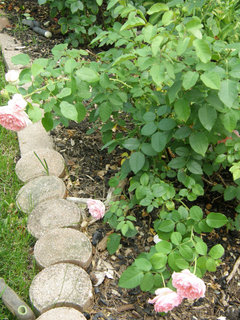
    Austins with low lying branches that root itself (like Radio Times) has better bloom production when it's older with extending root system. Below is my Radio Times as 12th-year own-root, 100% healthy. Pic. below shows 1/2 of the bush, taken in late July in only 4 hrs. of sun:


    I have Knock-outs and FlowerCarpet which were bought grafted-on-Dr.Huey when my daughter was 3, now she's 20. These have grown ownroots ABOVE the grafted bud. They are in soaking wet & poor drainage clay.

    Two lost Dr.Huey-rootstock completely when I dug it up, but they grew small own-roots above. Still abundant in blooms after 15+ years in only 4 hrs. of sun.

    The best blooming is from those with BOTH own roots above and Dr.Huey rootstock below.


    In contrast, Double-Delight which I bought 9 years ago as grafted-on-Dr.Huey NEVER grow its own-root since it's a dry spot (near a big spruce tree). This Double Delight bloomed well for the first 3 years, then it's a drastic decline in blooming in 4th year, and now as 9th-year grafted, I got only 5 blooms max per year !!

    Nearby rose park replaces Austin roses (grafted on Dr.Huey) every 2 to 3 years, and hybrid teas every 4 years.

    For VIGOROUS rose to grow its own-root above Dr.Huey-roostock, I topped it with 1 foot of fluffy soil, plus poor drainage clay below so it's constantly wet to rot Dr.Huey-roostock.

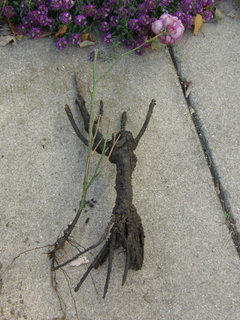
    Growing own-root above Dr.Huey is possible in high-rain climate, see below the big & chunky root of Dr.Huey, and the tiny own-root (on the left) that grew ABOVE the grafted-union. It's from grafted Pink Peace when I dug it up in a soaking wet bed:


  • 3 years ago

    All but two of my roses are grafted, most on Dr Huey and some on multiflora rootstock. All are healthy and blooming well, with a bunch of 18 year olds on Huey, and several 16-17 year olds on Huey and multiflora. In our alkaline, high desert soil, I don't see why they couldn't live for a long, long time. The exception is a grafted Blue Bayou, which I thought was pretty much dead, but has staged a comeback. This rose was from Hortico, and I've grown it for about 17 years. My two own root roses are smaller and produce fewer blooms than their grafted counterparts. Diane

  • 3 years ago
    last modified: 3 years ago

    It should also be noted when discussing the longevity of grafted roses that not all roses graft well to the rootstocks they're put on. Some varieties are not a good match for the understock variety, and they eventually fail from "incompatibility" issues that manifest as a decline in vigor and performance.

    There are roses that can thrive for decades when grafted to one of the most oft-used rootstocks, and there are some that are inclined to decline quickly after a few years of acceptable growth.