Software
Houzz Logo Print
marylandmojo

American Chestnut Tree

19 years ago

I was blown away a few days ago when a friend that I have known for 20 years, in a neighboring state, showed me 3 American Chestnut trees on his farm--3 trees that were not affected by the Chestnut Blight that decimated all other known American Chestnut trees in a period of less than 40 years (from about 1904 to 1940).

He's an old man, and when he bought the farm in 1940, the trees were present, and the previous owner said his father planted the trees at the end of the Civil War (1865), so they would have been 75 years old in 1940.

The previous owner told him that officials from the Department of Forestry had come to take a look at them, and documented the fact that they ARE American Chestnuts, and that they were unaffected by the blight. I don't know what year this was supposed to have occurred, but someone has surely forgotten it. Maybe it was done sometime before 1940, when the trees were dying so rapidly that no one knew HOW MANY were left, and might not have found it extraordinary.

I realize there MAY be American Chestnuts here and there, unaffected, and in googling, I noticed someone had discovered a small cluster in Pine Mountain, Georgia, or some such area. A picture of the guy standing next to one shows it to be about 6" to 8" in diameter.

Night and day from the trees I have just seen. These trees are HUGE by comparison. Of course I intend to measure and document them, but they appear to be approximately 3 feet in diameter, about 60 feet tall, with about a 60-foot spread. They are fruiting now, and THOUSANDS of Chestnuts are on the ground.

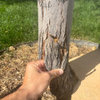
I think it was only the second time I have seen an American Chestnut, and there's no way of confusing it with an Asian Chestnut, from what I've seen. The bark is DEEPLY furrowed, with grooves as much as 3 inches deep in the bark. Leaves are much longer than Asian Chestnuts--from what I've read, Asian Chestnuts have leaves up to 6" long, and American Chestnuts have leaves from 6" to 11" long. The leaves on these trees average 8" to 10".

The trees appear very healthy, to be 142 years old. A few broken branches toward the top, which I attributed (guessed) to be broken by wind, or heavy cropping, combined with wind.

My question to anyone knowledgeable about Chestnuts (of any kind): I'm gathering all the nuts I can find on the ground, and intend to store them until next Spring, when I will attempt to grow them out. One source I searched said to put them in somewhat-dampened Sphagnum Moss in a plastic zip-lok bag, and refrigerate them.

I'm wondering why they can't be frozen, so I won't have to worry about them molding. Surely nuts that come from a tree that tolerates temperatures to -40 (F) can be frozen and remain viable, can't they??

I would think that in nature, in cold climates, the nuts are frozen over Winter, while lying on the ground, or under snow and ice, just as Acorns from Oaks (a relative of the Chestnut) are frozen over Winter.

So that's my question: Would you freeze the Chestnuts, if you were in my position?

Also, there are numerous (what appear to be) root "suckers" growing about the base of the tree. Is there a way to grow these out? I haven't probed to see if they are attached to roots--just guessing that they are. It would be great if they were free-standing, actually growing from nuts that fell on the ground, but that is doubtful, to me, because they are specifically located about the base of the tree--a strange place for nuts to grow, I would think.

I may attempt to root cuttings from these "suckers", if that is what they are. Can anyone suggest other ways that they would attempt propagation? Maybe a bit down the line, tissue culture would be in order.

I'll also contact NAFEX, to see if they have a Chestnut expert. They probably do.

Please don't post that I should alert all concerned autorities. The old man is still farming, and says he is too nervous and time-constrained to have people coming and going from his farm, regarding these trees. I'm respecting his wishes, and he has designated me the overseer of the propagation effort.

He tells me he has made this decision upon realizing that he--and the trees--are getting old, and he doesn't know how much remaining time either has.

My intentions are to photograph the trees, measure them, and try to propagate them in the manner I mentioned. I'll also photograph the nuts (which are also HUGE--the largest I've ever seen), and the leaves. Any other information or advice would be welcome and appreciated. I'll post on this forum the progress and (hopeful) conclusion of this experiment.

Comments (23)

  • 19 years ago
    last modified: 11 years ago

    Do not freeze the nuts. I can assure you that if you do, they will not be viable, come spring.

    Here is a link that might be useful: Growing American Chestnuts.

  • 19 years ago
    last modified: 11 years ago

    Oh i'd love to see these,they sound magnificent,and they got history in em! As for the nuts,I don't know about the freezing but will you be roasting any for Xmas? And as for the suckers are they thick enough to air layer? Altho actualy its a bit late in the year for that.

  • 19 years ago
    last modified: 11 years ago

    lucky:

    Thanks for the link--and a comprehensive one, at that. I know that Virginia Tech and the University of Maryland have had ongoing American Chestnut research projects, and I'll certainly contact the proper people at each. I'm going to try not to do anything dumb while attempting the propagation--like killing the seeds over Winter--and the link you provided is a good one.

    I intend to put some nuts in damp Sphagnum Moss and some in damp Peat Moss, in plastic bags, with pin holes for air exchange. I'll refrigerate them, but watch them closely for mold.

    I still can't understand why they can't be frozen, as that happens in nature. Maybe I'll freeze just a few in damp peat moss, also in plastic bags with pin holes for air exchange, to see what happens. Seems nearly identical to what would happen in nature.

  • 19 years ago
    last modified: 11 years ago

    "Do not freeze the nuts. I can assure you that if you do, they will not be viable, come spring"

    I have to agree with Marylandmojo on this - a species which is native where temperatures drop to -40C, with soil freezing depth down to half a metre or more (deeper than squirrels ever bury them), must have seeds that can tolerate freezing. It may require a careful, slow drop in temperature and with the right moisture content in the nuts (not too high, or ice expansion on freezing will burst the cells, nor so low that the nuts are dehydrated), but it must be possible.

    Resin

  • 19 years ago
    last modified: 11 years ago

    Maybe you could send some to the American Chestnut Foundation and tell them you wish to remain anonymous?

    You might could also cantact Ken Asmus at Oikos. He's an expert at propagating and breeding chestnut trees. Surely if you explain your situation they will understand.

  • 19 years ago
    last modified: 11 years ago

    A group that is interested in document old trees of great size is the Eastern Native Tree Society. They would love to have any photos and measurements of the trees.

  • 19 years ago
    last modified: 11 years ago

    If you have enough of the nuts, you might also try sowing some now in soil, outside, whether in pots or in the ground. Both would need rodent protection over the winter. If you sowed in pots, I would also give them some protection from sun and extreme cold - exposed pots can get some wild temperature swings, which wouldn't do sprouting seeds any good.

    It sounds fascinating - I envy you your glimpse of the giants of the past! And your task in keeping these remnants alive.

    It's not really my business, but.... Since your friend really wants to protect the trees, has he thought about putting a conservation easement on even the few acres the trees stand on? More acreage, of course, would be better, but to protect ancient American Chestnuts, most land trusts would be happy to put even 5-10 acres under protection. Easements are written individually, for the parcel in question, but carry on in perpetuity, protecting the trees long after your friend is gone. Certain activities, especially scientific/protective ones could be allowed, and could be written into the documents. Logging, etc., could be forbidden. There is a Land Trust Alliance, of local land trusts, but I don't now remember if it covers only the Southeast, the East or the entire US. I know Virginia has a number of active local land trusts, and would imagine that MD and the other neighboring states do too.

  • 19 years ago
    last modified: 11 years ago

    Thanks for the suggestions from all. The link "lucky" included was very informative about growing--how to protect them from squirrels and mice, etc.

    The largest diameter of these trees has a "snow drift" fence around it, up to about 6 feet, or so. I wanted to measure its diameter at 4 feet, as required by the Big Tree federation. That's what I always called the fences--a slat every 4 inches, or so, wrapped with wire, and completely encircling its base, put there to keep livestock from the tree, at some point in time. Couldn't tell if it was nailed to the tree, or just tightly wrapped, and have no clue (yet) how long ago it was put there. Trying not to bother the farmer too much during harvest time, but will ask him later when he did it.

    I had an uncle who took care of a 250-acre farm (100 hectares, for Europeans) all his life. Don't know how he did it alone, but he was always nervous from having so many different things to keep up with. I'll never know how he lived to 103--must have been the fresh air and sunshine.

    The largest tree appears larger in diameter than I thought--approximately 4 feet--and not as tall. Amazing how first impressions aren't always accurate.

    I weighed some of the larger nuts on a gram scale, and many weighed an ounce (28.34 grams) or a bit more--most others between 27 and 28 grams.

    Many of the nuts did not separate from their husks when they hit the ground, and I don't like the looks of that. I used to have a Chinese Chestnut in my yard many years ago, and the sound of falling Chestnut husks, with nuts shooting out of them like bullets as they hit the ground, is still fresh in my mind. That's the way it's supposed to happen--Hickory Nuts, the same--and when they're found in their husks, something isn't right. Appears about half of these didn't completely open, and some not at all. Genrally they mold and rot in their husks, when that happens. It's been bone dry back this way for the past few months, but don't know if lack of moisture would cause it.

    I've got to hand it to all those who keep Chestnut Trees in close proximity of their house--I couldn't do it. Had one in my yard many years ago, and my small children were always crying from having stepped on them, and the dogs were always limping around with the "needles" in their paws. The small "needles" separate from the husk, the same as needles from a cactus, and become imbedded in children's/dogs' feet. I had to cut mine down. amd don't believe I'd every want another one to deal with (in my yard).

    Know a guy who said, as a child, he used to pray every night when he went to bed that the Chestnut tree would die, because his father gave him the chore of picking up the husks, and he was always getting stuck by the needles.

    I know from the past few days that the "needles" even go through heavy gloves.

  • 19 years ago
    last modified: 11 years ago

    Regarding the freezing the seeds won't require it, so there is no need to take the chance of it spoiling them. The minimum amount of days - whatever it is for this species - below 40F will probably be perfectly adequate to overcome embryo dormancy.

  • 19 years ago
    last modified: 11 years ago

    Michael Dirr recommends 3 months cold stratification.

  • 19 years ago
    last modified: 11 years ago

    I'm with mdmojo - no way I'd want chestnuts in my yard. Those burs - egads! They'll go through tennis shoes, hate to even think about stepping on one in my bare feet.
    And, the stench of blooming chestnuts!?! Bradford pears smell like heavenly ambrosia in comparison.
    I like chestnut trees, but I don't want them close to my home; I'll prefer to view them from a distance - like a couple hundred yards or more.

  • 19 years ago
    last modified: 11 years ago

    marylandmojo, it's possible the Chestnuts are just very lucky & not blight-resistant. I found a single 14" dia, 50' one where I used to live in SW Va (the heart of blight country). It was apparently a sprout from a diseased specimen, so it wasn't resistant -- just lucky partly because of isolation. But you've got enough links & contacts to investigate -- the Amer Chestnut Foundation & OIKOS would be the first ones.

    Yeah, I have some OIKOS hybrid chestnuts planted as far away & downwind from the house as possible because of the potential flower-stench. Deer browse these like candy, tho.

  • 19 years ago
    last modified: 11 years ago

    "Those burs - egads! They'll go through tennis shoes"

    Really??

    If yes, that's a big difference between American Chestnut and Sweet Chestnut. Sweet Chestnut spines are fairly soft, I've often used my shoes to open the burrs to get the nuts out and never had problems with spines going through even soft shoes.

    Resin

  • 19 years ago
    last modified: 11 years ago

    OK, Resin, now that I think about it, I can't really make that claim for American chestnut - none of the C.dentata seedlings I've planted here have reached sufficient maturity to produce burs, and the two chestnut trees(I'm presuming they're Americans) up in the forest here on the farm have usually dropped their burs and split open before I ever think about going up there to look - and the nuts are gone.
    However, spines from the burs of the Chinese chestnuts will go through your tennis shoes at times when you're using your shoes to open burs that have dropped, but have not yet split open.
    Even so, I still don't think I'd want a chestnut in my lawn area.

  • 19 years ago
    last modified: 11 years ago

    m,arylandmojo, what I've done to sprout burr oak acorns ,which would be similar, is to put them in a large pot, I cut a plastic 55gal. drum into two 25gal pots, fill with a good potting soil then plant the nuts about 8in. deep and leave outside over winter. This will stratify the nuts and they will sprout and grow. If you don't stratify them they wont grow. I don't think freezing them would be a good idea. Grow them inm the pot for two years then set them out. Thats what I'd do. speaking from experience on acorns. james

  • 19 years ago
    last modified: 11 years ago

    White Oak Group acorns will sprout quite easily without stratification.

  • 19 years ago
    last modified: 11 years ago

    white oaks may not need stratification but if you don't plant them outside in the fall they won't sprout. You can't keep the acorns inside over winter and plant them in the spring. They won't grow. The chestnuts are very similar. The best thing to do wopuld be to plant them not keep them inside either frozen or drying out.

  • 19 years ago
    last modified: 11 years ago

    True. They'll dry out and won't be viable.

  • 19 years ago
    last modified: 11 years ago

    "The leaves on these trees average 8-10" long"
    You need more than that to document that you have American Chestnut. You could have Sweet Chestnut or C. sativa.
    Why don't you post a pic of leaf, nut and burr. I'm skeptical.
    Sam

  • 19 years ago
    last modified: 11 years ago

    Some old, surviving "American chestnut" trees may be hybrids between C. dentata and C. sativa.

    The most famous hybrid in the early decades was 'Paragon', which originated [before/during]1880 in Germantown, PA. Often sold in U.S. nurseries at least until 1907, it was the most widely planted nut cultivar, featuring larger nuts, borne even while tree is young. Hybrids can be very difficult to distinguish and there is often dispute as to parentage

    --A.L. Jacobson, NORTH AMERICAN LANDSCAPE TREES (1996, Ten Speed Press)

  • 18 years ago
    last modified: 11 years ago

    The american chestnut is the fastest germinating species i have ever seen. With all the germinating test i have done, they start germinating only two days only in warm temperature. This species is relatively easy to grow and fast growing, we are lucky to have some in Quebec. 4 month at 4°C in cold stratification.

  • 18 years ago
    last modified: 11 years ago

    Indeed, were it not for the Blight, they'd still be everywhere - they are a tough, fast-growing, yet large and long-lived tree.

  • 18 years ago
    last modified: 11 years ago

    Thought some of you might enjoy reading this!

    Rare chestnut tree still survives in Ohio

    State official let it slip that one mature tree stands in Ohio; its exact location is protected.

    Staff and Wire Reports

    Tuesday, March 25, 2008

    SANDUSKY For about seven years, the state's natural resources leaders have harbored a secret.

    They still won't reveal the exact location of it or allow outsiders to see it.

    This Ohio treasure's existence was closely guarded until last week when the director of the Ohio Department of Natural Resources revealed that a full-size American Chestnut tree still stands in a marsh near Lake Erie, the Sandusky Register reported recently.

    For tree experts, it's a big deal.

    American chestnuts that grew up to 120 feet once accounted for about 25 percent of the forests in the eastern half of North America until a fungus wiped out all but a few.

    'They are often referred to as the redwood of the East because of their tremendous size,' Gary Obermiller, a regional manager for the Division of Natural Areas and Preserves.

    The fungus was first detected in 1904 in trees in New York City, and by 1950 some 3.5 billion trees about 90 percent of the species were dead.

    Only a few trees had resistance to the fungus and survived.

    In Ohio, most American chestnut trees were found in the eastern half of the state.

    In August, the Dayton Daily News reported on the existence of a stand of American chestnuts anchored in a working sandstone quarry in Braceville Twp., Trumbull County, just west of Warren near the Mahoning River.

    The specimens that sit on a standstone knob are a handful, the tallest reaching 75 feet.

    According to the Register, the state's largest existing chestnut tree known only to a few until last week is in Sheldon Marsh, a 465-acre state nature preserve about midway between Toledo and Cleveland.

    The tree stands 89 feet tall and has a 5-foot circumference. 'To our knowledge, we don't have any that come close to this size,' Obermiller said.

    Most surviving chestnut trees are small, sprouting from the roots of trees killed by the fungus.

    Steve Maurer, the new chief of Natural Areas and Preserves, decided the public should be told about the tree, Obermiller said.

    'He realized this was a very special tree,' Obermiller said.

    American

    Chestnut facts

    American chestnut trees once made up about 25 percent of forests in eastern North America.

    The trees grew up to 120 feet tall and lived up to 600 years.

    Its wood was valuable because it was straight, light and rot-resistant.

    A fungus that eventually wiped out most of the trees was first found in 1904 in New York.

    All American Chestnut trees in New York City were dead by 1912.

    By 1950 about 3.5 billion trees about 90 percent of the species were dead