Software
Houzz Logo Print
radagast_gw

First amaryllis in many years...

17 years ago

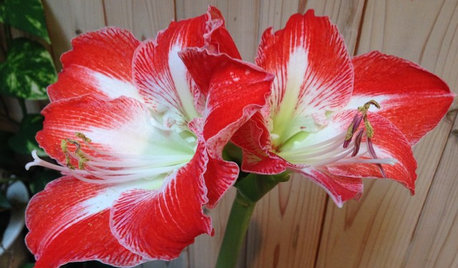
Thanks to the folks here who alerted me to the arrival of holiday amaryllis bulbs at Lowe's, Home Depot, etc. I was able to pick up a Red Lion amaryllis for $7 at Lowe's today. That seems a reasonable price for an experiment since I haven't had the best luck with these neat bulbs. About 10 years ago, I had several amaryllis - all basic ones in various colors - and I was never able to get them to reflower. I must have been doing something wrong, and I hope to correct that this time around.

Anyway, the bulb is now potted in a mix of about 50% basic Miracle Grow potting mixture and 50% vermiculite, which seems reasonable than the coco-peat brick disk that comes with the kit. The bulb is planted about half-way in the soil.

I think I'm off to a good start - light watering and some sun should be enough to get it to flower the first time. After that is the trickier part...

Comments (14)

  • 17 years ago

    Oh, I forgot to mention that I popped out some of the drainage hole disks in the pot - the basic pot they come in has "pop-out" disks in the drainage holes, but the instructions don't tell the grower to pop out any disks. I'd think not allowing for drainage would lead to rotten bulbs - better safe than sorry, IMHO.

  • 17 years ago

    Rad, good move on adding the drainage and not using the dried brick as potting mix. I made both those mistakes this past year and almost lost the bulb, but caught it in time. I've learned from that mistake! Alana

  • 17 years ago

    You are off to a great start it sounds like to me. Lots of sun and very little water with good drainage is key. We can't wait to see photos!

    -Frank

  • 17 years ago

    Welcome back to the wonderful world of Hippeastrums, otherwise known as Amaryllis!

    A few key points to remember are:

    Hippeastrum bulbs almost prefer to be treated like succulents, so remember to allow the soil ball to dry out in between waterings.

    Bright light is important for the bulb to be able to recharge. Indoors, a southern or eastern window should do the trick.

    Food is an essential part of getting your bulb recharged for its next bloom cycle, so be sure to feed. I use an average liquid houseplant fertilizer at about half strength every time I water.

    Good drainage and a porous medium will help the bulb to grow and keep healthy roots, and there's a lot of discussion here about what constitutes the perfect soil mix. I use a very bonsai-like, porous mix made with small pine bark pieces, perlite, granite chips, and a handful or two of vermiculite.

    Vermiculite has a tendency to hold moisture, as opposed to offering better drainage... a better choice for mixing with your potting soil would be perlite.

    But other than that, it sounds like you are off to a great start. Stick around, and you'll hear all about our different preferences for mediums, fertilizers, light sources, pots, re-potting and dormancy, breeding, etc...

    I've included a link that gives the basics on how to care for your bulbs so they re-bloom for you, and when to put them to rest for Christmas time blooming.

    I grow mine just as I would any other houseplant, and mine bloom on their natural schedule, which is spring.

    Feel free to ask any questions you may have... we're happy to help!

    Here is a link that might be useful: How To Make Your Amaryllis Bloom Again

  • 17 years ago

    Thanks for the information!

    It seems that they thrive on neglect (up to a point, of course) and bright sun. The bulb gets light from a big, south-facing window, so it should be good. They really do sound very similar to succulants in this regard.

    I'll keep you informed, especially as the bulb wakes up.

  • 17 years ago

    Hi there,

    You've got already very good advice so i just wanted to stress again on the importance of proper waterring. Waterever you do, do not overwater! My experience is that Hippeastrums are pretty tough ladies and are not prone to getting diseases or other problems easily. Overwatering on the contrary can kill them, and sometimes very fast! Mainly in combination with low temperatures (low would be under 15 degrees Celsius) Of course, they can resist lower temperatures, but as long as they are kept very dry. Here in Holland i kept them outside till the 4th of oktober, when temperatures dropped at night below 10 degrees Celsius. But they hadn't got any water for a long while.

    My advice: watch the temperatures. Also at night. I don't know exactly which zone you live in, but in this time of year where i live, temperatures go down at night. This is not so good for some tropical houseplants. For fortune, we have a kind of blinds we roll down at night (sorry, i don't know their name in English) and they isolate so well, that it stays nicely warm the whole night in our livingroom. Temperatures inside rarely go below 19 degrees during the night.

    I hope things go better this time and that you fall in love with amaryllis again :-)
    Veel plezier met je amaryllis! (enjoy your amaryllis)

    ~Lourdes~

  • 17 years ago

    Thanks for the encouragement!

    I'm going to be sparing on the water and treat it like a succulant. That seems to be the safe bet with most bulbs.

    Oh, I updated my profile (I hope) to show my zone. Yep, it can get cold here in the winter, so the bulbs won't be spending the winter outside.

  • 17 years ago

    I grew some Red Lions last year in some potting mix, and let me tell you they bloomed beautifully, BUT afterwards I started noticing that I was getting fungus gnats flying around the plants. So, this year, yes, I did use the brick disks they came in, but added some peat and vermiculite to the mix. And, I will watch that I don't overwater this time. Hopefully, no more gnats! Ugh!
    Anyone know of a good way to water from below instead of wetting the surface? That should also help with the gnats.

  • 17 years ago

    I wonder if using a wicking method similar to African Violets - but keep the potting mixture free-draining - would work? I'm no expert in soils... all I know is that most "typical" houseplant soils risk soggy plants, especially when talking about plants that like it dry.

    Fungus gnats are a pain! My mom had them go after her germaniums, and they were difficult to eliminate; less watering (letting the soil dry out) was one step that was needed to beat them back.

  • 17 years ago

    I'm affixing a link to an excellent information source about soils and water retention. The man who wrote the article is considered by many on GardenWeb to be the "soil guru"... I'm a definite follower of his theories regarding mediums and fertilizers, and everything related.

    I promise you won't be sorry if you take the time to read it all.

    I've completely switched over from regular bagged potting soils to what we call "Al's Mix"... which is comprised of pine bark fines, granite chips, perlite, and few other ingredients... the best way to describe it is a bonsai-like, porous, gritty medium that drains well and quickly, and allows for the exchange of oxygen to the roots and gases away from the roots, which is essential for healthy roots. It's mostly inorganic, does not decompose quickly and therefore, does not collapse.

    I've got a good portion of my bulbs planted shallowly in this medium, and I'm having very good results. I've still got a few bulbs in the old potting soil, and a few in very fine cocopeat... I plan to re-pot the remainder of my bulbs into the new medium, so I'll try to get some pictures of before and after, plus some shots of what the new medium does for root systems. I'll post my results when I get everything uploaded and put together.

    In the meantime, please read the article at the link... it's incredibly interesting, and I found it extremely educational.

    Here is a link that might be useful: Container Soils - Water Movement and Retention

  • 17 years ago

    Jeez, what is the poster (of the link) a college prof! Wow! Very detailed! I'll have to make a pot of coffee before I read that one!
    Informative I'm sure, and eductional. Some of those terms remind me of my college course in hydrogeology, especially when they speak of flow potentials! Too much right now for this brain lol.

  • 17 years ago

    I found that in order to grow healthy bulbs, I needed to learn about how everything coexists in a container environment. I needed to know how to grow healthy plants from the roots up. The articles written by Tapla over in the Container Gardening Forum are the best source that I've found for the information I was looking for.

    He breaks everything down into easy-to-understand terms... science wasn't my strong point in school, so I needed information that wasn't too technical.

    Once I understood how soil, water, and the plant all interact within the confines of the pot, and why, I was on my way to growing much healthier bulbs!

    Instead of settling for what the retail gardening industry sells as soil, I followed the instructions from the articles and mixed up my own brand of medium. It has made all the difference in the world for me!

    Where I once had rot and fungal issues, I now have healthy roots and no rot, whatsoever. Fungus gnats no longer have a place to breed. I have more control over moisture and fertilizer content... and my plants are happy!

    Once you grasp the basics of what Tapla is saying, and you understand the relationship of moisture, soil, and the roots within a container, it makes a lot more sense to steer away from organic potting soils that decompose fast and are too fine to offer the aeration necessary for healthy roots.

    I sound like I'm preaching, I'm sure, but it never hurts to look into new methods of growing... and when something new works for me, I like to share that information. Gardening is for sharing!

  • 17 years ago

    UPDATE: The Red Lion bulb is waking up! The upper neck and single tip of a leaf that is poking out have gone from pale to green.

  • 17 years ago

    Very cool! How exciting!

    Now, be very careful about your watering habits... and make sure the plant gets good light from a sunny window... and you should be on your way to growing a beautiful red flowered hippeastrum!