Software
Houzz Logo Print
dave_in_nova

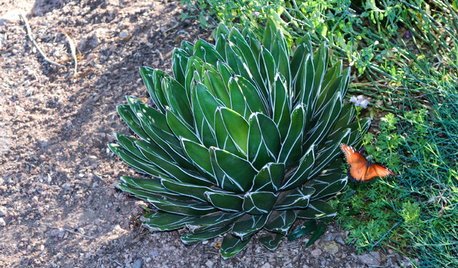
Please help ID hardy Agave

This plant has been growing outdoors in Frederick, MD, and it was a given to me.

It has a little cosmetic damage on some of the older leaves from the cold.

I'm hoping to get it settled into my garden this summer.

My best quess is Agave ovatifolia. We are a zone 7A.

Does that sound about right?

Comments (31)

  • 13 years ago

    Here's another photo for scale.

  • 13 years ago

    Good guess. It looks like a variety of Agave ovatifolia to me. Maybe "Frosty Blue". My two large ones got lacerated by deers butting it. I think they use iit to scrub off the hair on their new horns. That means I have a new buck in the area. Last one got run over. I have had does and their families so I guess there must be a guy out there.

  • 13 years ago

    Thanks Wanton. I'll look that one up. Perhaps it will become more evident once it gains some size.

  • 13 years ago

    Too bad about the damaged parts, but it's a gorgeous agave otherwise. Dave, I'm curious how cold it got at your place to get that damage?

    And I hope nobody minds me changing the topic a bit, but I'm wondering if 'Frosty Blue' is superior to the regular ovatifolia and worth the extra dollars?

  • 13 years ago

    I like the whiter ones better myself. The crenelated ovatifolias are my favorite.

  • 13 years ago

    Thanks for the comment Mara. I really like the wavy look too. Ovatifolia seems to have a lot of different looks/forms, which I guess shouldn't surprise me for an agave given how different some of my montanas look.

  • 13 years ago

    The plant is A. ovatifolia, and 7a may be pushing it. The good news is that it tolerates moisture better than many Agaves, and is a wicked fast grower. By mid to late summer, the ugly white leaves should be no more than a distant memory. The bad news is that it gets rather large, and may be challenging to cover as cold snaps push through in 3-4 years.

  • 13 years ago

    GermanStar and anyone, is this the best agave for a wet climate in zone 8 or a 7b perhaps? If I recall correctly, Chad in North Carolina has had good luck growing this agave and I think he is zone 7b.

  • 13 years ago

    GermanStar and anyone, is this the best agave for a wet climate in zone 8 or a 7b perhaps? If I recall correctly, Chad in North Carolina has had good luck growing this agave and I think he is zone 7b.

  • 13 years ago

    I think Cadec is your man to ask. I think the Agave proto-americana , or the one I have has seen cold wet winters sitting in red sticky clay here and it did alright in a 12 degree wave 2 years running. I also hear the Agave portrerana is a good one. She is on my short list. What ones are the absolute best, I can't tell you since I am 8b and I only get a few COLD and WET winters. LOphanthas alls seem to be quite resilient also. in those conditions. The trick is to search for cold hardy ones that live in NorthEastern Mexica mountains. I think he grow A. havardii outside in North Carolina.

  • 13 years ago

    Linda, I just picked this up from a friend in Frederick, MD, about 45 minutes to the North of me.

    I'm not sure what his low was this winter. Likely in the mid-single digits. It had NO covering whatsoever and has been in the ground at least 3 years.

    We're a bit warmer down here and I'm not opposed to throwing a clear plastic sheet over it in the winter time to keep moisture off.

  • 13 years ago

    Thanks for the suggestions. I think I have some lophanthas here, which I will have to try out. I say think becuase I also grew some lechuguilla at the same time and my labels faded long ago. I don't know portrerana and will have to google it. We've had a very mild winter - the coldest it got was -2C/~28 F.

  • 13 years ago

    Thanks for the info Dave. I missed your posting because we must have been typing at the same time. Mid-single digits sounds promising. I put plastic over some of my agaves, but not all of them.There are some parryi with no rain cover and they look pretty good and we've had lots of heavy rain at times this winter.

  • 13 years ago

    My spelling was off. Agave potrerana. I have getting the spelling right on this ALL the time. Here is a discription. I see three of them in my future. I have been trying to get a local nursery to find larger ones for sale. No luck so far.

    Here is a link that might be useful: Agave potrerana

  • 13 years ago

    In my z7, which I am just across into 7b proto americana 'silver surfer' is my best performer. Havardiana is bullet proof but extremely slow. Ovatifolia has seen some damage this year. They get so big and the rosette is very tight. Which holds water. But I am not complaining. It faired better than any parryi.

    Heres one of my ovatifolias.

  • 13 years ago

    Thanks for the link Mara. It will be a long time before I see it around here I suspect. If I keep hearing good things about it I might try some seeds.

    Except for the lower bits, that's a nice looking ovatifolia Chad. It will grow out of the damage pretty fast I bet/hope. I intended to get a couple of ovatifolias soon, but I'm thinking I will only get one and try 'Silver Surfer'. Here are a few of mine - I believe they are all parryi - that weren't protected from the rain this winter.

  • 13 years ago

    I love agaves. I grow the houseplant varieties due to there being no hardy outdoor variety for my clime ( zone 5a Albany, NY

  • 13 years ago

    I love them too and grow them inside and out.

    I was having a hard time posting another pic and hopefully this works. I forgot how to post several at once.

  • 13 years ago

    .This one is under an overhang, but it looks like it needs some nitrogen.

  • 13 years ago

    Linda,

    Did you know there's an A. ovatifolia here for your May visit? When customs heard it was for you I was waved through immediately.

  • 13 years ago

    Those are some nice agaves linda. Most of mine are now in a new bed at the edge of my back yard. They are not hardened if yet so they get a pot on top of them. No loses, just mushy leaves. Hopefully next year I will not need to protect them as I am plant 10 more that will need protection for a few years. Gentry 'jaws' took some damage, I am not impressed yet.

  • 13 years ago

    I have a Sansevieria that that color of blue. We had thre nights of 20F, no damage, even the San.came with out damage but I didn't water for three months. I am putting together a collectioin. We have several that surprise me, Norma

  • 13 years ago

    Jeff, thank you!! I guess I should thank customs too! ;-) I did not know that you did this. I know it was mentioned before, but I assumed you didn't end up having the room or time. Wonderful - I really appreciate it. The workshop is May 24-26 and the evening of the 25th (and possibly late afternoon) will be the only time that I don't have to attend, so hopefully that works for you.

    Chad, that damage doesn't look so bad, especially given the size of the plant. I grew some A. macroculmis from seed, and I believe macroculmis is considered gentryi now, and will go outside once they are larger. All of my montana had protection from the rain and they look good. Some, like the one in the pic, had minimalist protection - I'm sure qutie a bit of rain still reached them - and they are fine, mind you it was an unusually warm winter here. I also have three bracteosa with no protection and they are ALL damaged - very disappointing. I will protect them from the rain or move them to where there is an overhang for next winter.

    Norma, I wish I could grow Sansevieria outside, but it's usually just too cold and wet in the winter here. I tried one once because there was some spares after repotting and they melted pretty fast. I don't think it was even that cold, but they weren't blue.

  • 13 years ago

    That is so odd about the bracetosas. Mine are always tough as nails here. They flew through 12F with ease, 3 days of freezing rain where an inch of ice held in the rain that seeped below it. Trees fell over because the dirt became waterlogged under the ice. I wonder if there is variability in the source of where the bracetosa came from, Like how high up the mountain, ect., OR if they need to have a couple of years to harden off to their true hardiness. It could be that if these survived, they won't be as prone to damage in the next year. Living in hope and dilusion is fun. True my soil is very porous and they never have their toes in logged water.

    This post was edited by wantonamara on Sun, Mar 10, 13 at 19:31

  • 13 years ago

    I know - I've heard nothing but how tough they are and mine are planted in gravel on a slope. Maybe I will give them one more chance unprotected next winter and see how they do. I can always dig them out if it gets really bad. I'm always hopeful about these things and hopefully not too delusional about it. :-) Two are 'Calamar' and the other is the regular clumping form from Plant Delights.

  • 13 years ago

    Maybe this winter, protect them in place and then leave them to the elements next winter after that. I do not know how you experience your cold. If your cold comes in a constant even cold or if it comes in short dives down below freezing. We have short periods that we need to protewct so most of the time they are out in the elements..

  • 13 years ago

    It's usually mostly short dives here and maybe one or two longer bouts. It really depends on the year though. Even the -2 C low this winter was just one night. I could get used to this! It will be interesting to see how quickly they recover.

  • 13 years ago

    If that's all it got, I would suggest the bracteosa damage is from something else. Tough call without pics, but no way does -2C harm A. bracteosa.

  • 13 years ago

    I concur with GS. Definitely not cold damage. I stuck some in the ground with out roots in october and they are fine. They haven't grown any but not a stitch of damage and we got to about -C3 to - 4 this winter. Almost a non-winter. I had fresh rootless pups make it through 20F last years winter.

    This post was edited by wantonamara on Mon, Mar 11, 13 at 21:31

  • 13 years ago

    I thought it might be the combination of rain and cold. We average 45 inches of rain a year and most of that falls in the winter. Summers are dry. It seems that we've had a lot of dry days this winter, but there has also been some really intense, heavy rainfall in short periods. A rainfall warning is in effect right now.

  • 13 years ago

    Winter rot does seem more likely. You can tell by looking at A. bracteosa (being completely spineless and all), it must be a cliff-dweller (else it would have been grazed to extinction long ago), and unless I miss my guess, cliff-dwellers are far less accustomed than most to the kind of standing water issues than may manifest in winter.