Software
Houzz Logo Print
jenn_gw

Replacing thirsty plants, one native at a time

14 years ago

I'm considering converting areas of the backyard to CA natives, 1 small area at a time. One small area includes a Westerland rose against a fence, flanked by Clematis vines on each side (2 on one side, 1 on the other). I envision a small native tree (or large shrub grown as a tree) surrounded by smaller natives, and turning off the sprinklers around them.

Digging up these plants to save water seems a little like giving away a child to save money on food, LOL. Of course, I would offer them to a happy home.

Has anyone else committed this Rose/Clematis-lover's sacrilege and how did you come to terms with it?

Comments (20)

  • 14 years ago

    Definitely can relate. To me it was a matter of feeding me or feeding the plants. Guess who won!!
    I even went to the extreme of turning down the thermostat in my greenhouse to 45F. Needless to say I have lost plants that I did not want to lose but I am learning that less is best expecially when you want to do more with the time you have left other than take care of something else!
    Nonetheless, old habits die hard, as even today I had to say to myself: NO NO to a very tempting plant at eBay! Got to keep in mind that SSA leaves little leeway for extras and cutting back on controllable utility use is a good way to keep those dollars in your hand!

    Here is a link that might be useful: CA natives for drought tolerant gardens

  • 14 years ago

    I agree!It gets so much easier when you can no longer spend $200-300 a month in the summer on water and realize that you're nuts to do so. If you're still committed to growing, then you switch to less demanding plants. Everything here (that isn't already) will go to natives and / or extremely drought tolerant plantings....and there are so many wonderful plants to choose from. No problem....

  • 14 years ago

    I retired last year and the money tree isn't as productive as it once was. :) I have more time to water individual plants, but a lot less money to pay for that water.

    We made our first trip to the Theodore Payne nursery last weekend and were very impressed. Every group of plants is well-labeled with all details about the plant including soil type and community, and each individual plant includes its own tag. The setting is naturalistic and the staff is helpful. We're planning to return later this fall.

  • 14 years ago

    Doing a section at a time is a great idea. You may want to consider retrofitting the sprinklers to timed drip so that you can plant things that will need water once a month or during the winter if we get no rain.

    You also might want to draw out a plan for the entire yard first, so that as you work your way around, it all comes together.

    I think one of the main challenges is finding the money for hardscape or lawn replacement of some sort. If you plan out winding paths with small native trees and shrubs in wide beds you won't have to worry about that problem. I have been thinking about this for some time now- how to start building up a cheaper and bird-friendly garden one step at a time- a real challenge.

    Renee

  • 14 years ago

    One thing to consider is how well the native replacements will like the amended soil and watering methods that were used for the previous plants. It may not be enough to just cut down on watering time.
    Over and over I read that CA natives don't like amended soil (compost create a fungus friendly environment) and I have lost a few myself so I am not a skeptic. Secondly you will read that natives don't like drip irrigation.. this is harder to swallow, but I have had some issues in this as well. An occasional sprinkling of the foliage (natives can absorb water this way) may compensate, as well as keeping the emitters far from the crown of the plant.

    Lastly I would change "natives" to 'natives of Mediterranean climates' since the goal is to save water and still have fun doing it !

    Chad

  • 14 years ago

    I agree on the 'natives of Mediterranean climates'. I'm growing native salvias, toyon, rhus, etc.....but my absolute favorite tough plants are echiums / Pride of Madeira and others, and all of the various cistus. You do have to have room for these if you want to grow them to size, but I love them for hedges, etc. Mine are quite established and getting hardly any supplemental water now

  • 14 years ago

    I went through the same dillema. I'm always one to fall for big, frilly, fancy flowers (Hydrangea, Brugmansias, Cannas, Roses...) but made the switch over to drought tolerant plants, and I also did it in sections. You don't have to be restricted to natives (Although I do incorporate plenty of them in my garden). Like Chad mentioned, you can choose from an enormously wide variety of plants from places with similar climates. Do some research into plants from South Africa, Western and the interior of Australia, Central Chile and the Mediterranean.

    Some of my favorite plants are native to those places. And the best part of all is that there exists so much variety in textures and foliage color, that they don't need to be in bloom to look amazing.

    I'd suggest looking into some of the following plant families

    Leucodendron Species
    Protea Species
    Hakea Species - H. Laurinia is my favorite
    Grevillea
    Furcraea Species
    Agave Species - there are hundreds of exciting and beautiful species ranging from the gentle (Agave Desmettiana, A. Attenuata & Agave Vilmorniana), to the compact (Agave Victoria-Reginae, Agave Lopantha & Agave Parryi), and to the giant monsters like Agave Americana and Agave Ovatifolia.
    Aloe Species - Aloe 'Hercules', Aloe Alooides and Aloe Ferox are 3 tree aloes that come to mind.
    Eucalyptus - E. Torquata and E. Macrocarpa are two stunning smaller trees
    Brachychiton - B. Populneus and B. Acerifolius are two that come to mind
    Euphorbia Tirucalli - forms beautiful, multi-colored shrubs
    Callistemon species
    Carex - many varieties of grasses to add texture.
    Ceanothus Species - I've always had trouble with growing these inland.
    arctostaphylos Species - aloe hundreds of species ranging from low, ground-hugging plants to large tree sized plants. Also somewhat fussy, depending on the species.

    Just a few off the top of my mind to help you get started :)

    Here is a link that might be useful: You're welcome to check out my blog where I post about the transition every now and again

  • 14 years ago

    A little at a time is very do-able. Except for a 5 gallon lavatera I got on sale, none of my plants was larger than a gallon size when I put them in several years ago. Small plants take transplanting easier and you don't have to dig as big of a hole.
    I didn't put in drip irrigation because I heard that natives don't like drip. You don't have to go all native, either. There are drought tolerant plants from other areas that do well here.

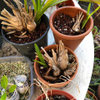
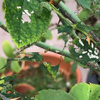
    {{gwi:523600}}

    I have more info about my transition to drought tolerant on my blog.

    Here is a link that might be useful: What's Growing On?

  • 14 years ago

    Interesting...I've found that roses and cannas need less water than I was led to expect. Good soil and mulching have helped a lot.

    I'm a cottage gardener so not big on CA natives. Mediterranean, yes, but even so good planning really helps. I grouped plants according to water needs, and my thirstiest plants are helped by runoff from a bed above them (it actually worked out great to be on a hillside, LOL).

    Also, we're in Northern CA so the cooler temps make a big difference, I think. I'm on the edge of the fog belt so unless we get one of our three yearly 1-week long heat spells, I can go 2-3 weeks between watering with soaker hoses. Helped along by our overall cooler temps, our water costs are $25/mo in summer, not counting all the irritating extra charges EBMUD likes to throw in, LOL.

    Some of my beds don't need watering at all, runoff keeps them alive. Meyer lemon, Japanese maple "Sango Kaku", aucuba, euonymus, solanum jasminoides vine, pelargonium, lantana, coleonema, evergreen iris - they're all living happily on no direct summer watering.

    The top half of this bed IS watered - it's my camellias, rhodie, callas and hydrangeas. But this bottom half, shown from the JMaple on the left to the edge of the variegated aucuba, is never watered:
    {{gwi:523601}}

    The vine on the arbor, RH side, is the solanum jasminoides vine, with liriope, vinca and iris underneath. Both this and the small rectangular bed facing it, with the T. heteromalla on the left out to the green-leaved lantana that borders the stairs, live strictly on runoff.
    {{gwi:523602}}

    These 'dry beds' aren't a big portion of our garden (I have two more long narrow strips that I occasionally water in summer when I think about them). We have a total of 15 different beds, but I figure every little bit we can save, helps.

    My project over the last year has been to convert all my planters to more drought-resistant plants, like sedums and crassulas. I've got my fingers crossed, I have a hard time imagining what the combinations are going to look like as they mature.

  • 14 years ago

    Natives don't like drip systems. This is because they don't want to have a deep watering, but if you have sand you can probably get away with it. If you have clay then I would not use a drip on natives. If the whole point is saving money on water, you can just sort of go around with the hose, or you can set the drip for less time. Since it does not rain here in the summer, the plants don't want a deep watering in the summer as that would go against nature. As natives they can survive without your help. That is the theory anyway. And yes compost will rot them out.

  • 14 years ago

    jkom51,

    I guess if you live in the fog belt of Northern California you can grow more demanding plants. I live in inland, central California so if I were to stop watering my cannas for more than a week, they'd wither and retreat underground haha.

  • 14 years ago

    Natives dislike San Francisco fog and lack of heat. They have always die on me. I really wanted to grow red hot pokers. But, you can grow non natives with much less water.

  • 14 years ago

    "Natives dislike San Francisco fog and lack of heat. "

    Well now doesn't that depend on the native? There are some CA natives to be found in foggy cool areas.

    Long term I plan to save just a few special roses and switch the rest of the garden to plants that need no water. We are the victims of a private for-profit water company and our bills are ridiculous--it's over $100 without using any water at all. I'm doing it slowly over time. Aloes, Agaves, South African plants, Mediterranean plants, Australian plants. There is so much to choose from. Aloes have spectacular flowers that rival roses. There is no need to limit yourself to CA natives.

  • 14 years ago

    Hoovb, that sounds terrible what the water company is doing to youguys. We have a flat monthly charge. I forget how much it is, but it is sure a lot less than yours.

    You should post a photo of your yard Hoovb! I think I remember seeing a photo of it once and it was amazing.

    Josh

  • 14 years ago

    Hmmm......they must not have put you on meters there yet.....My Dad always had a flat monthly charge before. I think his area went on meters just this last year.

  • 14 years ago

    my vague sense is that grafted roses may lose their graft, but selfrooted cv can't. I've seen roses grown dry. they flower in spring, then dry back.

    drip.
    streamside/watercourse plants should like drip. (grapes, brambles, bermuda grass, aesculus c., iirc oleander. poplar would like drip so much, it would soon clog your water meter :-) )

    ca natives have brief history of cultivation (nursery, hort abuse and hybridization, selection), so non-watercourse natives (diplacus?) likely lack hort-flexibility of non-watercourse ancient hort plants (perhaps olive is good example?).

    soil.
    suburbs are usually clay. most aesthetically popular dry plants are native to coarser soils (or are large)

    Reading years ago, I decided that all major Mediterranean climates differ significantly from each other. We grow plants without their native fauna and flora. so much is different...

    so, nothing beats (somebody's) hands-on research :-)

  • 14 years ago

    Thanks everyone for your great comments and suggestions. You are so right that CA natives aren't my only option for a drought-tolerant garden.

    I've decided to give this spot one more year and keep a closer eye on it now that I am retired. Mulch, mulch, mulch!

    tropical_thought: hoovb is right, there are natives suitable for your climate. The Las Pilitas site has a tool where you can search for your own plant community based on zip code, then locate the plants suitable for that community.

    Here is a link that might be useful: CA Zip code search at Las Pilitas

  • 14 years ago

    I suggest you do most of this work in Fall! If you are new to CA natives you will be losing lots of plants if you do the planting now.

  • 14 years ago

    I would second Las Pilitas! I love their website and list.

    You can also save money if you are removing lawn (I hear a nice layer of plain brown cardboard covered by a free load of tree guy wood chips will kill that lawn and get you some water free landscaped zones/walks. Some tree guys need a place to dump the freshly ground greens/trees but make sure you get good chips so you are not causing your soil damage in the future)

  • 14 years ago

    Thanks everyone. I've decided to move a few of the plants and keep the climbing rose (Westerland) growing on the fence. I probably will remove the Clematis due to its water needs, and replace them with a non-vining plant that looks good most of the year.

    I agree that CA natives aren't the best choice for this spot due to the amended soil and nearby rose. I'll keep the purple Verbena and add a few Daylilies, possibly some Iris, and something white like Shasta Daisies or the like. This spot is at the far end of the lawn, a distance from the patio, and long-blooming white blooms will light it up a bit at night.

Sponsored
The Creative Kitchen Company
Average rating: 5 out of 5 stars52 Reviews
Columbus Area Kitchen Remodeling and Refacing Professional