Software
Houzz Logo Print
ms_amanda

Cactus ID please

14 years ago
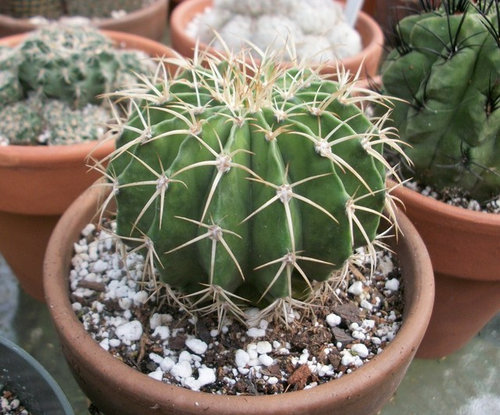
Hello, This is my first time posting, and I was hoping I could get some help IDing this cactus.

I've had it for a year now, but it hasn't flowered or else I would try to ID it myself. It seems to need more water than my other cacti because after watering it the same time as the others it still becomes skinny and is shriveling at the base. (This picture was taken after an unexpected rain, and it looks a lot better than it did before!)

If I knew what kind it was then I would be able to take better care of it. Any ideas will be appreciated! :)

Comments (12)

  • 14 years ago

    Could it be a juvenile melocactus before it forms its cephalium (Top notch structure with embedded flowers and seeds). It grows in the Carribean and more tropical areas. They hate cold and should never be allowed to dry up for a long period in winter.

  • 14 years ago

    If you can feel transverse ridges on the central spine, it is likely a Ferocactus. Transverse ridges are small ridges running the short way on the spine (hence the 'transverse'.) The best way to check is to run your fingernail down the spine. On some species they are visible, on some like F. hystrix they are hard to see but the fingernail can detect them easily.

    If there are no ridges, the acute angles on the ribs reminds me of a few Echinopsis (the old definition, not the new Echinopsis that includes just about anything with spines).

  • 14 years ago

    I have considered a melocactus or discocactus after searching the web a while back. IF it is a melocactus, how many years does it take to form the cephalium?

    I checked for ridges via the fingernail and they seem pretty smooth. So I guess I'll try to do more research into the Echinopsis species.

    Thank you both for your replies!!!

  • 14 years ago

    Ahoy! I found this pic labeled 'melocactus bellavistensis' It has a close likeness to mine. Is it safe to say that I have an ID? :D

  • 14 years ago

    I'd go as far as saying they're both Melos, but doesn't yours have six central spines and your example have seven? If so, no, it's not a correct ID.

  • 14 years ago

    I would say it is probably a Melocactus, but my practice is to not label it with a species epithet (the 'bellavistensis') unless you can know what the plant source was, or if you know the seed source. Some hybrids can look just like a species. DNA would clear up that question for sure, but I try to discourage a precise species ID unless you can have a chain of ID from the grower.

    As an aside, the genus (Melocactus) is always capitalized, and the species name (bellavistensis) is always lower case.

    Melocactus come from high rain areas (for cactus), and from warm places. Most are from the Caribbean Sea area and the areas nearby. This means that when you have temps like Cuba, keep it watered. When it is cool, keep it drier, but not bone dry like cacti from inland deserts. Although they are very sensitive to frost, a couple of species have tolerated freezing temps here when the heater failed. That said, your plant craves full sun (after acclimation), heat and a moderate amount of water. When the cephalium forms, the plant quits growing, except for the cephalium.

    When does it make the cephalium? It depends on the species and the care it gets. Some get quite large before maturity, and some, like M. zhentneri and violacaus can be grown in 4 inch pots. I think bella... gets about 8 inches in diameter or so. Not one of the little ones, not one that grow as tall as a human.

  • 14 years ago

    I thought most were from Brazil, with some being in the Caribbean and Cuba?

    Here are some cephalium here - Mr. James Pickering does Brazilian cactus right. I'm holding one but look at the cacti to the right of me.
    {{gwi:572442}}

  • 14 years ago

    Greetings Jeff. Brazil has the most species, and a few are fond in Peru and Ecuador, but some of the most common ones in the trade come from Jamaica and Cuba. A friend spent 2 weeks in Cuba 2 yrs ago, rented a car from Cubacar (where else? they are state owned and have a monopoly) and they drove around the island on the littoral road. He took some habitat shots of groups of what I think are M. matanzas and several other Melos for me.

    So yes, Brazil has the numbers, but the Caribbean species are more commonly encountered, and describing a Cuba climate is easier than starting to familiarize people with Bahia climate. Both are tropical with a dry season, both grow nice Melos.

    Mexico also has a species or 2. Minas Gerais state, just south of Bahia state in Brazil is the center of most Melos, and has a lot of nice cacti, most of them quite rare in cultivation, like the Discocactus. (Drool on the keyboard at the thought of visiting Mr. Pickering. Visiting you in SD was one high I got, I think getting that close to Mr. Pickering would cause heart failure.)

    BTW, is there still a Pickering website? Didn't he used to host the definitive columnar site a few years ago?

    (My name/handle is pronounced dzee-mwi-doh, means 'Please tell me' in a dialect of French. Now you know me?)

  • 14 years ago

    Dzitmoidonc,

    Pleased to meet you. I didn't know about the ones in South America other than Brazil.

    I would love to see them in habitat anywhere, but particularly this spot - I wonder if your friend went to this habitat? I cannot find the picture, but it shows Melocactus hanging off of a cliff that it jutting into the sea and the plants are no doubt getting salt watered.

    And here's a link to the Melcactus of Cuba. En Francais! Perhaps you or your friend wrote it?

    Here is a link that might be useful: I Want To Go

  • 14 years ago

    Hey Jeff. My friend is a farmer who travels, he can tell a cactus from a tree, but it stops there. His specialty is pomme fruits and stone fruits. Thanks for the heads up on the book though, it is in English for those who are Melo freaks.

    Pieter, from Belgium, now Spain, also has a good website about Melos in his in-laws country, Peru. For habitat shots. In English as well as several other languages.
    http://www.cactaceae.be/habitat.php?taal=en

  • 14 years ago

    I used to chat with Pieter when he posted on The Garden Forums, a forum a lot slower than it used to be. I enjoyed his posts.

  • 14 years ago

    @cactusmancharris

    I took a good look at the spination on my cactus and for the most part it has 7 spines, but some areoles have 6 or 8. Go figure.

    I'll gladly take your gentlemens' advise and just label it a Melo for now. And I thank you for your time and info. :)