Software
Houzz Logo Print
sunnysea_gw

Help with ailing Jade Plant

14 years ago

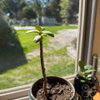
Last weekend I acquired some Jade plants. They were all planted in the same pot and for quite some time because the soil was like concrete and did not drain well. I bought cactus mix, washed the roots, pruned them and replanted them separately. Then I found out that this one (pictured) was rotting. I scooped out the rot and dusted with cinnamon as per instructions I've read here. Is there anything else I can do for this plant? After all I've done to it it's probably in shock. Also, I have kept it outside since Saturday when I acquired it, so that it can get some light which I think it has been lacking. Any other suggestions?

Comments (12)

  • 14 years ago

    The potting medium looks very peaty. I would recommend that you repot the plant in a grittier mix with better drainage. I have linked a thread that goes into a lot more detail if you are interested. For a quick fix, I would amend your soil with perlite until it is 50-75% of the potting medium. Do not water when you repot.

    Here is a link that might be useful: Container Soils - Water Movement & Retention

  • 14 years ago

    Thank you movenpick, for the advice. I felt that it was over potted as well so I replanted it in a smaller pot with a gritty mix containing a lot of perlite, and did not water it. I hear about Jades being over potted but don't know what damage it causes. Does anyone know what happens to a Jade plant if it's planted in too large of a pot?

  • 14 years ago

    It's not the pot size that determines whether or not a plant is over-potted, it's your soil choice. If a soil holds no or very little perched water (the water that occupies soils made of fine particles, and stays at the bottom of the pot, refusing to drain), you can pot the tiniest little slip-of-a-plant in a 55 gallon drum if you wish - without worry about the plant being any more susceptible to root issues than it would be in a tight-fitting pot. You only need to be extra cautious about over-potting when the soil holds perched water, with the greater the volume of perched water held, the greater the risk of problems (root rot and compromised root function)associated with soggy soils/over-potting.

    The link provided above will provide you with a good working knowledge of soils suitable for container culture. In my experience, gaining an understanding of how soils work and how to tell good soils from poor soils is the largest step forward a container gardener can take at any one time.

    {{gwi:1295}}

    Al


  • 14 years ago

    Al is absolutely right.

    When I potted Jade cuttings in a large container...the result was fast, dynamic growth.
    I used a gritty mix, and I fertilized and watered copiously (once a week at least).

    The bad news about the Jade in the picture is that it appears you've cut through several
    nodes/internodes down the length of the trunk. I'll be truly amazed if the Jade survives.


    Josh

  • 14 years ago

    Thank you all for the great information. Tapla, I have always wondered about over potting and I guess I assumed that was about an over-sized pot. Thank you for clearing that up. I now have it potted a amazing well draining gritty mix that doesn't hold water. greenman28, thank you for the suggestion as that I have many more that came from my Jade acquiring last weekend that I have probably over pruned and I am hoping for some new growth this summer as that they now have no leaves, here is a picture of one of the other ones. I am trying to care for the plant pictured above extra well as that I am hoping it survives from the rot. I cut half of it out and carefully lifted the rest out in an effort to minimize the damage. I hope it survives the base is the largest trunk I have.

  • 14 years ago

    Anyone have any idea how long it will take for new leaves to grow. Some posts have said 2+ years, I'm really hoping it won't take that long. Also, how long should I wait to water after re-potting?

  • 14 years ago

    How long it takes for leaves to grow depends mostly on the size and health of the root system, which is where a good amount of the initial energy for pushing a new flush of growth will come from. If the root system was large & healthy at repot time, you should see evidence of new top growth within a few weeks or less.

    I think the large wound in the first pictures isn't a big concern to the plant's survival. You could probably cut a healthy plant into 2 plants from top to bottom and have both halves survive. I've seen that done as a novelty to Adenium and several tree species. I think the larger concern is probably the fungal infection that precipitated the necessity of having to carve out the rot. I think it might be a good idea to treat the plant with a systemic fungicide at the earliest opportunity. Bayer Advanced Disease Control for Roses, widely available over the counter, has Tebuconazole in it, which fits the systemic fungicide bill. I've used it for a number of fungal problems that already had a foothold, and it acted very well as a fixative. I also use it prophylactically on several species of bonsai prone to needle cast (hard to cure). Tebuconazole is also available in Bayer Advanced 3-in-1 Insect/Disease/Mite Control, which has the systemic fungicide, a systemic insecticide (imidicloprid), and a miticide. Be sure you don't confuse this product with the 3-in-1 product that has fertilizer if you use it - they're very different.

    Al

  • 14 years ago

    Hello Al, Thank you for the tip on the Bayer Advanced 3-in-1 Insect/Disease/Mite Control. I will go get some today. Do I need to spray all of the plants that came in the same pot as that one? Most have no leaves left, I cut them off because they were dirty and dusty and I felt that the whole thing needed a fresh start. Also, should I spray the wound or avoid it. Do you recommend that I cut all of the other leaves off down to the stem and spray the stems? If so for how long? I will have no way of knowing if it is doing well or not since there are little to no leaves left. Included is a photo of all of the plants in question from what has now become the Jade Acquisition Fiasco of last weekend. Thanks again for all of your help.

  • 14 years ago

    I wouldn't remove the foliage. I'd spray the entire plant, including the wound. I'd try to keep any excess mix from getting into the soil - just in case the vehicle is rough on roots, and I'd spray at least 3 times at 2 week intervals - I think that's what is suggested on the container. You can get it in 3 forms. Concentrate, a spritzer, and hose end sprayer. Opt for the concentrate or the spritzer.

    You might just consider sticking a wick in each pot to help drain excess water after a rain or thorough watering. Allow the wick to dangle below the pot or rest on the soil, and it will help remove any excess water there might be in the soil.

    Best luck!

    Al

  • 14 years ago

    Thanks Al, They are outside but I actually only moved them altogether on the grass so that I could get a photo of all of the ones in question together. I am keeping them on a covered patio that gets lots of sun and no rain. I will control the watering rather than letting the rain do that. I haven't watered them since they were replanted again yesterday. I guess I'll give them a little water over the weekend after the treatment. How will I know if the treatment has worked? Now that I know they are compromised I don't know if I will ever bring them inside which is unfortunate because I was hoping for them to be indoor plants. Actually, I only wanted one, I got a little more than I bargained for with all of these and I'm not sure what I'm going to do with them all. At this point I'm hoping that at least one survives this ordeal and I can successfully rehabilitate it enough to bring it indoors. Does anyone know why the trunk on these are rough, I thought Jade plant trunks had a smooth finish? I have other Jade plants though and they are all so different. Is there a chart somewhere that shows what kind of Jade is what? Here is a photo of all of my Jade plants, I have no idea what is what.

  • 14 years ago

    I don't know, Al...seldom would I gainsay your advice, but that wound is *profound*...
    I haven't ever seen a Jade respond favorably to the loss of multiple nodes/internodes.
    But this will be an interesting experiment, and I may learn something new about Jades :-)
    I do know that the Jade I accidentally froze did develop some scar tissue on its damaged side...
    but that was freeze-damage, and I just let the thing heal on its own.

    Sunny, Jades have varying texture to their trunks. It's actually what drew me to Jades in the
    first place....that grey, elephantine skin. Some Jades are brown, some silvery-grey, some
    slightly hairy at the nodes, some crackled and flaking with rough bark....although most will
    develop the crackled, rough bark with age.

    As far as I know, there is no comprehensive chart or page that shows the different Jade cultivars.
    It's something that I've entertained for quite a while - but I haven't gotten around to it. The
    leaf-size, the shape and pattern to the leaves, and the bloom color are the best indicators of
    unique varieties. To add to the confusion, cultural conditions (how/where a Jade is grown)
    can greatly impact the appearance of a plant. A droopy, deep green, large-leafed plant in a hotel
    could exhibit upright, brightly colored, compact leaves if grown outdoors in southern California.


    Josh

  • 14 years ago

    Hi Al, thank you for the great advice. I'm unclear about wicks are there plant wicks? Or is it something I make on my own?

    Josh, thanks for the info too. I will do my best to make this Jade a success story and keep you all posted.

    Again, thank you all for such great advice.