Software
Houzz Logo Print
hijole

Beach sand is No no.

15 years ago

I know all you guys are out there and it's a holiday weekend but don't forget the Forum: Beach sand is a Not a substitute for fast draining soil. I used to think, I love the beach look at all the cacti & succulent mix I found; some say to mix sand in your mix but Not beach sand. Not only is is to rich in salt but it does'nt drain fast enough and the water just stands there. Anyone ever tried it though? share your results.

Comments (23)

  • 15 years ago

    Sand of any kind is a no no. The problem is that sand has such a small particle size that it maintains a very high perched water table when saturated. Roots below that level will quickly die without access to air. I wouldn't imagine salt would be a problem though, as any soluble salt is easily rinsed from sand. Gravel of 1/8" or more is a much better choice, though.

    And personally, I never liked the look of sand in pots. I much prefer coarse gravel if one wants to add a top dressing. It stays on top better as well.

  • 15 years ago

    Yeah, I think you're much better off with screened grit (crushed rock) rather than sand. Some finer sizes of grit give you much of the visual effect of sand, but with much better drainage. And the slightly coarser sizes work for me both as a top dressing and an aggregate component of my soil mix.

  • 15 years ago

    Before I found the sound advice of these lovely folks here, I mixed beach sand and potting soil for my trough.
    {{gwi:591014}}
    I built the trough to grow lettuce but found out quickly that lettuce likes to be in the ground here.
    I had a handful of succulent cuttings from my neighbor which I was actually rooting in water, (shows how much I knew then), so I decided to throw those in the trough. I put lots of plants in the trough that summer.
    Over time, the sand has separated from the soil. Though many plants have rooted succesfully or even thrived in this mix, some have died, failed or are not performing.
    I'm in the process of removing most of these plants and replacing the soil.
    For a long time, I used Kellogg's Cactus Mix which hasn't been bad but has more fine sand than I'd like and requires a bit of intuition.
    I've been experimenting with amending the Kellogg's with different materials for a while with decent results. Still working on finding good, cheap particulate in my area. Point is, I learned my lesson.

  • 15 years ago

    Phew! For a second I thought this was going to be a contradictory post saying, "You guys are crazy! I grow my plants in pure beach sand and fertilize them with old coffee, and they grow so well I win prizes at my local CSSA affiliate."

    In seriousness, sorry to hear about your trouble! That looks like a cool planter with great stuff in it. It is strange, isn't it, how tricky the supply angle is? ... when you're looking for large quantities of material... good for cactus and succulents... cheaply and locally. I think this is why people keep going back to perlite as a component, even though it has drawbacks. It's a serviceable standby.

    I spoke with nursery owner Phyllis Flechsig at her sales table yesterday.. she had 1/2 cubic yard of pumice delivered to her growing grounds. She said it took her forever to get through it, but she finally did run out. And... speak of the devil... now that it's gone, she is back to using a lot of perlite, because it's cheap, easy to get and lightweight.

  • 15 years ago

    Hope I'm not going off-topic but had a quick question.

    "Fertilize with old coffee" - Is this bad? I remember there was this huge thing about using leftover coffee because of tannic acid for schlumbergeras.

  • 15 years ago

    Well... I don't grow schlumbergeras at present. I was just rhetorically reaching for a modestly kooky, urban-myth-like practice.

    Coffee on plants is slightly controversial. It's probably fine on the garden. It probably breaks down quickly there. Or if you pour old coffee in the compost pile and then let the microbes in the pile do their magic. I wouldn't use coffee or grounds -- uncomposted -- on my container plants, for all of the reasons (but perhaps with less of the zeal) they bring to the topic over on the container gardening forum.

    I've seen mold form on old coffee, and I'm not going to pour anything in my plant containers that I've seen form a layer of mold when left to sit.

    Some folks say some of coffee's alkaloids are not favorable to other plants, so that would be bad. It's definitely not a substitute for fertilizer. I suppose it might lower pH... but for my plants, I'd stick to more standardized products for that: vinegar, citric acid, HCL, Ammonium Sulfate, or whatever. But hey, if someone experiments with it and it works for them, I have no quarrel with their using it on their plants. I've heard of crazier things.

    [Gosh that was wordy... but I'm going to sleep rather than work to make it shorter.]

  • 15 years ago

    I absolutely agree that beach sand or any fine particle sand is not a good idea to use in any potting mix.

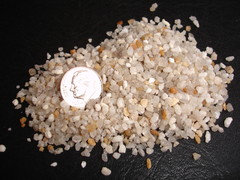
    The only sand that's okay to use is "Silica Sand"...here's a picture of what I use and its very coarse.

    {{gwi:30705}}
    Here's the bag.
    {{gwi:54377}}

  • 15 years ago

    Silica just refers to the primary composition of the sand, SiO2. Beach sand from most temperate zones is also silica. The primary issue here is size. According to geologists and other experts on these matters, the particle size of sand goes up to 2mm. Beyond that you have gravel. So the sand pictured above may more accurately be called gravel. I prefer particles of at least 3mm since that is about where the perched water table disappears and roots are no longer submerged after watering. So I look for products labelled grit or gravel, and avoid sand since it is usually too fine.

  • 9 years ago

    ... I just "came across" this thread... and I'm literally bumping my head against the wall! I naively also thought that a layer of beach sand at the bottom of my pots would be a good idea for better drainage. So I have all my terrace pots with a 1/4 inch layer of fine BEACH sand and then regular soil. And I have planted all sorts of plants: peppers and tomatoes, roses, marguerites and selenias, cactus and ficus among other things. Now I'm dreading that the sand might kill all my plants when the roots reach that layer. Is there anything, short of removing the soil and the sand and re-planting, that I can do?

  • 9 years ago

    Sounds like it's not much sand, maybe extra watering can leach the salt out? Hard to say without knowing how salty the sand is and what size your pots are, therefore what proportion is beach sand.

  • 9 years ago

    Layer of fine beach sand at the bottom of pot topped with 'regular' soil doesn't sound like it would improve drainage. What is regular soil? How are the plants doing? Do you have photo?

  • 9 years ago

    Wow, Though Hijole came back! Wonder how he is?

    Any sand or soil mix works for some due to growing conditions and temp. For me, fine sand is a killer. I use a coarse grit mix, and it works well for me. I live in zone 6 and winter time is the worse time for me. Cold plus water equals death.

    Fine sand mix is great for mortar or cement.

  • 9 years ago

    Agree, Stush...

    I also wonder about Hijole.

  • 9 years ago
    last modified: 9 years ago

    As with many other issues, I suppose there are different views... but being a newbie and after having read different responses, here and elsewhere, I'm more inclined to accept that beach sand is not a good thing. Thanks for your input :))

    @lisasfbay9b

    I would say the proportion is say 1 to 8 in the smaller pots, 1 to 15 in the medium-sized ones and way bigger in the others, so yes, it might not be such a drama after all. As I said, the intent (alas, how mistakenly it seems now!) was to have a small layer of a material which, in principle, would always be dry (beach sand doesn't retain water, right?) so when the plant roots reached that level at the bottom of the pot they wouldn't be soggy or wet in case I over watered, hence they wouldn't rot. Yes, all the pots have holes, I'm newbie, but that I get! As per how salty... I'm not tasting it, huh (LOL!), seriously, I wouldn't know and I don't have the equipment to measure it. I can only say is natural beach sand from the beaches here in Barcelona. It's very fine sand. As per salting it out, well, since there are plants in the pots I don't want to overwater and then kill them.

    @rina_Ontario,Canada(5a)

    Regular soil means (to me as a 'city dweller') standard bagged soil you can purchase in 5,10,20 and 50L bags at most garden centres, and I believe in English is referred to as "potting soil", right? As per how are they doing, well, some are doing fine others no so much, but (a) it's been a recent plant out and (b) those that are not doing so well it might just well be that I'm a newbie and perhaps I'm watering too much, or perhaps they are too exposed to the sun.... or a thousand other things I might be doing wrong. As they say "always walk through life as if you have something new to learn and you will."

  • 9 years ago

    Now... I wouldn't want to abuse your time... but if anyone feels like spending some of it helping me with tips (especially regarding watering, temperature and sun exposure) on the different plants I have...

    • pericallis × hybrida
    • silene pseudoatocion
    • alocasia odora
    • aloe mitriformis
    • asparragus plumosus
    • yuca
    • crassula ovata
    • graptopetalum
    • sedum morganianum
    • sedum rubrotinctum
    • rose bush
    • ficus benjamina
    • avocado tree (from seed)
    • poinsettia
    • schefflera arboricola
    • polygala
    • aucuba japonica

    and also a few pots with

    • spring-onion
    • onion
    • tomato
    • pepper
    • garlic

    Everything was bought locally.


    ... I would really appreciate it -hey, maybe I learn something I'm doing wrong! I have obviously searched online and found lots of info but sometimes the little tips and tricks are those that make the difference.


    Thanks

  • 9 years ago

    Those plants are as different as night and day. I'm still learning myself and have a similar collection. I know mulch and humus in the soil is always a good thing. I think all plants like to dry out first before being watered but succulents can go much longer between watering. Not much help. Sorry.

  • 9 years ago

    cokie

    I'll be quite brief:

    typically, succulents will require watering bit less often than some other plants. What I use for succulents, is very grainy and inorganic mix. No sand, I find that fine sand will form layer that drains very slowly. Grainy sand is different - I would sift the sand using kitchen sieve, and use only what remains in it. Anything that falls thru (same for perlite and other substrates) is too fine.

    Growing tropical plants, perennials and vegetables in containers requires very good drainage just the same. I use mostly mix of lots of small bark, quite a bit of (sifted) perlite, add some grit and smaller amount of 'soil'. No layers of anything, all should be mixed well. All pots are in full sun (after acclimatizing them when they go out after winter indoors; same as veggie seedlings that I start indoors) and watered as needed. Some are 'water hogs' - like brugmansia; they get water 2x/day on some hot days. I try to use rain water as much as possible.

    Most of the pots sit directly on ground and drain very well. Smaller pots of succulents are on various shelves and sometimes shifted around.

  • 9 years ago
    last modified: 9 years ago

    Wow, nice to finally track down Greg ... I miss him, too and think I'll go stalk him a little on FB! Thanks for reviving this thread.

    Sand ... While beach sand is a no, no, due to its high salt content & fine grade, I use sand in my cactus mix all the time ... course river (construction) sand. Recipe is 3 parts soil, 2 parts perlite, 1 part course construction sand, a dash of Osmocote slow release fertilizer, mix well & serve. All my C&S are happy in this substrate.

    I add 3 parts bark for my Adeniums & Plumeria. Orchids, Epis (incl Christmas/Thanksgiving/Easter & Oxypetalum are in a chunky bark / perlite mix for maximum root aeration.

    Maria Elena

  • 9 years ago

    Maria Elena

    As you said, the key word is coarse sand. And in your climate I can see why 3pts of soil.

  • 9 years ago
    last modified: 9 years ago

    Exactly right, Rina ... tweek recipe to your climate. I've also done 50/50 soil & perlite. My substrate dries out super fast in our high humidity, tropical climate. Here's what it looks like:

    Maria Elena

    PS: Josh, couldn't find Greg. If you touch base with him, please ask him to come by and visit us little people.

  • 9 years ago

    Here's the inside of that Silica sand, I noticed the picture is gone...I'll repost.

  • 9 years ago

    My biggest mix uses Poultry Grit which is granite chips. Comes here in two grades, large and small. I use the small for huernias and seedlings and the large for all else. Sold at feed stores for about $8.50 per 40 lb. bag. Some fussy plants are in 90 to 100 % grit.

Sponsored
AIS Renovations
Average rating: 4.5 out of 5 stars15 Reviews
Custom Craftsmanship & Construction Solutions in Franklin County, Ohio