Software
Houzz Logo Print
mehearty

Damaged stem at base

19 years ago

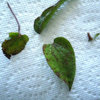
My 2 year old Jackmanii was just starting to grow again after a long, strange winter & a hard prune. This morning I was watering (unheard of to have to water in spring in New England! =-O ), and I saw the little guy flopped over & all wilty. I saw that it appears that either some stupid varmint started to chew the stem or some equally crazed cat or dog stepped on it. The break only seems to go about 1/6 into the stem however it is right near the ground. I leaned it's 2 little branches back on the trellis & mounded a coupla handfuls of topsoil around the base where the wound was hoping it will fuse itself back together. I thought about taping it. Is it possible to save this stem? It's the only stem coming from the ground.

I lost another Jackmanii to wilt last summer (grrrrr), and I haven't seen a new stem poking through the ground yet. I'm pretty sure that guy is a goner.

Any advise would be greatly appreciated.

~MH

Comments (6)

  • 19 years ago

    MH, first off I don't think you lost Jackmanii to clematis wilt last year. Jackmanii is considered to be in the viticella family or at least have viticella genetics in its heritage and those types of clematis rarely if ever get true clematis wilt. A clematis can wilt due to a variety of reason totally unrelated to clematis wilt as you can attest since your plant with the broken branch wilted.

    Your situation points out the need for all clematis to be buried 2 to 3 inches deeper in the ground than they were in their original pots. Doing so buries dormant nodes that can be called into play when the top growth is broken off as in your case.

    My opinion is that, if you did plant it deeper in the ground than it was in its original pot, you should cut it off and allow the plant to come back from its crown. If you didn't plant it deeper, then doing what you did is probably the best course of action although the stems more than likely will not fuse back together and could be an opening that could allow bacteria to get into the vascular system of the plant.

  • 19 years ago

    I had a stem badly twisted, almost broken last year on clematis Warsaw Nike, perhaps 5' above soil level. I attached a small twig to the stem along the broken part, wrapped both together with a soft, wide string, and tied them to a support in such a way that the broken stem had no chance to move in the wind and break even more. This worked - the stem survived and bloomed - but only for the summer. I cut it off, dead, this spring. Also, I once bought a clematis plant which had a twig broken at the height of about 3'. I asked the nurseryman if I should cut it off and he said no, you'll see flowers on it, just tie it to the support, you'll cut it off later. "Dressing a wound" on a clematis seems to be a one season solution. In my opinion, these plants really need protection from traffic, at least when very young (I've never had an old clematis - my oldest is perhaps 5-6 years old).

  • 19 years ago

    Thank you =) It perked up a lot yesterday & even grew so I'm relieved.

    nckvilledudes they are buried a few inches below the soil line so I've been anxiously looking at the grown near the one I lost. I DID lose it wilt as rare as that is for a Jackmanii. I wish I hadn't, but I did. =)

  • 19 years ago

    MH, in studies done by a university, most clematis that die from supposed clematis wilt, do not have any of the fungal agent that is thought to cause it in the plant material. In fact, there are still many out there that debate what the true cause of clematis wilt is. Some people think it is a fungal agent that causes the disease. Some people have postulated that since it is a disorder that attacks the vascular system of clematis, that is might result from a plant having too much top growth for its root structure to support. As a result the plant's top growth collapses to allow the root system to develop more to be able to support the top growth. If this is the case, I wouldn't write off your older Jackmanii yet. Some people have had clematis wilt and have the affected clematis come back 2 or 3 years later.

    Also, true clematis wilt is characterized by the plant wilting almost overnight and the leaves turning black or brown at the same time.

  • 19 years ago

    I had a similarily damaged Mrs. N Thompson this year. I took some florists tape and taped the pieces back together and it perked right back up and hasn't seemed to have suffered from its injury one bit. I'll leave the tape in place for about a month or so and then remove it and see how it healed.

    ~Chills

  • 19 years ago

    I don't know why I had a hard time finding this thread today. Thank you all so much for the info. I'll try the florist's tape Chills, thank you.

    Nckvilledudes thank you for the scoop. "Also, true clematis wilt is characterized by the plant wilting almost overnight and the leaves turning black or brown at the same time." That was exactly what happened to that Jackmanii last year right as it flowered. I posted about it here and was surprised as a lot of others that a Jackmanii got the dreaded wilt (or a similar disease). That's interesting that it may spring back up in another year. Thanks! =)

    Thanks for all the suggestions everyone!

    ~MH

Sponsored
CHC & Family Developments
Average rating: 5 out of 5 stars5 Reviews
Industry Leading General Contractors in Franklin County, Ohio