Software
Houzz Logo Print
pondluvr

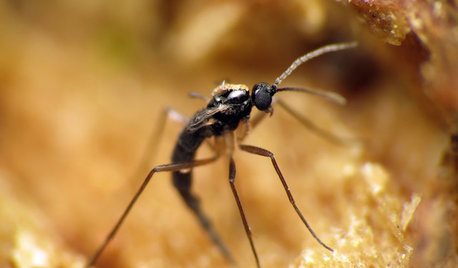
Fungus gnats!

15 years ago

I have a nice dish garden full of different succulents. It has been planted for well over 6 weeks now, and is doing well. I have not even watered it yet, following everybody's advice of "when in doubt, DON'T water". Everything is doing great, except for the past several days, I have been noticing fungus gnats. Yuck! As I understand it, they like it moist. I don't understand as the potting media is on the dry side after not having any water for this long. I don't know what to do to kill the little buggers, because I don't want to apply any water to the plants right now. They are not ready to be watered. But these things are driving me nuts. I'm tempted to unpot the whole thing and replace the media, and then repot, but I really don't want to disturb the roots. Anybody???

Thanks,

Sandy

Comments (17)

  • 15 years ago
    last modified: 11 years ago

    What kind of mix are they in? I've never had a problem with fungus gnats in the mix I use for my succulents and cacti which is very gritty. The only time I deal with them is when I'm using a peaty mix or a mix high in organic matter. You need moisture for fungus gnats so maybe your mix isn't draining well enough, especially if you haven't watered in a long time.

  • 15 years ago
    last modified: 11 years ago

    Yes, this has me truly perplexed. I bought the bagged cactus mix (I think Miracle Gro), then mixed it with 50% perlite to loosen it up and provide even better drainage. Nothing else was added except I top dressed with some largish polished stones bought at the dollar store. It's larger than pea stone. I just don't get it. I bought a soil tester (battery operated) awhile back, and it says the soil is dry (almost in need of water). I know the tester is accurate because I use it for all of my houseplants.

    I'm truly stumped.

    Sandy

  • 15 years ago
    last modified: 11 years ago

    You need to let the soil dry out completely. Use no peat either as it attracts fungus gnats. The soil has to dry out long enough to kill the fungus gnats eggs. I let my succulents dry to the point they start to wilt and then water and in a few hours drain off any excess water. Most soil moisture testers are not accurate enough for succulents. If you don't want to change the soil you can put decorative stones or sand on top and the gnats can't get to the soil to lay eggs.

  • 15 years ago
    last modified: 11 years ago

    Top dressing can trap moisture. Also Miracle Gro's cactus mix is mostly peat, still. If you're stuck with Miracle Gro products, the orchid mix is mostly bark and forest compost and shouldn't have any peat, unless they reformulated it recently.

    You might also try adding pumice, small-but-still-chunkier pieces of pine bark, or baked clay.

  • 15 years ago
    last modified: 11 years ago

    Amccour is quite correct.

    Josh

  • 15 years ago
    last modified: 11 years ago

    Well, as I said, there IS a topdressing of largish pea stone. I mixed the Miracle Gro with half perlite, which loosed it up considerably. And I have NEVER watered since I planted this dish garden over two months ago. Not even a sprinkle of water. I did not have the gnats until the last few days. When I stick my finger in the soil, there is no moisture. I understand about the gnats liking it moist. That is why this is perplexing to me because it is NOT moist. I did remember though that I added an extra succulent to the dish about 10 days ago. Maybe they came in through that? There are not a lot of them, like sometimes I will get when I bring in a houseplant that has been outdoors all summer. I've only seen a few. I do have pine bark "fines" I could use. I suppose I could unpot the whole thing and start over. I just hate taking the change of defoliation because of shock, which does happen occasionally when potting new succulents. At least that's been my experience.

  • 15 years ago
    last modified: 11 years ago

    Yep, could have come in on the new succulent.

    Also, Perlite doesn't alter drainage characteristics of a mix until the mix is mostly Perlite.
    What Perlite does do is reduce the overall water-holding capacity of the mix.

    I would re-pot, and then shelter the planter in a shady location for a few days.
    This greatly helps reduce foliage damage during transplanting.


    Josh

  • 15 years ago
    last modified: 11 years ago

    I would also re-pot in new soil and disinfect the container. Stay away from MG mix and make your own. I haven't found succulents to be that susceptible to transplant shock. Besides that I think you are better off risking a bit of transplant shock compared to leaving your plants in the mix they are now in. I use B-1 (Superthrive contains a small amount) with most plants to help reduce transplant shock but have never found it necessary for succulents.

  • 15 years ago
    last modified: 11 years ago

    I've noticed that Fungus Gnats seem to really like peat even if it's not particularly moist. Peat is sort of bad in general unless you have something that specifically needs it.

    Also 2 months seems a bit too long to go without watering succulents from what I've seen, at least this time of year. I've had success with more or less weekly waterings (rough average; every plant has different needs) from mid-April till about mid-October (although thanks to the generally terrible weather this September, I've been keeping stuff pretty dry lately).

  • 15 years ago
    last modified: 11 years ago

    Yes, I agree. It is a long time between watering. However, they do not show any signs of needing water, and I have killed far too many succulents and cactus by over watering. I go by the philosophy "if in doubt, DON'T water". It has saved me a lot of grief.

    I will repot, since most of you think it is caused by the peat mix holding too much moisture. Will have to find a medium first, as the MG was the only halfway acceptable one around. I really thought that since I cut it 50% with perlite, I'd be fine.

    Thanks, everybody, for your input.

    Sandy

  • 15 years ago
    last modified: 11 years ago

    Everybody, if I don't want to go running around for hours looking for all kinds of special ingredients to repot my succulents in, what do you suggest I use to make an acceptable medium? I have on hand the MG potting mix, perlite, pine bark fines, sand. Is there a bagged potting "soil" that does NOT contain peat that I could start with and then just add perlite? I'd like to keep it simple, and I don't wish to have bags of stuff laying around when I'm finished.

    Thanks!

  • 15 years ago
    last modified: 11 years ago

    The key is to understand why you need a porous mix and to make what works for you. You should have a mix that holds moisture for a small period and yet dries out in a quick fashion at the same time.
    You also have to have a mix that hold moisture too, sort of a balancing act.
    A mix devoid of organic matter will not harbor pest, especially gnats.
    You have a good head start with the friends here already.

    Just a couple of ideas for you

    1 part MG, 1 part perlite, and 5 parts of pine bark fines.

    You could use 5 parts perlite and 1 part MG.

    Unless the sand is very coarse, at least 1/16 of an inch or larger, I would leave it out. Peat should be a small fraction or your mix if at all.
    Peat or anything fine as peat would be left out of my mixes all together, but these ideas are based on what you have on hand. Your aim is to avoid a layer of wet soil that can sit in your container for days, especially at root level called a 'Perched Water table'.

    I think you get my drift.

    Mike;-)

  • 15 years ago
    last modified: 11 years ago

    I've top dressed for over 50 years to stop fungus gnats and never had a problem with moisture being trapped. Of course I always water from the bottom and very lightly. I have one jade that is 40 years old and has been top dressed since it was a cutting.

  • 15 years ago
    last modified: 11 years ago

    I just had a thought. When I potted my succulents, they are in a rather deep container. I felt like I would be wasting a lot of soil, so I put pop cans in the bottom of the container to take up space before planting. Perhaps I raised the "perched water table" too much, preventing the water from draining properly even though I used a very light mix? Is this possible? As I said, I mixed the MG cactus mix with 50% perlite. It really was more white than brown when done. I realize there's peat in there, but half perlite should have done something good, right?

    Next question: Pine bark fines is still organic. Would that encourage fungus gnats?

    Still learning....thanks to you all for your suggestions. Plan on repotting tomorrow.

    Sandy

  • 15 years ago
    last modified: 11 years ago

    Sandy, does the pot have drainage holes, other than pop cans?

    I'd toss the top dressing. The few times I bought succulents w/glued stones, I literally ripped that stuff apart trying to remove it.

    Yes, Pine fines are organic.. Like Peat, Pine isn't needed for succulents.

    I feel, in an ESP way, the container is too large for your succulents. I use MG Cactus & Succulent Soil, and amend with other ingredients. Perlite, super-tiny Pea Gravel and Sand. Yes, MG soil contains Peat, but I don't understand why Peat would attract gnats.

    Heavy black soil, constantly wet, yes, but Peat? I haven't seen gnats in many years.

    Which material is your container? Clay, plastic?

    If possible, open a window. Gnats dislike fresh, circulating air. Toni

  • 15 years ago
    last modified: 11 years ago

    " Perhaps I raised the "perched water table" too much, preventing the water from draining properly even though I used a very light mix? Is this possible?"

    Adding the cans did NOT raise the PWT at all

    Do you have a drain hole in the pot ?
    I would just wait a few more days ,As i think you new plant addition was infected ,and all will be well when it dries out .

  • 15 years ago
    last modified: 11 years ago

    Pop cans may or may not cause water to perch higher in containers, depending on how the soil is situated relative to the pop cans. If you used something as a barrier, like screen/cloth/paper, it's probable that it DID raise the location of the PWT.

    Josh was exactly right when he said that perlite won't do much to change the ht of the PWT and it won't much affect the flow through rates. What it DOES do is reduce water retention, but that is not enough. It's the perched water that kills. The water in the layer of soggy soil at the bottom of most containers when using soils with significant fractions of peat, compost, coir, topsoil, sand, or any other very fine particulates. The height of the PWT is directly related to particle size, and no matter how much growers using these soils want you to believe otherwise, they ARE dealing with the effects of PWTs and their trappings - over-watering and/or accumulating salts.

    In order to be free of the negative effects of perched water, you need to have a soil that has a very large % of its volume comprised of particles >1/10 - 1/8". You cannot be rid of the effects of perched water by amending peat/coir/compost/sand/topsoil-based soils.

    As an illustration: If you start with a quart of pudding, how much perlite do you need to add to get it to drain properly and hold some air? Even 60% perlite isn't going to do it. Only when you start to approach the perlite fraction of 80%+ do you start to see a little better drainage and SOME aeration. If you mix pine bark & peat 50-50, you get a soil with the drainage (flow through rates) and aeration of peat.

    FWIW - gnats don't dislike fresh circulating air. They live by the billions outdoors in their natural habitat. Indoors is actually foreign and unfamiliar territory for them. They simply love wet soils with a high organic fraction that breaks down easily, and organic fertilizers like various meals and fish emulsion MUST be an aphrodisiac because they multiply like crazzzy with the combination of wet soil/organic fertilizer.

    A little about container size from one of my other posts:

    How large a container "can" or "should" be, depends on the relationship between the mass of the plant material you are working with and your choice of soil. We often concern ourselves with "over-potting" (using a container that is too large), but "over-potting" is a term that arises from a lack of a basic understanding about the relationship we will look at, which logically determines appropriate container size.

    It's often parroted that you should only move up one container size when "potting-up". The reasoning is, that when potting up to a container more than one size larger, the soil will remain wet too long and cause root rot issues, but it is the size/mass of the plant material you are working with, and the physical properties of the soil you choose that determines both the upper & lower limits of appropriate container size - not a formulaic upward progression of container sizes. In many cases, after root pruning a plant, it may even be appropriate to step down a container size or two, but as you will see, that also depends on the physical properties of the soil you choose.

    Plants grown in 'slow' (slow-draining/water-retentive) soils need to be grown in containers with smaller soil volumes so that the plant can use water quickly, allowing air to return to the soil before root issues beyond impaired root function/metabolism become a limiting factor. We know that the anaerobic (airless) conditions that accompany soggy soils quickly kill fine roots and impair root function/metabolism. We also know smaller soil volumes and the root constriction that accompany them cause plants to both extend branches and gain o/a mass much more slowly - a bane if rapid growth is the goal - a boon if growth restriction and a compact plant are what you have your sights set on.

    Conversely, rampant growth can be had by growing in very large containers and in very fast soils where frequent watering and fertilizing is required - so it's not that plants rebel at being potted into very large containers per se, but rather, they rebel at being potted into very large containers with a soil that is too slow and water-retentive. This is a key point.

    We know that there is an inverse relationship between soil particle size and the height of the perched water table (PWT) in containers. As particle size increases, the height of the PWT decreases, until at about a particle size of just under 1/8 inch, soils will no longer hold perched water. If there is no perched water, the soil is ALWAYS well aerated, even when the soil is at container capacity (fully saturated).

    So, if you aim for a soil (like the gritty mix) composed primarily of particles larger than 1/16", there is no upper limit to container size, other than what you can practically manage. The lower size limit will be determined by the soil volume's ability to allow room for roots to 'run' and to furnish water enough to sustain the plant between irrigations. Bearing heavily on this ability is the ratio of fine roots to coarse roots. It takes a minimum amount of fine rootage to support the canopy under high water demand. If the container is full of large roots, there may not be room for a sufficient volume of the fine roots that do all the water/nutrient delivery work and the coarse roots, too. You can grow a very large plant in a very small container if the roots have been well managed and the lion's share of the rootage is fine. You can also grow very small plants, even seedlings, in very large containers if the soil is fast (free-draining and well-aerated) enough that the soil holds no, or very little perched water.

    I have just offered clear illustration that the oft repeated advice to "only pot up one size at a time", only applies when using heavy, water-retentive soils. Those using well-aerated soils are not bound by the same restrictions.

    ********************************************************

    Shallow containers are the most difficult of all to grow in because if your soil holds 2-3" of perched water it will be 100% saturated after a thorough watering or rain shower. These pictures show cacti & succulents growing happily in less than 2" of soil (gritty mix) in clay saucers. They can sit outdoors in these shallow containers during a week of clouds & rain & not rot - no perched water ..........

    {{gwi:13090}}

    {{gwi:3271}}

    Al