Software
Houzz Logo Print
bradarmi

Windbreak

14 years ago

I know we talk about windbreaks quite a bit here, and I have read many threads on the topic on this forum. After some pondering, I have decided to install a windbreak on the NE corner of my lot to protect the house from bone-chilling winter winds. This is a typical suburban lot (1/3 acre) and it is the first house as you enter the neighborhood and gets hit with the brunt of any wind. The area in question is an "alley" between my house, the subdivision entrance to the north, and the subdivision sign to the East.

I really like Norway spruce(s)but I have read that they get so large I might not need more than one or two if planted on 14 foot centers... (I already have one, not planted yet). I like colorado blue spruce as well, but they are overdone and not utilized well. I was thinking of a diamond formation with two norways planted in the back and a colorado in the center, and forward...On the inside of the windbreak I have several abrovitae planted in a semi-cirlce formation as well, so the larger evergreens will be a nice backdrop.

I am trying to determine what looks better, one or two rows, each of the same species planted equidistant apart, or an assortment of trees properly spaced....Any thoughts?

What do you think of a large Norway in the middle of a conifer bed flanked my dwarf or semi-dwarf blue spruces and some small yellow abrovitae for color? I have seen conifer plantings but never as a windbreak. Most windbreaks I have seen are for very large farms but never in a subdivision. My lot is landscaped/gardened, and the idea would be to complement the garden not have a wall of green to block even the views.

thanks for inputs

Comments (14)

  • 14 years ago

    i surely need a pic to conceptualize all this ...

    1/3 of an acre.. minus house [presumably near the center of the lot] .. detached garage.. etc .. and frankly.. you are pushing the envelope with ONE!!!! mature norway ... though that will take decades ...

    and you do not mention.. or i missed.. how far from the house this potential monster will be ..

    i think you are restricting your thoughts.. to the first ten years ... as it grows..

    you need to think of the 20 years after that.. and how GIANT these things get ...

    the norway in my yard.. which was 10 feet tall when i moved in.. nice little xmas tree shape.. is .. 12 years later .. at least 20-255 feet tall.. and probably about 15 to 20 feet wide. ... what will that leave you?? .. with your beds and yard???

    the next proper planting time is fall.. so you have plenty of time to work this all out .... and do NOT be limited with offerings of bigboxstore ... get the right plant.. for the future.. not what limited offerings are at BBS ...

    and for goggling.. you might try Picea abies .... rather than the common name ....

    you are in a box right now.. and i am trying to get you to look outside of it ...

    i dont have time right now.. to find my pix...

    pic please???

    ken

    ps: and no power lines in the area????

    Here is a link that might be useful: link

  • 14 years ago

    Depending on where you are in Illinois, you could try a true fir (Abies spp). They don't get as big as Norway spruce (The 40 year old Norway spruces in front of our house are about 50 feet tall), and they are a bit thicker. There is a company in Iowa that reccomends Canaan fir, which tops out around 40 feet (Even that's probably excessive). Others are concolor fir, fraser fir, subalpine fir, balsam fir, and korean fir. Douglas-fir is actually not a true fir, being in the genus Pseudotsuga. It is capable of even larger size than Norway spruce. Canaan, Balsam and Fraser firs are fairly similar, differing in their ability to tolerate adverse conditions. Balsam fir can't take heat, although the Morton Arboretum in Chicago has some fairly nice specimens. Fraser fir can take higher heat, but it cannot handle clay or alkaline soils. Canaan fir is probably the most adaptable of the eastern species, handling poorer soil conditions. There really is no substitute for a good, loose loam, though.

    Don't know if that helps, just some thoughts!

    Jim

  • 14 years ago

    Thanks guys -

    Ken, as you requested:

    ">.

    Courtesy google maps - this pic shows the full extent of the shadow of the house in late winter...

    You can see the shadow of the abrovitae attempt in a semi-circle on the NE corner of the property, (upper right). I should point out that the soil is clay - there are only a handful of spots where the soil is good and I don't think that area is one of them. I would be open to anything really. I have thought of Pinus flexilis, Austrian pine (Pinus nigra) and others...firs aren't too common here but I like them.

  • 14 years ago

    12 years later .. at least 20-255 feet tall

    ==>>> lets call that a stutter.. lol ... 20 to 25 feet ..

    boy that is not the mind pic i had of your lot ...

    will mull it over.. lets see what the others have to say ...

    the clay is a PLANTING ISSUE... otherwise irrelevant ... and when we get to that point.. we will take care of that part ...

    ken

  • 14 years ago

    thanks Ken, there are no power lines over the intended area, by the way. As for the clay, I have been adding a few handfuls of manure, compost, and topsoil to the fill and chop up the hunks of clay until I get a nice workable "loam". I remove large rocks and hunks of "rotten, yellow clay" and put back everything else. I also plant slightly higher than ground level although everything manages to sink to ground level within a year.

    I was thinking of two large Norways (one where the white spot is at approx 10 o'clock from the stone pillar and the other about an inch down and to the left from the O- in google map). Basically, just something to stop the winter winds from gushing at our house - we had some amazing snow banks last year with the blizzard. I would like to create a micro-climate on my side of the windbreak for azaleas, hydrangeas, and magnolias.

    Jim - the heat is an issue - it seems warmer as we are more "plains" although the Morton is not far from us - they are buffered by some other, old growth forests. We have corn on all sides.

  • 14 years ago

    just something to stop the winter winds from gushing at our house

    ==>>> gushing?? very poetic.. but i have never heard a gardener so describe the winter wind.. lol ...

    more along the lines of screaming banshees ... or dementors .. lol ..

    it seems you have allowed for traffic sight lines ...

    but i wonder about sidewalk interference.. its hard to put a scale there ...

    though it will help ... i dont think a couple trees are going to change your micro climate .... but its a start ...

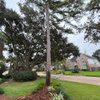
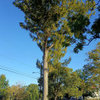
    below are three pix of the future .. it was here when i bought the house 12 years ago ... it was at least 15 feet tall then ... i limbed it up.. i have no clue how old it is ... maybe 20??? ..

    ken

    {{gwi:625614}}

    {{gwi:625615}}

    {{gwi:625612}}

  • 14 years ago

    Thanks Ken for the photos, I snapped a few of the pine in question. I got it almost free from a landscaper friend who was installing some trees and this one had no tag - it is a nice tree so I took it. (Usually I don't impulse buy, by I have space as you can see). In any case, I wonder if this is a Norway spruce (P abies) at all - it reminds me of one I saw on a Chicgo Botanic post - A dragon spruce Picea asperata.

    the tree:

    ">

    leaf detail:

    âÂÂ>

    What do you guys think - is this Norway or some other. I know that as they get older the branches become more pendant...younger Norways look even more different....

    thanks

  • 14 years ago

    ohhh brad .... pine??

    you have been talking about norway SPRUCE.. not pine ... lol ..

    and guess what.. it wont have PINE cones.. it will have... wait for it.. SPRUCE cones ... lol ...

    but it will have cones.. and by definition.. that is why it is a CON-i-fer ...

    anyway.. free is free.. plant it. .. but think long and hard before you put 20 more there ...

    in 5 years.. it will make a nice fresh cut xmas tree.. if nothing else ...

    i am not expert on ID in pix.. but that might even be a Picea pungens.. common name.. blue spruce.. but it still wont have pine cones .. lol ...

    i am sure the ID pro's will know ...

    i hope you have a sense of humor... with the joking around and all

    ken

  • 14 years ago

    thanks Ken!!
    I thought I was gona get busted, I do have a (sick) sense of humor so I am fine my internet feelings are not hurt at all - keep 'em coming.

    I would really like some feedback since I thought it was a Colorado spruce until I took a cutting to a nursery and held it up to Norway spruces...at least that is what was labelled. This was not HD or another big box store - so I am perplexed. (I will say though that this photo looks very blue...maybe it blued-up sitting in my yard - who knows.)

    In any case, I am just going to plant the damn thing and see what happens... I did want to get one more to "match" now it looks like I have to get two of the same, and have this one as the oddball!!

  • 14 years ago

    if it is a blue spruce.. then search out and find a Picea pungens Hoopsi ... like the one at the pic below

    also take some time to review an intro to conifers.. at the link below ... and pay attention to ANNUAL GROWTH RATES .... that will tell you all about the future .... of whatever you plant ... e.g. google 'Picea abies annual growth rate' ... and you will find out.. how fast it will grow to height ... i am guessing 18 to 24 inches per year... once fully established .... and that is what the pic shows you.. sans a scale ... [you will have to take my word for it ...]

    ken

    {{gwi:205545}}

    Here is a link that might be useful: intro to conifers

  • 14 years ago

    I planted it last night! Pics to follow. So far it looks good, not as heavy as I thought it would be.

    I also have a "blue" colorado blue spruce but a family of birds has just built a nest in there, so I'll have to wait.

  • 14 years ago

    Looks Picea pungens-Colorado Blue Spruce-to me. Keep in mind, there's much variation in needle color within this single species.

    Good trees, sometimes great trees, but quite prone to several potentially serious diseases in the east and midwest. I'd still plant it, but just be aware of that.

    Norway spruce is my favorite tree, and its propensity to get very large is one of the things I like about it, but that too you should bear in mind. Tall and wide usually. They do an exceptional job of keeping their lower branches right to the ground which is, of course, useful in blocking wind/views/etc.

    +oM

  • 14 years ago

    Eastern Red Cedar do well in clay areas and are often used for windbreaks. They really shine when you want something dependable as a mainstay/background tree and then plant more exotic trees for show.

  • 14 years ago

    Don't plant Eastern Red Cedar where you'll be mowing a lot - Those things are LITERALLY a pain in the @%!. They are pretty in a rustic, abandoned sort of way. They come up like weeds in old pastures around here.

Sponsored
Urban Upkeep LLC
Average rating: 5 out of 5 stars6 Reviews
Columbus High Quality Painting Expert