Software
Houzz Logo Print
groem

pine grafting

14 years ago

I am looking to learn more about grafting some pines trees. Been reading posts here and else where on the web. I think that I have the basic theory's down, just need to put it into practice. Or would it be better to just find pros to do it for me?

My first question is how to find out how compatible trees will be to each other. I know keep it in the family, but some family gets along better than others.

As I am in Utah and interested in native stuff I will most likely start with limber and pinyon pines. Could I put a pinyon on limber root stock? I have some seedling that I have started from limber, single leaf and edulis pines that can be experimented with. Also the University of Idaho sells various native seedling I can get hold of cheep. Where are some other places to get rootstock? Or what should I be looking for?

Eventually I would like to work up to hunting for brooms or interesting specimens to propagate. Thanks for the help.

Comments (9)

  • 14 years ago

    Pinus edulis will graft 100x better when only grafted to edulis.

    Pinus flexilis can be grafted to the most commonly sold seedlings: P.strobus, Pinus strobiformis and any other pine including flexilis that has needles in fascicles of five.

    For you: Pinus strobus or strobiformis is a fine choice. Also, Pinus sylvestris is a fine choice for pines with needles in fascicles of two. These are the commonly sold seedlings at nurseries, however, if another 2-needles pine is available, go for it. You just need to use common sense.

    Abies concolor has tap-root issues and should be avoided. I know some guys on here use it w/o fear, but I personally wouldn't recommend it. A good all around understock for you is Canaan (Abies x phanerolepis) or Abies fraseri (sourced to the SW). The common most frasier fir sold as SW origin if from Lincoln National Forest. If you can get nordmanniana, that's a good choice as well.

    Spruce: either Picea abies or Picea pungens are equal. I use Picea abies because the needles are not sharp and are easily removed.

    Maybe you've seen my grafting video? I'll link it. And I have two more videos.

    Dax

    Here is a link that might be useful: Grafting 2011 Bonsai and Root Grafts

  • 14 years ago

    Thanks Dax, I'm looking at doing a couple of grafts maybe this year. Both will be Pseudotsuga how does that figure for rootstock?

  • 14 years ago

    For inland/dry climates (poster that started this thread) he/she will need Pseudotsuga menziesii var. glauca (no exceptions). For you severn, you will need coastal Douglas fir (Pseudotsuga menziesii var. menziesii).

    Dax

  • 14 years ago

    Thanks Dax, so just find some P.m seedlings, about what age/size should they be ideally?

  • 14 years ago

    My experience also is that edulis understock works best for grafting edulis and monophylla scions. Followed by sylvestris, followed by strobiformis (or flexilis).

    Please keep us informed of your finds in Utah! I'm sure you will discover some interesting material there.

    In the past, I've mostly obtained understock from U. Idaho and Brooks farms, although there are several other good sources.

    For size, 1/4 inch (plus or minus) caliper seems to work well. I think this works out to about 2 years old.

    If you decide to try it, you might want to do some practice grafting first. Just grab some branches and twigs, and get a feel for how to make the cuts and bind the sticks together.

  • 14 years ago

    Thanks for the help and suggestions.
    I hear that the pinyon pines have a hard time in irrigated landscapes, so I was hoping to find a undersock that would work better.
    Another thing I have always wondered is does a tree grow to the limiting factor. If the understock tree is small and the upper part has the potential to get large the roots limit the top growth right? What about the other way? Does the top then limit the roots?

  • 14 years ago

    I understand the concern about irrigated landscapes, although it's been my observation that supplemental watering in and of itself is not harmful to P. edulis.

    Also, the amount of irrigation water can be relative, particularly in semi-arid and arid climates.

    I'm suspect that where it's a problem, the underlying issue is likely a lack of drainage.

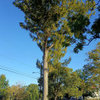
    Here is a nice P. edulis in a nearby yard. Looks great.
    {{gwi:623452}}

    I think there was a discussion a while ago about the influence of rootstock and scion (and vice versa). I'll post it if I can dig it up.

  • 14 years ago

    Well that is good to hear about the pinyon pines. Every thing I have read said they didn't do well in landscape, and that was why they were not used.I had planed on making some raised beds or hills full of sand or fast draining soil just for the pines.

    The next thing I am planing is a hot frame or small green house, as that seems to be the preferred way to let the graft get established. Does any one use grow lights? I am just looking into all my options right now.

  • 14 years ago

    I guess that now you can say, "most" of what you've read says they don't do well in landscape. ;)

    Here's another nice landscape pinyon.

    The raised bed idea sounds like a good idea to get things started. If you can track down some turface, that's also a great additive to sprinkle into the planting mix.

    To answer your question about grow lights, I do use them. I graft in the basement, so the extra light really helps, particularly when they're down there for several weeks. Some people also use them in a green house, though.