Software
Houzz Logo Print
ken_adrian

watering.. how do you do it

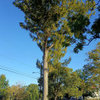
this is my native soil:

{{gwi:197426}}

i have had a backhoe dig down ten or so feet to bury some stumps.. its all yellow sand ... the kids can run the hose in the sand pit for 4 hours.. and have not much more than a half inch puddle ... this is drainage ... lol

conifers/trees love sand [for the most part] ... most do NOT like wet feet ...

when i plant a tree [using it interchangeably with conifer] i actually plant in a shallow bowl .... i then add 3 to 5 inches of hardwood mulch [free from whatever tree guy drives down the road, without leaves or a year later after the green gets composted] over the whole bed.. plus in the bowl .. 3 to 5 inches at application so that i end up with 2 to 4 after settling ....

i do the bowl so that i can put down 3 to 5 gallons of water at a time.. by august ... the puddle of water can sit there for 5 to 10 mins trying to soak in .... the sand is hard .. almost like concrete .....so during that time.. i continue to fill other holes .. i then go back and refill each bowl 3 or 4 times .. until i can actually stick my finger into the soil 3 or 4 inches.. and know the water is actually down in the root zone ... as the sand moistens it becomes very pliable ... if i didn't use the bowl method ... the water would continue to run off... never actually watering the tree ...

NOW THIS IS THE STARTLING PART .... in late summer ... i can do this 3 or 4 times.. and the soil NEVER GETS WET ... the hardwood mulch sucks up all the water ... so after one or two fills.. i have to bend over and manually remove the mulch from the bowl .. and then repeat the 3 or 4 fillings on the sand ... TO MAKE SURE THE WATER IS ACTUALLY GETTING TO THE ROOT ZONE ....

BTWay ... the bowl is completely opposite of how the clay soil people plant trees.. they actually plant on berms to increase drainage .. but i have never dealt with that.. so i claim no expertise in such ..

so the bottom line.. even with my number of years of doing this.. 7 years in this garden .. 10 in the last garden .. and many years at ma's place ... i still have to stick my finger in the soil.. to see if i am actaully getting water where it is needed ... but having uniform soil across the 5 acres .. once i test the first.. i know what to do with the rest .....

also .. as noted in another post .. i have found.. that if i go back the next day .... the water really goes down fast. and get a deeper penetration .. so i often go back and do it all again the next day ...

and then .. i usually dont go back for 10 days to 2 weeks .. before the next drink ... no tree needs that much TLC .. but for extensive drought in the year of transplant ... IMHO ... in my sand .. in my yard ...

how do the rest of you do it.. do any of you rely on sprinklers to do it all .. how do you check where your water is going ....

ken

Comments (6)

  • 19 years ago

    That tree in the pic won't like the damage to its roots!

    Resin

  • 19 years ago

    Ken, I have hard clay soils that can be very difficult for water to percolate. In our desparate drought situation here in N. Alabama, we've begun to use our Ross root feeder for the watering (not with fertilizer) of our trees. The response has been extremely positive.

    Again, we don't have to do it often, but it's been worth the effort.

  • 19 years ago

    Like Ken, I'm in sand country (pines and northern pin oak rule). While it has its benefits, it would be sooo nice to have soil with a bit more moisture retention... especially when going through a dry period like we've experienced the last three summers (actually winters as well). I know parts of the SE have had an awful time of it, but we're not in much better shape.

    I found Ken's comments on the mulch soaking up the water interesting. Earlier this summer I noted the water I applied from the end of a hose didn't seem to be penetrating the mulch. I took my hands and tried to break it up a bit, and found it to be surprisingly bonded together, almost like an impervious fabric. This is mulch given away by the city/county and it tends to be somewhat dirty, which may be contributing to the mulch's bonding affect. Bottom line--I ended up using a pitch fork to break apart the free, but low quality mulch around all of my trees. I'm now reconsidering using this mulch for future plantings. The price is right, but the quality is just not there. Too much crap material gets thrown in.

    Bob

  • 19 years ago

    I think everyones watering requirements vary depending upon their own micro climate area they are trying to grow plants.
    It can vary to the extent that the soil composition is different 10-15 ft from the house. In my case back fill dirt,sandy clay, from the basement dig is plowed up against the foundation and tapers off to rich loamy soil. The loamy soil is some of the best I have encountered. I am told my lot was a potato field for years.Because of the clay I water at a slower rate,because of runoff, then I do the good loamy soil.

    I use the finger test as Ken does. If soil is dry 3 inches down It's time to water. In order to water properly you need to really become acquainted with your soil. No need to do this if watering a few flowers is your game but if you are a conifer gardener as I am the need to know is important. Experiment to find out what how much water application is needed to satisfy what you are growing in a particular area. Dig down with a shovel and see how much water the soil has soaked up in a given time. It will take time to fine tune an area. Knowing this formula prevents over watering,most people are inclined to do this, and will save dramatically on the water bill.

    I use pea gravel and boulders as ground coverings. No particular reason other then I just like the look. The pea gravel serves to hold soil in place. It does help to retain moisture but could never compete with 2-4 inches of mulch for moisture retention. The boulders are just accent pieces. During the summer heat I find that the gravel and boulders have no effect with regard to heat transfer to conifers or deciduous plants. Same applies to winter.

    I tend to fill up an area with plants. In time the canopy these plants provide will prevent moisture loss as as oppose to a sparsely planted area. Don't try to achieve that look overnight. Know what you are planting as to width and height so over crowding does not take place.

    These are just a few tricks of the trade that I learned through trial and error. Watering is a need to know area in gardening that can make or break you. If you get it down pat your plants will reward you with growth and beauty.

    Dave


  • 19 years ago

    Great topic, since our life currently revolves around watering trees! And thanks to you, Ken, we're not dragging hoses quite as far!

    We're on clay soil here in So Indiana so we're use to planting everything high to avoid drowning. But here at our new place most of our conifers are being planted on a slope, which I've never dealt with before. It took me a while to figure out you don't have to plant as high on a slope. As a result, even though well mulched, our trees seem to dry pretty quickly, and I'm not too worried about over-watering. So we are watering like crazy, with so many new trees, no rain, and mid 90s every day. We were watering one tree at a time with the hose, about 30 minutes at a slow stream, 2-3 days/week. That's a lotta trips up and down the hill! My DH just rigged a 4 hose splitter, looks kind of like an octopus, and we can water 4 at a time. Much better.

    I know this is the worst possible time to plant a tree, but when you can buy nice trees at 60% off, and you NEEEED to plant lots of trees, it's hard to not take advantage of the great prices. If you're committed to watering, including running the sprinkler on the foliage to help it cool down and stay hydrated, what are the other drawbacks to planting in the heat of summer (besides the obvious miserable working conditions)? We're currently planting a mixed screen of various species that do well in our area -- Picea abies, Tsuga canadensis, Picea pungens, Pinus strobus, grown locally and B&B from a good nursery, so I'm hoping they will establish themselves with plenty of water.

    Off to move the hoses!!

    Kim

  • 19 years ago

    "watering.. how do you do it"

    With a watering can, on the rare occasions when it is necessary.

    Usually, it's a matter of trying to keep excess water away. Dig a hole here like yours, and it'll half-fill with water (completely full in winter, or this summer).

    Resin