Software
Houzz Logo Print
quercusluver

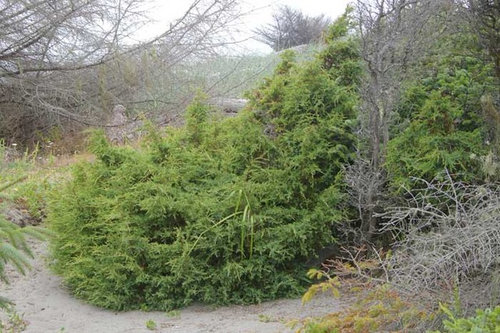
Seaside juniper (J. maritima)

17 years ago

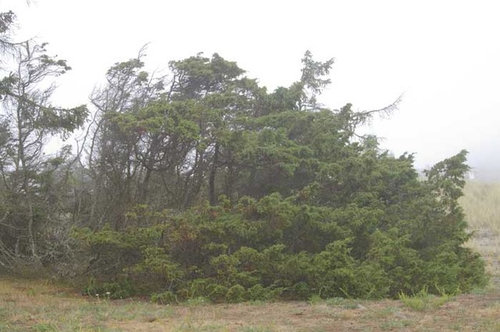
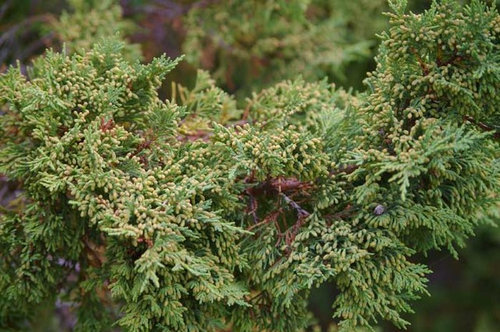
We just made a four day trip along the Washington state coast. However, instead of posting magnificent views of subalpine fir and mountain hemlock at timberline in the Olympics or my smiling family in front of enormous Sitka spruce, I'll share these foggy photos of seaside junipers (J. maritima).

This recently described species is endemic to the shoreline of the inner marine straits of northern Washington and southern British Columbia. While they are mostly found growing among rocks, we visited the small population on sand dunes west of Cranberry Lake in Deception Pass State Park on Whidbey Island. At this site are just a handful individuals mixed in with Douglas-fir and Sitka spruce growing just inside the first line of dunes from the shoreline.


Comments (10)

  • 17 years ago

    "Recently described" = proposal to distinguish it from J. scopulorum, which it has long been listed under. I posted a link to the paper on a prior occasion.

  • 17 years ago

    That's probably where I first saw it. Thanks! I don't know if we would have bothered chasing them down otherwise.

  • 17 years ago

    I suspect it might be better treated as a subspecies of J. scopulorum. The differences are decidedly small.

    Resin

  • 17 years ago

    Quite different in behavior and appearance from Rocky Mountain origin cultivars as seen in cultivation here. I once read it was more similar to J. virginiana than J. scopulorum.

  • 17 years ago

    "I once read it was more similar to J. virginiana than J. scopulorum"

    That's the claim made for its genetics in the paper by R P Adams where it was first described; however there may be some uncertainty about this, due to incomplete sampling. Morphologically - foliage, cones - it is indistinguishable from J. scopulorum; see J. Duemmel (2009), That New Juniper Species, Douglasia Summer 2009: 10-13. This leaves just the phenology (shorter cone maturation) and climatic adaptation, which are good for making a subspecies.

    Duemmel also points out that there are juniper populations in the northeast Olympic Peninsula on Three O'clock Ridge at over 900m altitude and at Deer Park at about 1500m altitude, so the habitat separation from typical J. scopulorum is less marked than Adams suggested at first.

    Resin

  • 17 years ago

    Reminds me when I was working in Badlands National Park (was National Monument back then), South Dakota. We were not to worry about the ID of the junipers, "they're all hybrids."

  • 17 years ago

    Rocky Mountain origin cultivars seen here do not have the same shoot orientation and density as the local native, often fail to produce large, persisting specimens - in fact I am not sure I can name a single one. We do have larger examples of J. virginiana in cultivation here.

  • 17 years ago

    "Rocky Mountain origin cultivars seen here do not have the same shoot orientation ..."

    Could just be that the cultivars have been selected for their abnormal shoot orientations? Like 'Skyrocket' and 'Tolleson's Blue Weeping'??

    "... and density as the local native, often fail to produce large, persisting specimens"

    Same applies in Britain, the champion J. virginiana is 21m tall, the champion J. scopulorum is 11m tall. Presumably due to their lack of adaptation to oceanic climates and the good conditions for disease.

    Resin

  • 17 years ago

    I'm not talking about the crown shape or even the orientation of the main branches. I'm talking about the density of the exterior of the canopy and the drooping of the terminal shoots.

  • 8 years ago

    In 2015 Adams published that the populations of "Rocky Mountain juniper" located between the range of seaside juniper and the main distribution of Rocky Mountain juniper are actually intermediate in nature.

    http://www.juniperus.org/uploads/2/2/6/3/22639912/341_-_2015_phyto_97155-66adams_scop_marit_dna_rev_12-12-14.pdf

0