Software
Houzz Logo Print
themidnightgarden

Coastal Redwood Help Needed

13 years ago
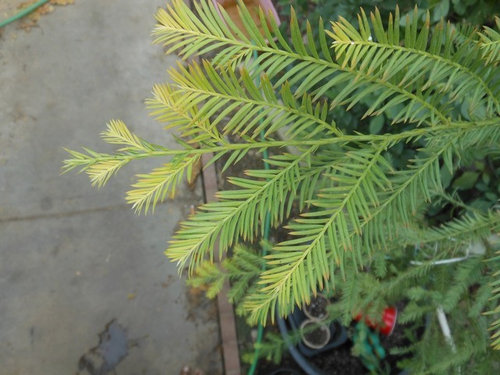
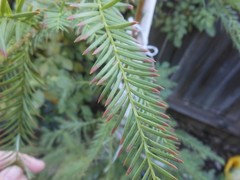
This is a 2.5 year old Coastal Redwood. Until a few weeks ago, he was doing GREAT! Than a few weeks ago his needles stared to yellow, and get brown tips......Is this a normal winter thing? Or is something wrong?

I have put my heart and soul into this tree! What ever I have to do, I will!

Comments (25)

  • 13 years ago

    I have put my heart and soul into this tree! What ever I have to do, I will!

    ==>> well ... give it away .. free it.. if you love something.. let it be free ...

    looks potted.. ???

    yes.. ??? how long.. last media change??? how big is the pot??? .. this thing is not meant to be in a pot forever ... especially with its growth rate ...

    it is winter.. even in z9 ... you should not be feeding it ...

    its not burning.. which is a good sign ... has it somehow become more shaded???

    thx for the pic.. but except for telling us its yellowing.. you havent given us any real facts.. nor a pic of the whole.. to get any real idea what could be going on ...

    more facts please ...

    ken

    BTW.. what happened a few weeks ago ...??? .. and what have you already done to it ... so we dont duplicate stuff...

  • 13 years ago

    The browning of the tips somewhat normal..the tree looks health from what i can see..i have a coast redwood also, and this time of year the tips on mine get brown too.. how big is the pot its in? How often is it watered?
    J

  • 13 years ago

    Ken Adrian-

    Nothing changed other than the weather. Here is Sacramento, we had a very late winter, and only starting getting the heavy rain, and overcast skies a few weeks ago. Last winter this tree was MUCH smaller and did not change colours or anything.

    I will try to get some better pictures when the rain stops.

    I have seen much larger trees than this, in pots much smaller..... I believe it is a 30gal pot?

  • 13 years ago

    taxo-man-

    I believe the pot is 30gal? It has been such a long time since I got the pot that I dont remember. It is huge though!

    I have not been watering much since I have not needed to with the all the rain

  • 13 years ago

    It'll need extra fertiliser if it's in a pot. Better though to plant it out in the ground.

    Resin

  • 13 years ago

    Resin-

    Could you please recommend a good fertiliser?

  • 13 years ago

    i wouldnt go dumping water soluable fert into a pot.. that MIGHT not be handling the rains ...

    you said: It has been such a long time since I got the pot that I dont remember.

    and if that is the same media.. that is so old.. you cant recall how old the media is.. then you might have a drainage issue ... and lack of proper drainage will turn a plant yellow.. faster than lack of fert ...

    you are in a catch 22.. if you cant tell ...

    now answer all who asked.. can it be planted in mother earth.. where it belongs??? .. because i dont see you wrestling it into a 40 or 50 gal pot ...

    also..as to fert.. well ... i never lived in your zone.. but i would NEVER fertilize in the dead of winter .. which is defined by the winter solstice next week ... lets figure out if there are other problems.. and in the meantime.. spring will get closer and closer ...

    ken
    ps: adding water sol. fert to a plant thats drowning for lack of drainage .. well ... again.. you can see the problem ...

  • 13 years ago

    the media is not nearly as old as the pot LOL

    Where we are now, no, the tree cannot be planted anywhere. If a larger pot is what is needed, than I will get a larger pot

  • 13 years ago

    If you're in the Sacramento area, there is no problem planting trees at this time of year, as long as the ground is dry enough so that the soil is friable, although you may mean that you can't plant it where you are currently living.

    A more problematic issue is that a coast redwood is not going to be real happy living in Sacramento...although there is a decent-sized grove at the UC Davis Arboretum and you might check in with them regarding success rates and what their experience has been. Sequoia sempervirens counts on coastal fog and humid air, which you are not going to get in summertime up there!

    Ken, remember that it is a California native and as such is just beginning its growth period. CA natives are sort of 'backwards' from what you are used to - has to do with our wet winter/dry summer situation. So, think of this as 'spring', not late autumn. A little bit of organic fertilizer - fish emulsion or the like - would not be amiss, but make sure that the pot drains well. I'd leave it outside (I have a S. sempervirens cultivar in a pot outside - it needs to develop more of a root system before I put it in the ground).

    And Midnight - it looks fine to me, just fyi.

    Good luck!

    Sara

  • 13 years ago

    FWIW, strangely enough, coast redwoods on the East Coast starting growing in late spring just like everything else. My 'Soquel' finally got established and sent up a shoot of almost 3' this year. I bought this cultivar because one of Michael Dirr's books said it was "zone 6" hardy, I figured he must have some empirical evidence of it being one of the hardier clones since others were rated zn 7; a famous PNW nurseryman's reaction to this was "he's been out of Georgia, what, 5 times in his life?" I didn't realize it was collected near the southern end of the species' range. In any case, I also have a couple 'Swarthmore Hardy' so I should be ok. Given I'm in a very favorable microclimate I don't think either one will be menaced by much more than a 30 year winter.

  • 13 years ago

    It's so interesting how plants (and, I guess, people) adapt. We can quote all of the wisdom in the world but if the tree is making it, that is the test! They die (or look like hell) by the score around here when planted just a few miles inland from their favored microclimate. But summer here once you get a mile or so inland is very unforgiving: no rain, very dry. Are there any examples of S. sempervirens making it past 10-20 years back there? Photos? Ain't gardening fun?

  • 13 years ago

    Yes it's been covered extensively before, they grow from about Philadelphia to points south, and throughout the coastal SE at least as far west as Nacogdoches, TX. IIRC one lasted in Orlando for a few years but died. The dry winters and springs in Florida can be hard for it, probably. (the rest of the SE is wet in winter & spring)
    The fact they are hexaploid might help; and perhaps (just guessing) the current ones are refugees of a time when they covered much more of the globe and were exposed to more varying climate conditions. They obviously have genes to cope with soil pathogens that they don't have deal with where they are currently domiciled. As you probably know, they will grow in Sacremento with irrigation, so the myth they can _only_ survive on fog is just that. In fact, the reason they (or any other plant) can't get higher than 400' or so is that the hydraulic force required to bring water that high from the ground becomes insurmountable. In addition to all the other engineering challenges of being that tall.
    Of course outside coastal California they can only get very high in climates with the relative absence of high winds and no lightning; even the UK has more of both than California.

    This post was edited by davidrt28 on Tue, Dec 18, 12 at 0:01

  • 13 years ago

    " They die (or look like hell) by the score around here when planted just a few miles inland from their favored microclimate. "

    Hhhmmmm. I know I've seen pictures of good looking irrigated ones in Sacremento, but I'm not going to go trouble myself with finding that. Suffice it say if they can look great on the east coast, nothing about Sacremento+irrigation is going to remotely challenge them. Yes, the air can be dry. They will suck more water from their roots like every other plant does. Their native range does have the extremely rare heat wave when Santa Ana winds start, unlike, say, the Tierro del Fuego.

  • 13 years ago

    Right, and, actually I've gotten in arguments with people who live in the Western USA (but not horticulturalists, per se) about the wisdom of the heavy amt. of irrigation some people practice there. So, in a way I'm probably on your side. If you want a coast redwood, you should probably just live in its native range. But, given that there is a culture of irrigating there and growing what you want in your garden, well, gosh darnit, if you want a redwood I guess you can have one, just as you can any other tree that's used to a moister climate.

  • 13 years ago

    Hello TMidnightG, this is a 1,5 year old tree last late winter exposed to winter winds down to -12d C (10F).

    Yes, it can get that brown but as you see in spring, it bounced back. If I remember there were only 2-3 branch tips with winter damage. 2,5 years old now, like yours. (that's a different-1 foot higher stake!)

    check up closely the brown tips, and if they are still soft with hints of green (and not withered, hard and completely brown) you are fine. If the image you show us is the worst that it looks, you are better than fine.

    Best regards,
    Fotis

  • 13 years ago

    That's interesting Fotis. Certaintly, my climate is probably somewhat cooler on average than yours in winter: http://www.sercc.com/cgi-bin/sercc/cliMAIN.pl?de6410 and definitely moister year round, but maybe only slightly more so in winter. Or maybe not at all: there are places in Greece that are quite moist and similar in some respects to some interior valleys of coastal Northern California, albeit markedly moister and more humid in summer. Are you similar to this place? (sorry about our antiquated temp. scale and the need for conversion!) That's kind of like Ukiah, CA with slightly cooler winters and somewhat wetter summers. Still, redwoods should grow very well indeed there, and not show this type of damage seen on yours.

    Anyhow, we've been having mild winters but they still had some cold, windy periods. I've never seen such damage even on a smaller plant, in fact in 3 years outside I've never seen my 2 clones of redwood bothered at all. Summer or winter. They have also seen from about -12C to 37C. Maybe my loamy soils are more moisture retentive than yours? So it makes me think that the problem you are having is more with dryness than absolute cold. Maybe your soil is rocky and a fair amt. of the winter rains run off or quickly percolates through. Or even this: maybe because you are a winter wet climate, the plant really does want to start growing in winter. But then, it experiences cold spells and is damaged. Since we have year round rainfall and slightly cooler winters, they only try to grow in summer here? Just food for thought!

  • 13 years ago

    FF .. et al ...

    i qualified my lack of experience with CA and the plant ... so i will defer to your more local knowledge ...

    now.. that said.. perhaps i missed your replies to this rather large tree with vast potential.. growing in a pot ???

    dont these things root rather freely??? .. compared to other conifers ...???

    if so.. why not root some.. save your beloved.. and get rid of the monster..

    and in this manner ... basically rejuvenate it back to a pot sized plant ..

    the link says:

    "Redwood can be propagated by cuttings ..... 40 percent of the cuttings from the tops of fast-growing seedlings that had been pushed into forest nursery soil with no special treatment developed root systems (38,39). Currently, rooting in excess of 90 percent is obtained routinely, with mist in a favorable medium, using juvenile cuttings from seedlings (27)."

    you ought to think long and hard about this ... since you do NOT have a yard for a 300 foot tree ...

    and in the meantime.. try rooting some pieces ... so if you ever make the decision.. you will be all set to go .. just think about all the space you will have in your pot area ...

    ken
    ps: and i am sorry. FF ... the winter solstice is 7 days away.. only a Californian.. would try to make me understand.. that this is spring.. crimminey .. lol ...

    Here is a link that might be useful: link

  • 13 years ago

    I think that the OP is living somewhere where he doesn't want to (or can't) put it in the ground (apartment?)

    Yeah, it should be in the ground, but one of the problems is that virtually no one has room for these monsters! And they sell them by the hundreds in #5s at Home Depot and the like. Between the fact that their native range is extremely limited (speaks to their particular needs) and the fact that they get so big - so fast! - I'd guess that about 95% of them are planted inappropriately! It's one of our state trees so not surprising that people want to have one...however the grizzly bear is our state animal and I know that I don't want one of those!!!!

  • 13 years ago

    As you said it David. This was the first winter exposed to the elements and it was a cold one reaching -13C. But not real damage. 95% of the plant was green in late April!

    As for Ioannina. (this is were I had my army duty and close to were I found the variegated Abies cephalonica). No, I'm more dry in summer (in precipitation and humidity) with lower winter average as I am in 900m (2700feet) elevation (instead of 470m for Ioannina) but with equaly wet winters.

    I don't know the cause for this extensive browning but I'm eager to see how it will cope this winter, also pray for a bit milder one with a more wet spring!

    Already had one good snowfall this December and actually saw the tree bent in 90 deg angle at mid-height as I've taken all the ties to the stake off except the lowest at 2 feet from the ground. Strong tree...

    Fotis

  • 13 years ago

    In Davis they do quite well outside the Arboretum too, almost every public park has some. The ones in the closest park to me have already started asexual reproduction, producing tiny new clone trees around the base of their trunk, this is a natural means of redwood reproduction. We always say don't plant your trees too close together but the redwoods do it on purpose! I mentioned in one of my early posts on this forum I was surprised Coastal Redwoods do so well in the Valley but they do, just don't let them dry out. I have three wild location seedlings of my own planted in the ground only 2 years old. San Francisco, on the other hand, is like their natural environment, you can plant them anywhere, you don't even have to water them, nature takes care of it all for you.

    Does the Metasequoia wild environment mimic that of Sequoia and Sequoiadendron? If you can keep one alive outdoors, does that mean your conditions work for the other two? I tend to see the three covering the same cultivation range (Metasequoia being vastly outnumbered by the previous two), at least here in CA. All three can be found on lawns here.

  • 13 years ago

    Thank you all for your posts and input. Sorry I have not been present in the conversation, I work all day lol. Here are some pics of the needles I took this morning. I can get better ones if needed, this was just real quick on my way out this morning.

    The brown part of the needle feels just like the green part, it does not feel dry or brittle.

  • 13 years ago

    Here is another pic

  • 13 years ago

    MIdnight I think you're fine. If you have to keep it in a pot, make sure that the drainage is good and don't let it get too pot bound.

  • 13 years ago

    Sounds like you plan on keeping it in a pot for a good while or forever. I would sugest you look to see if you can find a bonsai club you could go to. They can help you keep the tree manageable and healthy. Learn how to prune the top and roots to keep it an approprate size. Other wise start looking for a place to plant it.

Sponsored
Peabody Landscape Group
Average rating: 3.5 out of 5 stars8 Reviews
Columbus' Reliable Landscape Design & Contracting