Software
Houzz Logo Print
rockiecarol

Steam Canner?

18 years ago

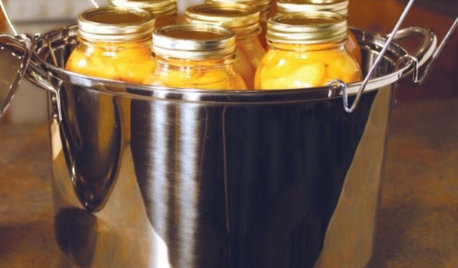
I have been canning for years, but found an ad for a Steam Canner in one of the seed catalogs. Has anyone ever used this method? If so, have you had success and would you recommend it? I can mostly tomato products such as salsa, juice, spaghetti sauce and stewed tomatoes. The ad says it is "ideal for tomatoes and fruits".

Years ago a lady at the office said she used her large kitchen roaster to can in using virtually the steam method, has anyone heard of that? Unfortunately she is no longer around as a source...

I love to can. The end product is yummy and better for my family than anything we could buy. It seems that canning using steam would save time and water. Any thoughts or comments are appreciated. I know I still need to use the pressure cooker for green beans.

Thanks for any help you can offer. Carol from Nebraska.

Comments (17)

  • 18 years ago

    Hi Carol - I have linked a couple of previous discussions on the steam canners for your review.

    Steam Canners

    Steam Canners

    Some folks do use them however it is important to note that they are not approved for home preservation use by the USDA or NCAFP - the 2 rules and regulating bodies - because they have never been adequately tested and none of the canning recipes reflect the processing times needed for them. So BWB or pressure canning is still the only approved way to go.

    I assume you are also doing pressure canning at home since you mention salsas, spaghetti sauce, and stewed tomatoes? I linked the NCHFP site for you below in case you want to review the current regs and info on things. It's a great source of info and tested and approved recipes and a handy link to have bookmarked.

    Hope this helps. ;)

    Dave

    Here is a link that might be useful: NCHFP

  • 18 years ago

    I agree with Carol. They are not safe. There are cold spots in them, so not all the food is heated evenly.
    The final internal temperature of the contents is not as hot as those processed in a boiling water bath.
    We do not recommend their use at the extension office.
    Plus, as Carol said, many of the things you are canning may not be safe in a boiling water bath. They may require a pressure canner if they have low acid vegetables, like onion, peppers, etc. Stewed tomatoes definitely need pressure canning.

    Stewed Tomatoes
    Makes about 6 pints.

    4 quarts washed, cored and chopped tomatoes
    1/2 cup chopped onions
    1/2 cup chopped green peppers
    4 teaspoons celery salt
    4 teaspoons sugar
    1/2 teaspoon salt
    Hot Pack

    Add all ingredients to a saucepan and bring to a boil. Simmer 10 minutes, stirring occasionally. Pack hot jars with hot prepared tomato mixture leaving 1/2-inch head space. Remove air bubbles. Wipe rim and screw threads and adjust lids and screw bands.

    Processing Methods

    Pressure Canner

    Dial Gauge Type @ 11 pounds pressure or Weighted Gauge Type @ 10 pounds pressure.
    Pints 15 minutes
    Quarts 20 minutes
    After processing, remove jars immediately, place on a rack to cool.
    Test for Seal.

  • 18 years ago

    Yup, me. I use it ONLY for high acid foods like tomatoes, pickles, and jellies. It takes a LOT less time to get things up to temperature and because youre not dealing with many gallons of water, the heat is very fast and very hot. This is one reason a few of my store bought jarred products will crack their glass if I attempt to reuse them for home canning. I don't own a pressure canner, and have not use a BWB since about 10 years ago. Nothing I make has had any spoilage and has always been very good. I even did some serious tests a few years ago, with a multi channel thermocouple type temperature measurement machine. It recorded temps inside the jars, and outside the jars, as well as at the top, middle, and bottom of the jars. Some jars had tomatoes tested, while some had fruit juice, or and vinegar and a couple of cucumbers to simulate the contents. All had heated evenly and reached the required temps within minutes of the steam canner starting to boil again. Of course, all the items were filled using previously boiling liquids and, and capped. I even had to drill small holes i the lids to fit the TC wires through . The recorder has no paper charts only adigital output for 6 channels and they wer all wihin a few degrees of each other at most times during the processes. For a beginner, I don't advise this, but for someone who is experienced and cans in the heat of summer and doesn't like overcooked things like pickles that turn to mush, its a great tool.

  • 18 years ago

    Thanks for the feedback. I think I will try the steam canner but will only use it for the tomato juice. That and salsa are my major canning ventures anyway. I believe we put up around 45 - 60 quarts of juice last year... I like to make four or five different batches of salsa, so we can have a variety of spicyness. We even called one batch Triple X!

    On a side note, I must admit that I don't 'can' the salsa at all. I use hot jars, fill them with hot salsa and use the inversion method. That is to put the jar on its top for 20 minutes, then turn over and allow to seal. We don't like the flavor once it is cooked.

    I have taught my kids and cautioned everyone to ALWAYS watch what they are opening if it is home made. The boys know to look at it, and smell it and if it looks or smells suspicious to discard the entire contents. I have very few that ever go bad though.

    Thanks for the links though. I will check them out as I always like to learn more. Dave, have you been canning long? Do you grow your own garden?

    Carol

  • 18 years ago

    Be sure that if used for the tomato juice that you add extra acid as required for any tomato product being home canned. Either the lemon juice, or the tasteless citric acid is a good choice. As to being unsafe, that is a mistake. They simply haven't bothered to do much testing on these and everyone who uses one has a slightly different approach to the whole process. Because I only steam can high acid foods, and have no pressure canner, I much prefer to use a steam canner vs. a water bath, as a water bath is just too much water, weight, steam, and heat to deal with, along with slower heat recovery times to get all that water back to a boil again. If my electric stove burners sink into the stove due to exteme heat bending the struts, I know that its putting out plenty of heat for the steam canner. I Have replaced my stove burners many times, as well as the sockets. I also have a higher powered canning burner that is raised higher on my electric stive. It has thicker metal stuts that don't sag from the extreme heat as easily either.

    The inversion method today, is VERY unsafe and has not been advised for many years. Additionally, any method using sealing wax is also out, as well as jars with glass domed lids and rubber rings. Inverting a hot jar isn't what pulls in the vacuum on a metal domed lid, its the cooling process that creates the vacuum. Inversion is meant ONLY for seeing if the jar leaks, and even for that, its not very accurate. Also, the lids can contain contaminates that could spoil the contents, unless the lids are immediately applied right out of a simmering pot of water. Today, with the metal lids and the embossed dimple in the center, you are going to know that a vacuum exists as it goes concave once a vacuum that is strong enough can pull it in. The all glass jars have no visable way to know if there is actally a decent vacuum, and any commercially made jars and reused lids are definately out, as they mostly have paper liners which are very bad news for home canners.

  • 18 years ago

    Dave, have you been canning long? Do you grow your own garden?

    Yes, to both. 66 year old farmer and some 50+ years of canning and gardening.;)

    First, as Ken says, it isn't that they are unsafe, just untested and unapproved. Semantics maybe, but an important distinction. So if you are going to use it be sure to adjust your processing times accordingly.

    Now, I'm glad to hear that you are always glad to learn more because it sounds as if you may be in for quite a few shocks when you review the links above. ;)

    And I can only stress again what Ken said above. The inversion method is ok (not approved but ok) for jelly but is extremely unsafe for anything else and we all strongly discourage it.

    We all have to define the level of risk that is acceptable to us so ask yourself if the risk really worth it to you? Botulism spores don't smell, don't discolor the food, and don't affect the taste. But they can make you deathly ill. So if you don't care to properly can the salsa then at least consider freezing it instead.

    And please, as Ken stressed, be sure to add the required extra acid to all your tomato products. It isn't a replacement for the required BWB or pressure canned products but it will at least make them safer.

    Dave

  • 18 years ago

    Ken and Dave, thanks for the pointers. I will follow up with the links you have provided.

    Rockie

  • 18 years ago

    On thing about inversion. Only flip a jelly if its got solids in it that tend to float. This was true with apple pie jam and because the apple pieces floated, you get all the apple bits at the top, unless you flip the jars a few times while it sets up. I ended up with a batch that had to be flipped about every 3-5 minutes, about half a dozen times before the jelly thickend up enough inside to hold the pieces in place.

  • 18 years ago

    Jelly by definition doesn't have solids.

    Inverting jams or jellies does somewhat increase the risk of seal failure; non-processed jams or jellies can have a shorter shelf life and higher likelihood of mold, but being a high-acid product, it's at worst a quality not a safety issue (as long as you don't eat jam with mold on the top).

    I can't emphasize enough the risks of open-kettle canning salsa (which is what you're doing by not processing, only sealing in jars and inverting).

    Ken and Dave have outlined the risks. Botulism CANNOT be detected by sight or smell, so those "tests" won't keep you safe. You can kill botulism toxins by boiling AT LEAST 10 minutes after opening the jar, but of course, that has the same effect on salsa as processing. Boiling does not kill botulism spores, but it will be safe to eat the product short-term.

    Salsa is extremely high-risk, primarily because it has low-acid peppers and onions, perhaps garlic, in addition to the marginally acid tomatoes. Even with vinegar added, the solid chunks can be dense enough to provide "safe harbor" for nasty poisons (aka botulism). We cannot urge you strongly enough not to expose your family to this risk by using untested recipes and by open-kettle canning.

    Whether you use a steam canner for high-acid products like pickles and jams is up to you. It isn't recommended or approved, but some forum members feel those products are inherently low-risk and are comfortable with the choice.

    Carol

  • 18 years ago

    I group jelly, jams, marmalades, preserves, and conserves into the same family. They are basically thick and usually have a pectin to set. When I do seedless red raspberries, they do have some texture due to the outer covering of each tiny bud of juice. Same with grape juices. Squeeze these through something and you do have some solids that will sink to the bottom.
    How do we differientiate between a true apple cider which is quite cloudy and the glass bottled types that are crystal clear? They are both considered 'cider' but the clear ones are more like apple juice.. Maybe we should drop the cider teminology unless its fermented. Then call both clear and cloudy apple juice either filtered or unfiltered. Interestingly, if you boil very cloudy apple cider, it will turn quite clear on its own, and doesn't need any fliteration. Apple jelly with a few bits of apple in it? Whats that called??

  • 18 years ago

    I'm speaking of the traditional definition of jelly, which is a clear, tender jell. In fact, its clarity is its most significant characteristic. In judging, a jelly that is cloudy would be considered an inferior product. Jelly is the most delicate of preserves because due to the straining of solids, the natural pectin level is lower. It's so delicate that the recommendation is to use sterilized jars and BWB only 5 minutes because with longer processing the jell may break.

    There are jellies that use commercial pectin which makes them sturdier but also tougher than the ideal.

    Jams have solids and preserves have chunks suspended in the jell. However, these definitions do overlap and it's really a moot point, because the risks of inversion are the same regardless.

    I would think where inversion would really become an issue would be with low-sugar or no-sugar spreads (as opposed to jams and jellies) because not only is the seal weaker, but the product lacks the preservative effect of sugar.

    Carol

  • 18 years ago

    Yes, thats one reason I add extra acid blend to my sugarless pectin based 'spreads'. Without these added acids, the taste will get 'fogged' due to the sugar free sweetener. My 'spreads' are not made for a competetion, but for me to enjoy when I want some, so they can be a inconsistant as I like them to be. As mentioned, I only fip a jar o get the solids to mix better as opposed to just floating on top.

  • 17 years ago

    bump - valuable info and about to disappear

  • 17 years ago

    They still seem to cause a lot of controversy, but I still like using it for pickles and jellies. Both of which are high acid foods. After all the heat testing I did a long while back, it convinced me that it was useful for what I can mostly.

  • 17 years ago

    I have been using the steam canner for as long as I can remember (15years?). I have not had a problem.
    I did talk with a gal from a university extension service a long time ago when the controversy started.
    She stated that they had to legally follow the guidelines set by the USDA (remember this is a government agency).
    She said that there just wasnÂt enough research done to endorse the method.
    She also said that the biggest problem was that directions were not being followed. The most common mistake was not waiting until you had an 8-10 inch line of steam coming from the vent holes. This is when the processing time starts.
    And, following the processing times for altitudes was a common mistake. Where canning is big in Utah, a lot of canners forget to add on minutes for altitude.
    I know a lot has been written regarding the temperatures of the food. But, my fruit is always boiling when I pull it out at the end of the processing time. So, I feel confident that the fruit does reach adequate temperatures.
    Happy Canning!

  • 17 years ago

    teamhs - many use the steam canners for high acid products like fruits and pickles. It is their choice to do so whether it is approved or not.

    But using it for low-acid canning is the BIG risk. That is a whole other issue. ;)

    Dave

  • 17 years ago

    Yes, thats what I use it for here. All my jams and jellies contain no sugar and I add an acid blend to them to retard spoilage after a jar is opened. For pickles, I use full strength vinegar at 5%. Today, my 20% food grade vinegar arrived and I have 4 gallons of it to last me quite a long time. I start my canner boiling before the jars are filled and by the time I have 2-3 jars capped, they start getting loaded into the canner. Todays quart jars are slightly larger in diameter and so 7 jars cannot easily fit in it, so I can only do 6 at a time. Steam jets out the two tiny holes near the base about 20 inches or more.