Software
Houzz Logo Print
herboholic

Cilantro Busting Out, Caterpillars soon 2 Follow

18 years ago

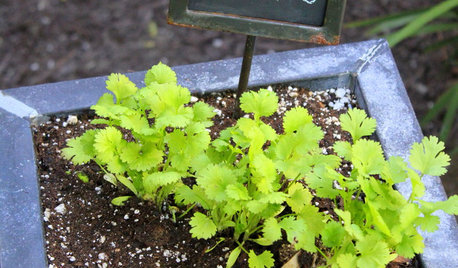
My cilantro is really busting out all over, growing it looks like up to two to three inches a day. I had a really good time with it last year keeping it from bolting (except for the patch I wanted to go to seed for the Coriander seeds).

But I did have a problem last year with those bright green and black striped caterpillars that are known to love to eat cilantro and parsley (they love dill also, I believe). I can't remember what I used last year. The bottle may still be in the garage. It worked but...

I'd like to do something more organic this year. I've heard of a dish soap (non-antibacterial) and garlic mixture you can spray on cilantro and parsley that will keep them off.(?)

Does anyone have that kind of recipe or something know of something similar?

Any help would be much appreciated. Because with the weather getting really warm, those caterpillars aren't far behind. And my cilantro is getting so lush, thick, green and beautiful. I want to stay ahead of them.

Comments (10)

  • 18 years ago

    Dish soap of most any kind is not wise to spray on leaves of herbs. Think of it as eating the leaves with soap on them, ugh! There are caterpiller preventives like Thuricide, Dipel and a few others with are strains of Bt, and are organic in nature. The foliage can be eaten right after spraying and it doesn't affect friendly insects. These Bt products work on the digestive system of the caterpillers and stops them from feeding. Asparagus plants also grow 2-3 inches per day when they are spears. Once the flat leaves of cilantro are harvested, it will not usually make any more, but instead will start making the thinner fern type leaves, then seeds (actually fruits), then more herb.. Keep the cilantro out of hot sun, as it likes cooler weather in shade.

  • 18 years ago

    ksrogers....Thuricide is the bottle I have in my garage I used last year and it worked fine. I was just trying to be a little more earth friendly....but I didn't know it was organic in nature....so that's great. It took care of the problem almost immediately.

    I was able to keep my cilantro from bolting (I know, hard to believe) last year. I kept cutting it back from either using it, or just plain pruning it, and it just grew and grew into a 3'x6' long row of lush bush-like herb, about 2' high. It is in a semi-sunny, shady area of the garden, and doesn't get a lot of hot sun, so I'm good on that.

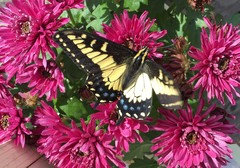
    Thank you SO MUCH for your response. I was wondering if anyone was going to bother to answer. I asked somewhere else (a cooking forum that had a "gardening" forum as well) and the only response I got there was from someone who posted a picture of the caterpillar asking me if it was the one (it was), and that they turn into these beautiful eastern swallowtail butterflies. Her (his) solution was to plant more cilantro/parsley/dill, so there would be some for her (him) and some of the caterpillars. Perhaps they had no idea how many eggs these little critters can lay and how many your garden will end up with if left unattended, and if you think they're going to stay in their little patch of herb you specifically planted just for them, you're fooling yourself. I know how quickly they can devour cilantro/parsley.

    I am an animal lover. Even if I find a spider in the house, I will scoop it up (usually on a piece of paper) and set it outside. Even catching the stray mouse, I use a humane trap and will release it out in the woods. I hate those poisons and especially those sticky traps where they get stuck and just starve to death. How cruel can you get? A housefly or ants...different. SMACK! Gone! I didn't mean to appear cruel, but I posted back and said "Perhaps I didn't make myself clear, unless the Swallowtail is on the endangered species list, it will not live in my garden". And picking them off, one by one, isn't an option. As I said, there are many eggs they lay that will replace them.

    Finally from you, a logical straight-forward answer. Thank you. Thuricide it is. Because they are coming. Planting season is around April 15 here...the last day usually for the threat of any frost. And the weather is already warm and I know these caterpillars are not far behind. And I don't want a repeat of what I experienced last year.

  • 18 years ago

    Another, totally non chemical or organic method is to make a tent over the plants. Use a light weight white plastic fabric. These are also called row covers. If its covered from the ground up over the plants, not much can get in there then. Besides that, it might also help to cool a little by reducing some strong sunlight. They let about 85% through, which is fine. Cilantro doesn't transplant well, so your correct in that its directly sowed. Here is also a web site I use for many safe organic things:
    http://www.gardensalive.com/product.asp?pn=8756
    http://www.gardensalive.com/product.asp?pn=8797
    Although the Thuricide isn't mentioned as an organic, its the 't' in Bt. Bacillus thuringiensis. Yours may have a petrolium base, but check the bottle first. If it does, the Dipel is a dry powder and is similar, and you mix it with water and spray it on.

    Here is a link that might be useful: light weight fabric

  • 18 years ago

    Thuricide is a certified organic pesticide. It does have a minute amount of a petro/hydrocarbon solvent, but that's considered part of the inert ingredients.

  • 18 years ago

    karen_b....that's all well and good, but you cannot control where the caterpillars will feed ("this patch of herbs is for you and this is mine"). They will end up all over everything they like to eat and lay eggs everywhere. So that's not an option. Nope, sorry if this offends, but D-E-A-D is the only way to go for me. They're not on the endangered species list, there are plenty in the world without being in my garden. Sorry.

  • 18 years ago

    I get the feeling this isn't the answer you are looking for either, but I find large caterpillars are easy to hand pick and most of the big butterflies have big caterpillars. I loathe to use anything organic or not in my vegetable and herb gardens if I can deal with the pest by hand, not that I find butterflies a pest. If it is a swallowtail caterpillar, they also eat (non-vegetable garden list): queen anne's lace, prickly ash, hoptree, lilac. willow, cherry, apple, ash, birch, and cottonwood. You could move them to another host plant if you wish to enjoy the adults.

    FataMorgana

  • 18 years ago

    Dang it. The list of swallowtail foods I gave you isn't quite right. The document I looked at had a couple of swallowtail varieties noted and I didn't realize (bad formatting on the author's part or bad reading on my part) the host plants I listed were for some of the specific varieties of swallowtail. The black swallowtail likes queen anne's lace or wild carrot as well as some vegetable garden plants.

    FataMorgana

  • 10 years ago

    Why not plant enough for the caterpillars and yiur kitxhen needs? I enjoy raising the Nise swallowtails fe fennel and dill, because so many are eaten by spiders and yellow jackets i

    move themninside near a window until they fly away,. You canngrow cilantro indoors to avoid xaterpillars and not hVe to use poisons.

  • 7 years ago

    Please don't kill the swallowtail caterpillars! Everyone loves butterflies, I'm sure even you! I agree, grow more herbs :-)