Software
Houzz Logo Print
ponderinstuff

Are All Chives Invasive?

18 years ago

I've read that garlic chives can be invasive. I don't have garlic chives; just regular old chives. I live in Zone 6. Are all chives invasive in my area?

Comments (34)

  • 18 years ago

    Here in the subtopics, where chives grow very well, I have never found them to be invasive at all. That goes for onion chives as well as garlic chives.

    I cannot tell you how they'll behave where you live.

  • 18 years ago

    Garlic chives are not very invasive. I have yet to get any bigger clumps out of two or three very small ones. I plucked black seeds off the dead blossoms last year and none sprouted either. If you snip off the flowers, you will only see a slight expansion of the base clump the following year, only because you have essentially removed seeds before they fall. My wild onions, look and taste like chives and they can be invasive as the tiny bulbils will spread. Every year they come up under an evergreen and every year I pull them up. Not a lot, but are very obvious due to the tubular leaves. My wild onion patch is very crowded and is quite hardy. These die out in the heat of summer and come back in mid to late all through winter and spring. Right now they are at their peak of harvest time. Chopping them and comparing to regular chives, you can't tell the difference. The wild onions have tiny pea sized bulbs, compared to a garlic chive or regular chive.

  • 18 years ago

    Regular chives can grow into a bushier clump and can drop seeds but the seeding happens right next to the mother clump. Even so, the few unwanted seedlings are easily moved or removed. I would not call their spread invasive at all - they have a gradual spread like most perennial plants.

    I've had so-so luck with garlic chives so I think they are less hardy and even less apt to spread. Other members of the allium family can spread more but those are not the ones you are planting so little worry there.

    FataMorgana

  • 18 years ago

    Does anyone know for certain if wild onion can be poisonous?

    I've seen references to it being so, but my daughter used to eat it as a child, with no apparent problems resulting.

    I've often been tempted to use it like chives myself, because it is so prolific and comes up so early.

  • 18 years ago

    Been enjoying wild onions as chives for a many years now. Yes, they look like chives and the greene only show up in very cool weather (fall through spring). By summer they all but dissappear, but a small seed/bulb ball is on a thin stiff stalk. I crumble these and they produce more the following year. The onions are very small like pea size, as I mentioned in several other recent posts here.

  • 18 years ago

    If you're worried, all you need is to remove flowers before they mature and go to seed. Toss the flowers in your salad :D

    Vera

  • 18 years ago

    I'v grown garlic chives for years, having received a pot as a house warming present. When I want to start a new clump I sprinkle the seed where I want it. Wouldn't say invasive. And an absolutely great perennial flower as well as being tasty in stir fries.

  • 18 years ago

    Here in Texas I have seen them grow in my grass, but still they never were invasive. If they ever did then you can always find friends and neighbors to give the leftovers away.

  • 18 years ago

    One allium which can be very invasive is Allium triquetum, three cornered leek. Garlic chives (A tuberosum) are invasive in some situations/climates. Ordinary culinary chives (A schoenoprasum) can self seed but are not a real problem.

  • 18 years ago

    We had regular chives in a container last year and those buggers drifted into the yard and we had chive patches everywhere. It looked like we were invaded by Chia Pets. Nightmare...

  • 18 years ago

    I think most of the people calling chives invasive in this thread live in no or very little snow areas. While I occasionally get a few chive "volunteers", I would not call chives invasive. But then again I live in a place where the snow fall totals between the 3 major cities in this part of the state are talked about almost as if it was a competition. ;) As such I think the experience with some plants vary greatly with your location and this may indeed be one of them.

    Ask gardeners where you live as to their experiences with chives. It will be more true to your probable experience than mine or most others commenting here.

    FataMorgana

  • 18 years ago

    (I'm the original poster of this message)

    I've been a little confused with the responses to my question about chives as people are giving me different answers. Some say yes, some say no, some say maybe. I guess FataMorgana may be right; I need to find out the experiences of someone in my area and then go by that. I live in Zone 6 in Huntinton, West Virginia. Any gardeners in my area want to chime in on this question?

  • 18 years ago

    To be invasive they have to set seeds that will drop elsewhere. They cannot make new plants from the roots. My variety of chives (actually wild onions), only grow in winter through spring. Right now, most are dieing out and are producing a stiff stalk that forms a small bulbil ball at the tips. I collect these once they are fully formed and crumble them nearby the patch they are in. If I were to remove all these round bulbil heads, I would not see any further evidence of any growth elsewhere. Admittedly, I do have a couple of these that come up every year well away from the original planted bed, but these distant ones never set a seed head, as I remove them all so they never reproduce any further. Wild onions are are tiny and about the size of a pea. The bulbils are about the size a big marble, but as mentioned,if these seed heads are removed before they start to drop, you should have no spreading. Now, if this were walking onions, thats a different story. Here they tip over and replant the snall bulbils nearby the main onion. They also reproduce at the root/bulb aea as well. If left unchecked, they could spread throughout my whole garden in just a few years. Every year, even though I collect as many of these bulbils that fall to the ground, some still survive and show up the following year, even in places where I don't want them growing. Now THATS invasive!

  • 18 years ago

    Garlic chives are invasive in my garden, but regular chives are not. I'm going to try to relocate my regular chives to see if I can get them to grow a little stronger.

    FataMorgana's observation that those for whom garlic chives are invasive may be in low snow areas. That is certainly true of my climate - our winters are quite dry all around. I love the garlic chives, but truly they are a bit of a pest, and there is no way my family of 8 can eat enough of them to justify their presence in the garden. I agree with gladgourd that they are just about impossible to remove. A big problem for me is that they seed into cracks in the sidewalk, between bricks, etc., and you CANNOT pull them out entirely. They just grow huge and healthy there and resprout happily no matter how badly damaged. Thank goodness they are neat in appearance and have such cute little flowers.

    robinia

  • 18 years ago

    I found no problems with garlic chives. In fact, I used to have more, but am now down to only two small clumps. I tried collecing last years seeds and replanting them nearby, but none sprouted. I'm also in Z6. and right now my wild onions which are very close to looking like regular chives, have stopped producing green leaves. Instead, they have sent up some stiff stalks that contain a little ball of bulbils inside. These are tiny onions about 1/8 to 1/16 of an inch in diameter in a round cluster. The wild onions planted are only pea size. Its nice to go out and cut some in late fall, winter and early spring when they are thriving. By summer, there is no trace of them except for the little seed balls. Bees love the garlic chive flowers too. The wild onions have been in the same spot for about 10 years now, right next to the small clump of garlic chives which are out of the photo at the lower right. I pluck off the seed balls of the wild onions and crumble them and replant near the ones that are there already. That task will come soon as the bulbil seed balls are getting bigger and will be quite loose soon.

    {{gwi:883995}}

  • 18 years ago

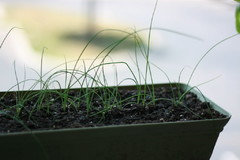
    I have planted garlic chives this year in an ok sized planter (about 2 ft long by 8 inches wide by 8 inches deep). Just in the past few days, it looks like they've started to die off a bit. Is my planter too small (not deep enough)?

  • 18 years ago

    Tranplant shock.. Make sure its watered, but not too much water that the soil is soaking. If they are from seed, they can take quite a while to mature. The roots are not very deep or do they spread very far in their first year. When I want to trasnplant things, I try to add something like a moisture absorber for those dry times, as well as a fertilizer that has vitamins and some natural hormones to help it from getting too shocked. Almost everything I start in small pots and then get transplanted are always doing quite well, after a few days of getting used to their new surroundings.

  • 18 years ago

    cool..thanks! They are doing a bit better now since I placed them in a sunnier spot. I'm going to transplant them this weekend.

  • 18 years ago

    Last fall, I collected seeds from my few plants and replanted the seeds in a new row nearby. I just noticed very thng green stalks emerging. It took from late last summer until now, to get them to sprout and grow just a little. At least I will have a few more of the garlic plants next year.

    BTW, all that junk in the background of the photo is now gone. The canoe fianlly rotted way and the car bumper was sold with the tire. It was the next door neighbors stuff.

  • 18 years ago

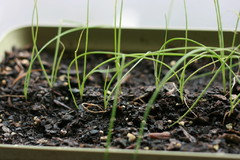
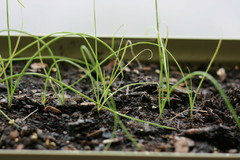
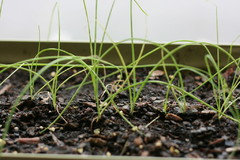
    Here's a few pics of them. Let me know if you see anything wrong besides limited growth space. Thanks! =)


  • 18 years ago

    As chives grow, they form a clump which gradually becomes wider and wider. A mature clump of chives, starting from just one bulb, would fill that pot easily. I would allow at least 30cm apart between plants.

  • 18 years ago

    ok...thanks. =) I was wondering what was going on with them. I'll attempt to transplant to a larger pot.

  • 18 years ago

    They do take some time to mature to the big thick flat leaves. My new seedlings look similar to your photos. As mentioned, they do tend to clump and my mature ones are about 2 inches around, whic lots of leaves.

  • 18 years ago

    Ksrogers, you've mentioned before that you don't have the real chives (Allium schoenoprasum), but the wild onion, from which you use the leaves. Chives have a round, hollow, tube-like leaf, not flat. They are only a few millimetres in diameter at the thick end when mature, about half that of the leaves of a spring onion, which are also hollow.

    Garlic chives (Allium tuberosum) have a flat leaf, similar in appearance to the leaves of other members of the onion family.

    Tn veggie gardner, take a look at some pix of chives at the link below. That should give you some idea of just how big the clumps can get.

    Here is a link that might be useful: chives pix

  • 18 years ago

    I have BOTH GARLIC CHIVES AND WILD ONIONS. The WILD ONION are hollow, tubular long leaves and look EXACTLY like regular chives. The tiny bulb in the soil that these grow from are the size of peas when mature. During the heat of summer the chives do not have green foliage. The GARLIC CHIVES are flat, thick leaves and are NOT the same as my wild onions, as I have pointed out in the past. They have a distictly different color green, as well as the size and shape. My photo above is a shot of my WILD ONIONS (chive), that have green round tubular leaves that I cut up as if they were common chives and they have the same characteristics. Right now, the wild onion/chive are not producing the green leaves, but instead have thin stocks that have a small balls of tiny bulbs on the tips of them. The GARLIC CHIVES are definately different, yes, and have white FLOWERS that bees love. They are NOT in the same photo, however. They are further down at the lower right, and are not seen in this picture.

  • 18 years ago

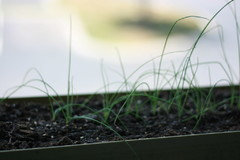
    My chives seem to be on their way down the drain. :-\ So, I think, unfortunately, I may just uproot, mash up a bit & use for food on other plants. I dunno yet though...pics below that you can compare to ones above from a week or so ago.


  • 18 years ago

    Your chives look just fine to me. If you're worried about the drooping, that's what they do - it's normal.

  • 18 years ago

    I have to agree. They look like happy chive seedlings. Chives will take about 3 seasons to get to their full stature. So they will be small for a while. Gardening lists patience as one of the lessons it teaches. :)

    One comment, if you have a nice location in a garden bed, I would expect your chives to fair the best for you there. I'm not sure how they fair in the long run as a potted plant but it is always worth a try.

    FataMorgana

  • 18 years ago

    cool...thanks y'all. I was seriously thinking of uprooting them like I mentioned. I will leave them alone (patience...), then transplant to something larger when it becomes available or I can afford it. :)

  • 18 years ago

    My chive was not invasive but this year with beetles. Will these beetles harm my roses? The white bloom looked so good by my pinkish-salmon rose.

  • 18 years ago

    My chive was not invasive but this year with beetles. Will these beetles harm my roses? The white bloom looked so good by my pinkish-salmon rose.

  • 18 years ago

    I've never saw any beetles on chives. Roses on the other hand are chewed to bits by Japanese Beetles, amongst other insect pests. The beetles were probably visiting the roses.

    FataMorgana

  • 18 years ago

    Late to the party here, but if you're looking for a non-invasive, sterile chive, try Richter's Profusion chives. I bought it 3 years ago because I was tired of trying to reign in the seedlings my regular chives produced - I've got too much garden to catch every flower needing dead-heading, LOL!

    Profusion seems to be a finer leaf than regular chives, but everything else is the same - good flavor, pretty flowers in spring. The patch does get bigger every year and can be divided, but it doesn't seed the whole garden!

    Here is a link that might be useful: Profusion @ Richter's