Software
Houzz Logo Print
saypoint

detaching Cl. Hydrangea from house

21 years ago

I have a large Climbing Hydrangea going up the side of my brick house. I'm having the brick sealed this fall, and will have to pull the vines off of the house to do that side.

Anyone done this before? Anything I should know before I do it? I'm assuming that if I put the vines back up with some kind of support later on, they'll eventually reattach themselves to the house. I hope. Or will I be better of pruning off the branches and letting them grow back on their own. They're more than one story tall and cover most of my kitchen wing.

{{gwi:46117}}

Comments (16)

  • 21 years ago

    Oh my word....I would just not seal this portion of brick (LOL) This hydrangea is too beautiful to harm one leaf!!!

    I have read in a few places that unlike ivy, they can be removed without damage to the surface. However, I have read just as many articles saying that the opposite is true. I am too busy trying to get mine to look like yours does now, to have any first hand experience with a large removal.

    My own limited experience has been, when trying to redirect a stem that had already taken hold, was that as I peeled back the stem, it split (lengthwise) and left the tenicled half of the stem on the tree it was clinging to, and the other half in my hand. Now this stem was still pretty soft and green so maybe a mature woody stem will break away from it's tenicles and leave the stem in tact, in which case I believe, with some intial support help, it will develope new tenicles to re-stick with. Having said that...I don't envy the poor person who gets stuck with the job of trying to untangle and peel back the one in your picture!! and it's also possible that the mature wood will be too brittle to bend. I'd hate to see you have to cut it all the way back, but maybe it would be easier to handle if you just cut it back to where the top of the windows start. If it is true to form, it should take off again rather quickly afterward. Sorry I couldn't be of more help...Maybe someone who has actually had to perform this task will chime in with their experiences. If not, experiment with an inconspicuous stem or two and see what happens. Good luck.....yg

  • 21 years ago

    Jo, I have no first hand experience with Petiolaris + brick, but in case of P. + cedar shingle, removing vine was equal to removing shingles.
    I resorted to cutting, SCRAPING the vine off the shingles, replacing the most damaged one, sanding the rest, painting the whole thing and... moving vine. Thanks God it was not as mature as yours.
    I think that asking the same question on landscaping forum wouldn't hurt.

    Good luck!

  • 21 years ago

    Thanks, guys. I have peeled off small sections of it that were going places where I didn't want them, and redirected them to areas where I did want them, such as the piece on the left. I tied it to a nail in the masonry and it refastened itself with holdfasts and really took off. I just never did it with a very large chunk.

    I know what you mean about wood siding. Cl. Hydrangea is supposed to be OK on masonry, though I believe it can leave stains behind if removed. A previous owner told me the whole house was covered in English Ivy when he bought it, and I can still find traces of it around the trimwork on the attic windows.

    The lucky person who will remove this and put it back again is yours truly, being the resident gardener, chief cook, and bottle washer. :o)

    I may try posting this over on the LD forum.
    Jo

  • 21 years ago

    I have a question about your gorgeous H. petiolaris. After pulling down the vine ( presuming you've tried this), did you have any damage to your mortar? I have an antique brick house and am wanting to plant a climbing hydrangea, but have had conflicting reports on whether it will damage the pointing on the house.
    Cate

  • 21 years ago

    To the best of my knowledge, H. petiolaris does not do the kind of damage to masonry that is done by plants with aerial roots such as Hedera helix (English Ivy). The roots find their way into cracks in the mortar and loosen it.

    Climbing Hydrangea has holdfasts that adhere to the masonry, rather than creep into crevices. I believe that the holdfasts can leave stains behind if the vines are removed, but from what I have read, they are considered safe for masonry walls. I haven't yet removed the vines from my house, as the mason isn't coming until the end of September, but the bits I have peeled back to re-position came away without too much trouble and didn't seem to leave any damage behind.

    Maybe someone else has had more experience with them. I've only been here three years, during which time the vine has about tripled in size.

  • 21 years ago

    I guess I'm willing to try it, and hope it doesn't bring down the house! I'll check this posting in Sept. and see if you have any advice after bringing the vine off the house. BTW, is your home older too? I have a feeling the new brick masonry may behave differently than my 200 year old stuff.
    Cate

  • 21 years ago

    My house was built in 1837, the additions sometime about 10 years later.

  • 21 years ago

    I planted mine yesterday, and will hope for the best over time. I know it will soften the facade of my rather stern federal colonial. Maybe I will get the repointing done this fall, before my hydrangea grows!
    Cate

  • 21 years ago

    Back in college, I used to paint houses. I often ran into English Ivy that had to be removed from brick or wood so I could paint behind it.
    This may work for you. Get a putty knife from the hardware store. You might want to buy one with a rigid blade and one with a flexible blade. While you're at it, buy a putty knife-type tool used for applying patching plaster to drywall. It has a blade that's about four inches wide.
    Armed with these three tools, start at the top of your hydrangea and scrape away at the holdfasts, which attach the vines to the brick. Be aggressive, pulling back the loosened vines as you go. Hopefully, they won't be so woody, they'll snap.
    You COULD build a rough 2"x"2 frame and staple chickenwire to it. This could serve as a back support as the plant is loosened and brought to the ground.
    Good luck. It's going to be a headache or a heartbreak.

    Hyperboy.

  • 21 years ago

    Wow, is this ONE cl hydrangea or are there several planted here? I ask because I have two planted in a small area on my chimney. They are still babies by comparison. I am wondering if I should move one while I still can. Is it better to transplant the climber in the fall or spring? Can it climb vinyl siding and is it safe to have it do so -- I don't want it to pull the siding off the house? Where else can it be planted? Also is that pachysandra in the foreground? THanks.

  • 21 years ago

    Sugar Magnolia, yes, this is pretty much one plant. I don't think I'd let it climb vinyl siding, it can get pretty heavy. A fence or masonry structure such as a chimney or wall would be a better place for it.
    That is pachysandra in the foreground.

  • 21 years ago

    Another option: Plant the climber around the base of a large tree, such as an Oak and let it climb the tree. I've seen Hydrangea vines reach up 25 to 30 feet into the tree's canopy and it is fabulous when flowering. It surrounds the trunk with green foliage and just needs a bit of training to get started up the trunk.

  • 21 years ago

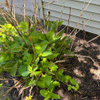
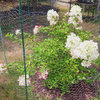
    Update: I peeled the hydrangea off the wall a couple of days ago. It actually came off very easily, and left very little residue on the brick. I only broke a couple of branches, mostly through my own carelessness, one that I didn't notice was hooked on a fastener in the wall, the other I pulled to hard, and a couple of small branches.

    The main stems were quite large.

    Once the brick maintenance is done, I'll maybe prune it lightly to reduce the weight a bit, and fasten it to some wires or something until it sends out some new holdfasts.

    {{gwi:1016592}}

    {{gwi:1016593}}

  • 21 years ago

    Wow, what a job. No residue huh? Very interesting. Thanks for following up with your results.....yg

  • 21 years ago

    Great job, Jo!
    I recently moved Cl. hydrangea that was growing along the stone wall and eventually suppose to climb on a nearby dead tree. I was told that dead tree will not support weight of hydrangea and anyway will fall down much sooner than I think.
    I was surprised too of how easy I was able to peel it off the rocks.
    I checked it the other day and some 'holfasts' already attached themselves to another tree.