Software
Houzz Logo Print
ajfan

Perennial Markers or Labels

21 years ago

With fall upon us here in the North I've been wondering if all my new perennials come up next spring how I will know what is plant and what is weed. What do you all use to label & ID? I'm afraid the little plastic tabs will get lost over the winter months, curious to hear what all of you experienced people use? Thanks a bunch.

Comments (15)

  • 21 years ago

    Try drawing yourself an informal map of your planting beds and labeling what's what. Tags and markers DO disappear over winter or the labels fade. If helpful, you can cut out photos of the specific plant from old catalogs and paste them on to provide reminders of what the plant looks like once spring and new growth resumes. In a couple of seasons, you will be adept enough at recognizing the difference between desirable perennials and weeds and this won't be so critical. But the map will be a good reminder of those sometimes tough to remember plant names.

  • 21 years ago

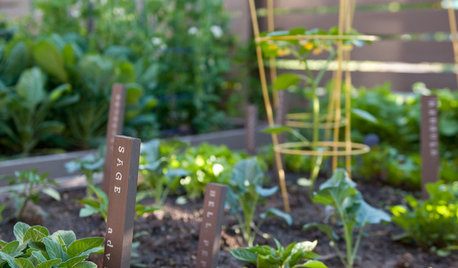
    If you are talking about something that you can insert into the ground next to the plant in question, you can use wooden strips and permanent markers (black), or even aluminum blinds recycled for the purpose. You can often find used aluminum blinds at flea markets or stores that sell used clothing and household goods.

  • 21 years ago

    I buy labels at Bachmans. They're silver stakes with two prongs, and a strip of metal hung between them. You mark them with special carbon pencils that come with. They work well for me, they don't get lost and don't fade.

  • 21 years ago

    As Pam says, a plat is invaluable; if you can, add photos which easily remind you of colors and sizes.

    That said, my best labels are recycled canning lids. Clean and dry thoroughly, punch a hole near one edge, paint with exterior craft paint (mine are forest green to blend with the leaves); use a paint pen such a Painty's fine point to print info on. An amazing amount of info can go on front and back. I then take a wire coat-hanger, straighten the kinks, divide it into two pieces and run one end through the tag's hole [use needle-nose pliers to loop and curl in the raw-cut end]. That leaves 9 to 12" for burying and a nice amount above ground, or a shorter wire can be made into a loop and fastened around a tree branch (very handy for fruit trees). I have some lids that are over 10 years old and still quite legible. I'm experimenting with using avery's labels (the info printed on by computer) and protecting the paper with a coat of clear exterior polyurethane. The oldest is 3 years old and still looks new, so this may be a viable method.

  • 21 years ago

    :) copper roof flashing (groundscored at no cost to myself- it was such an amazing score I actually rang the door bell, and confirmed that the nice old man MEANT to throw half a roll of flashing out!) 'embossed' with a dead ballpoint pen, with a stake made from last year's bamboo stakes.

    another option is a nice rock, painted, and sealed.

  • 20 years ago

    I use the 1" aluminum or plastic blinds ( which I find at yard sales, etc.) cutting them into 5" or longer pieces. I write on them with a permanent marker on both ends. The end that is buried in the soil will not fade, but the other end will, so be sure to write on both ends! A little hokey but the price is right!!

  • 20 years ago

    try this www.dpind.com
    different types of labels and awesome Garden Marking Pen, best i've ever used

    Here is a link that might be useful: http://www.dpind.com

  • 20 years ago

    I went the label route until I found something which is fairly permanent and to me looks very natural: I use rocks about as big as my fist or bigger, and paint the name of the plant on them. Then I set them in front of the plant. Looks great and the price is right!

  • 20 years ago

    I just wait until it gets warm and things start growing a bit.

    Gad, I'm lazy! LOL What's the harm in being wrong and letting a weed grow? Can always pull it.

    This is my first year in this place. I had to do it because I really didn't know what the previous owner had left behind. I was pleasantly surprised by peonies, astilbe and a number of other things. My only 'mistake' were those onions. LOL Oh well, pulled them and all was fine.

    It worked so well last year, I'll do it again! ;)

    (Btw, the map is a great idea.)

  • 20 years ago

    Oh, smom - you have a marvelously laid-back attitude :)

    It's possibly unfortunate, but lots of us have a desire to know what was planted where -- if for no other reason than to learn what didn't survive winter! Seriously, folks who plant lots of bulbs (like me) often find themselves [in December or January] looking for a place to put just a few more, and it's a bit heartbreaking to discover that 'bare spot' you shovelled out was the home of some perennial you had cared for so tenderly the previous summer. At least a label warns that the spot is not so bare underground.

    And then there is multiplying and sharing -- it's nice to know just *which* daffy multiplied so prolifically, and to be able to share the extras with someone, saying "these are Palmares," and knowing for sure that they *are* Palmares and not Triparte or whatever. Same holds true for almost any plant because the happiest ones are going to multiply and sooner or later, you are going to want to share (aka get rid of) the extra babies. I have some lovely plants that were given to me as 'I don't know what it is but it flowers all summerlong' and most of those I enjoy every year, but some I wish I had never set eyes on! I've learned the hard way that sometimes a plant which well-behaved in New York, can turn into an invasive bully in my more southern locale.

  • 20 years ago

    I found a website a few years ago that had copper strips for $.03 each, so I ordered a ton (OK, less than a ton, but lots of them). They work well. Strips of aluminum, cut from soft drink cans work equally well & please the frugal even more than the $.03 copper things.

    Here's what I almost always use: The white plastic plant tags. They're smooth on one side & matte on the other. If you write on the matte side with a very soft (#1 or B grade) artist's pencil, it will last and remain very legible for years and years.

    Al

  • 20 years ago

    You guys have some good ideas.
    I was looking to see what's new since checking out this topic a few years back.

    I will say that in my garden miniblinds are great for annuals but are apt to crack in half over time with perennials. I use them to mark where seeds are planted- or to make a quick label for a pass along plants' new owner

    Probably the best advise is to keep a running list on paper of your purchases/trades- or write the exact name on the receipt.- and keep 'em!

    I keep a garden journal that has all the tags and planting info in there.

    I notice some people keep a running list here on their trade page. If you don't go back and make changes every now and then- the inactivilty will cause your page to 'go blank" and I've heard members find this out the hard way. So if you do that do a copy and paste and save it somewhere else.

    I have tried a drawn map- but I change things around so much a photo is better/quicker- and gives you info on height and color....

    Follow my member page to link for webshop album called plant tags for how to's on how to make from black folgers lids. I think this type of pen is key. Is see they are making them now as calligraphy pens. The one pictured I cannot find in stores now. Make sure it is a kind you have to pump up nad down to get the ink?paint to run to the tip....Sharpies don't last!

    I have purchased metal tags like the ones someone described (altho from a company in paw paw. ) but after less than a year I'm finding a number have lost their metal strip (name plate) So if I was spending money on it again- i would get one that's all one piece of metal.- on the plus side I have to say they are easy to reuse- just cover teh old name with black FLAT rustoleum and write the new name. (not GLOSS)

    I have tried engraving on alumininum tape (adhesive type at menards) and found it very hard to get on the label without wrinkles and very hard to read without wiping it off and having the light shine on it just so.
    I don't bother with those anymore for this reason and the fact that alumininum looks like an eye-sore.

    Hopefully some of this info will help you with your many choices!
    Karen

  • 20 years ago

    AjFan:

    I've been pondering the same question for several years and have generally used the Zinc Botanical Markers found in the Metal markers section of the web site below.

    Actually, most garden centers carry these type of markers and also generally have them in two sizes: one as shown at the link noted in this post and one slightly larger.

    In years past, I used a Dymo machine and "printed" the labels out and fixed them to the zinc markers. I was fortunate if they lasted more than two seasons due to the sometime rapid climate changes on the tallgrass prairie area of central Illinois. Eventually, I gave up on using these labels (Dymo).

    However, I have been toying with the idea of using some of the newer labeling machines with heavier backing tapes, which come in different widths.

    Although they are relatively expensive "toys" if simply used only in the garden, I thought that these machines and the newer tapes could be put to a world of uses - namely the labeling of file folders, etc. in the home and/or office. One could use the regular tapes for labeling folders and other things around the home and use the tapes with heavier backing in the garden.

    Two of the (Brother) label makers that I am currently considering are the:

    PT-1960 Deluxe Labelmaker with Carry Case, 4-Line BRTPT1960, which Amazon is offering for less than $80.00

    or the:

    PT-2610 Labeling System, Includes CD-ROM, USB Cable, AA Batteries, Carrying Case BRTPT2610, which Amazon is offering for under $120.00.

    With a little searching, I suspect that you may find either machine for a little less.

    Obviously, either one is a good chunk of money, but if you can whip up a good excuse to use either one in various situations, they might become "more reasonable." ;>)

    As for me, I'll probably opt for the 2610 model, which has more features, i.e. fonts, uses up to a 1 inch tape, etc. The 2610 model is currently being used by our office/school secretary in the educational building where I work. With the holidays coming up and the potential high price of heat, I suspect I'll put its purchase on a temporary hold and save my hard earned money and purchase the 2610 model early next year with the arrival of spring.

    I already have the Zinc Botanical Markers noted in the link below having purchased them locally.

    Hope these ideas and resources are of some assistance.

    Bill

    Here is a link that might be useful: Garden Markers That Last

  • 20 years ago

    What I have found that works very well, and is cheaper than all of the stuff mentioned above. Plastic dinner knives. I use a paint pen in a dark color; and you can write on the handle or the blade. (I use the handle so that when you stick it in the ground, it doesn't look so hokey). These have lasted several years without fading or breaking. The wooden ones fade and disintegrate over the winter. The small plastic ones that are meant for labels, break over the winter. My garden is way too big to get those fancy copper ones. You can buy the knives in bulk at places like Gordons Restaurant Supply-really cheap for 100 knives.

Sponsored
Peabody Landscape Group
Average rating: 3.5 out of 5 stars8 Reviews
Franklin County's Reliable Landscape Design & Contracting