Software
Houzz Logo Print
claireplymouth

Winter Moth hatch coming soon

The UMass Extension has just published a news release concerning The Warm Winter of 2012 and What to Expect From Winter Moth in Massachusetts.

"As of the second week in March 2012, here in MA, we cannot say for sure what the outcome will be this spring for winter moth damage to plants. However, it may be possible that winter moth eggs could hatch perhaps as early as the third week in March this year and that the host trees will still have very tight buds that will prevent the tiny caterpillars from entering, feeding and causing damage thus forcing the tiny caterpillars to starve."

The critical question for this spring seems to be whether the unusually warm weather will cause the winter moth eggs to hatch before the tree buds are opening. If so, then the caterpillars may starve to death. This would be wonderful (from the viewpoint of trees and tree-lovers), not so great for winter moths (are there any winter moth lovers out there? I hope not).

As of March 9, there were a lot of winter moth eggs waiting to hatch, but no sign of hatching yet.

Claire

Comments (16)

  • 14 years ago

    Already saw two winter moths hatched hanging around under the garage carriage lights last week. And, I saw a black Eastern Swallowtail last week that appeared to have just hatched judging from its flight movements. I've raised Monarchs, so the new flight pattern was familiar. But there is no real food available.

    Jane

  • 14 years ago

    Havent seen one yet. But I'll never forget the Spring of '09 and the damage they did. I will always be aware of them now, as they destroyed my entire rose garden and yard, essentially.
    Lets hope they all starve!

  • 14 years ago

    Thanks for the update, Claire!
    After going all winter without seeing a winter moth, I saw two yesterday!

    Teresa

  • 14 years ago

    Well, I guess it would be too much to ask that all these cold temps might kill a few winter moths, hun? (g)

  • 14 years ago

    I have two Maple Trees; one is facing South, the other East. As of May 5th 2012 the South-Facing Maple has experienced significant defoliation; the East-Facing Tree not nearly as much.

    In Spring 2011 I applied insecticide to the Lawn under both trees, in the hope of killing the caterpillars as they dropped to the ground. I used Bayer Advanced Tree Protect as well. I also sprayed the South-Facing Maple with Sevin as best I could; it is a tall tree and I certainly could not reach the top with my hand sprayer. Finally, I manually crushed as many hanging caterpillares as I could reach, wearing nitrile gloves.

    In Fall and Winter 2011-2012 I saw far fewer Moths, and hoped I had solved the problem. But I had not.

    In 2010 and before I could not even sit under my East-Facing Maple due to the heavy rain of feces. 2011 it was not too bad. So far in 2012 there has been no rain, but it is early.

    I am very disappointed with Bayer Advanced. It may have worked with my East Tree, but certainly has had little effect on my South Tree. I applied more last week, anyhow, hoping it may work better next year. I used $75 worth of the stuff. Maybe I'm a sucker.

    Today I sprayed my South Tree with Sevin, with a hand sprayer, using a step-ladder to get more height. Still, the crown of the tree certainly received no spray.

    Almost instantly I noticed many caterpillars dropping with their silk. Some were just falling off the tree without silk, at least no silk I noticed. Then they lay on the ground, wriggling. Is this a good sign ?

  • 14 years ago

    I'm sorry to hear you are having a defoliating tree from the Winter Moths. We've had them for at least the last 5 years. Some years worse than others, on our large Maples and then they drop down and work on the shrubs near them.

    I'm not sure if you realize that there are dangers to using the pesticide Sevin and any other commercial pesticide. Especially in such large amounts to treat a tree. You might want to try horticultural oil instead. Especially since using the more dangerous chemicals aren't doing the trick any way. I believe someone on the forum suggested using horticultural oil applied at the correct time. Maybe it was Claire? There are also tree companies that offer this service of applying it and can get the entire tree.

    I am noticing some but not a lot of winter moths so far but last year they fooled me and showed up late, so I'm not holding my breath. I don't enjoy them at all. They make such a mess and the poor trees.

    Here is a link that might be useful: Six Dangers The Pesticide Label Won't Warn You About

  • 14 years ago

    I agree whole-heartedly with prairiemoon2, Sevin is a vicious chemical to apply to anything. You may have killed a few caterpillars, but in the process of spraying, the spray will drift around the yard and you probably got hit by it too. It also puts children, neighbors and pets in danger.

    It's almost like the people who celebrate by shooting guns up into the air - those bullets have to come down somewhere.

    The UMass Extension has a good fact sheet on Winter Moth Identification & Management.

    It's too late for horticultural oil, that only works on the eggs. You want something to kill the free-feeding caterpillars. Btk and Spinosad products are recommended.

    Licensed Arborists have access to other pesticides such as Tebufenozid and have equipment that will allow them to spray the whole tree. If your situation is that bad, you might want to just have a professional treat the trees this year and hope the population is knocked down enough so next year will be better.

    Claire

  • 14 years ago

    I would use BT on the caterpillars. It's targets just caterpillars and is much safer for other insects, people, pets, etc. I just bought some last week and sprayed the Amelanchier and Purple Sand Cherry, which have little green caterpillars. Not sure if they are winter moths?? Also sprayed the American hazelnut that was heavily defoliated last year and probably can't survive another season like that.

    I will also use it on the kale and other cruciferous vegetables if the cabbage worms are bad this year again! Last year I tried picking them off and putting them in the bird feeder (they were munched right down), but the kale was pretty chewed on.

  • 14 years ago

    I saw this little guy eating a Heuchera yesterday. He must have come from the Oak Tree shading it.

    Steve

  • 14 years ago

    I agree that Bt is the safest treatment and is the best for mass spraying of trees. We use Spinosad in smaller quantities (on roses, heuchera, weeping cherry) because it is still relatively safe/natural and doesn't have to be re-applied after it rains. But Spinosad is dangerous to bees until it dries, so you have to be careful not to spray it on anything flowering, and not on a breezy day.

    Winter moth has not been quite as bad for us this year. In past years you could stand in the yard and actually hear them munching/see the shower of their droppings. gross. Let's hope they are on the wane.

  • 14 years ago

    I too saw a w.m. caterpillar on a heuchera yesterday. As mentioned above, those critters really decimated my heucheras a couple of years ago, as well as all our maple trees. I hand pulled the bugger yesterday, and am hoping for a better year this year.

  • 14 years ago

    The winter moth caterpillars seem to have disappeared in the past 48 hours. I barely saw any winter moths last winter, and the caterpillars were late to show up here. But I'm thrilled they are now gone. We had some damage to our trees, but nothing compared to last year.

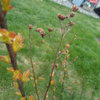
    My maple tree May 2011

    The same tree this year.

  • 14 years ago

    The caterpillars showed up at my place last weekend. It's absolutely amazing the amount of damage they can do in a single day. They decimated the leaves on all four of my apple trees and had taken maybe a third of the canopy on my Freeman maple. There was significant damage to roughly a third of the canopy on my two Zelkovas. I nuked them with malathion and that pretty much ended their onslaught. I haven't seen any damage since. You earthy-crunchy types can save your criticism of me using Malathion. I prefer modern technology to the organic controls that never seem to work for anyone. Malathion is also quite safe to humans. It has been demonstrated that you can drink it without ill effect. I do however reserve its use to plants that aren't blooming. Bees are killed rather quickly by it.

  • 14 years ago

    I dont know about it not being as bad this year compared to last. The damage the things have done to our pear tree might actually kill it this year. Its too bad the migrant birds didnt come through earlier and take care of them when they are still small. We havent had any wild blueberries around here in like 7 or 8 years because of them. At least the birds eat them not like gypsy moths. And I thought they were thinking of releasing some bacteria or something that would kill them at the genetic level. Maybe it harms native moths.

  • 14 years ago

    Msilenus - apparently they released some parasitic wasp in Wellesley. Since I am right on the Wellesley border, it appears that I have benefitted from this wasp. Hence less damage for me this year - as you can see in the photos. I don't think my maples could have survived another devastating year.

  • 14 years ago

    I'm still wondering if it is too early to see how many winter moths there will be this year. I thought someone in RI had posted last week that they were at their peak there. So I'm still waiting to see if we are going to get the same as last year. So far, the damage has been minor compared to past years, but it is still early to say. I was hoping the crazy weather had lowered the population of them. I've seen fewer rose pests so far this year too.