Software
Houzz Logo Print
runktrun

Wisteria Lane

18 years ago

I took a ride around town this morning and took a few snap shots of how different folks grew wisteria. Wisteria is a genus made up of ten species; I believe floribunda (Japanese Wisteria) and sinensis (Chinese Wisteria) are the species most commonly seen in yards throughout New England. To be honest I know little about this plant family (and I am hoping some of you vine savvy folks can fill us in) other than Wisteria sinensis and perhaps other species as well tend to be invasive and is one mighty strong vine that needs to be sited thoughtfully. Im hoping youÂll share photos or thoughts about your wisteria. kt

This wisteria vine that is growing in a shrub like form is very old (to my knowledge 30+ years) with an extremely thick trunk is a cool way to grow this vine without concern for structural damage.


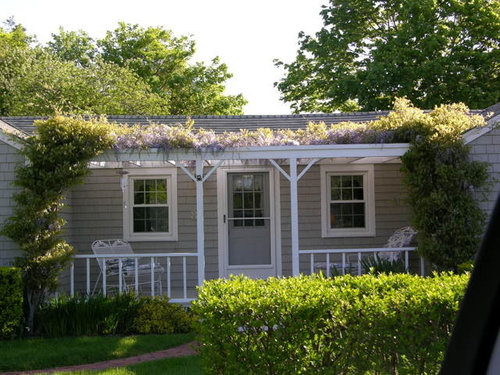
Cute showcase for what might have been considered a non descript cottage. The vine also p rovides them with a shaded summer porch.

This structure that I believe is separate from the from the side of the house is amazing from both outside the property as well as making quite the shady private retreat on a busy street corner.


What can I say here other than to my eye trouble with the roof and electrical meter are but a few short months away and I am sure Joe would be sharpening his axe if I dared to try this?


Across the street the neighbor seems to have a volunteer!!!


Here is a white wisteria vine that I planted ten years ago growing up an oak tree. I had visions of a grand romantic white corner with white azaleas below, sadly what I didnÂt consider was the timing of the bloom Â.this vine holds off and blooms just after the oaks leaves have matured so the only way I have ever seen a flower is by standing directly under the tree and squintingÂnot exactly what I had dreamed of.


Here is my wisteria standard that is again ten years old and I do like how it has spread the length of the fence but I wish I would have sited it further back away from the fenceÂhmm I wonder if I have what it takes to move this next winter.

Comments (30)

  • 18 years ago
    last modified: 11 years ago

    Those are beautiful photos--spring in New England! You did a great job capturing the beauty of it all with the single theme of wisteria running thru each photo. We are lucky to live in such a beautiful part of the country.

  • 18 years ago
    last modified: 11 years ago

    I was just reading that branches of the wisteria native of China (Wisteria sinensis) wind and wrap from left to right in an anti-clockwise direction whereas the wisteria from Japan (Wisteria floribunda) twist and wind round in a clock-wise direction from right to left. I wonder why? kt

  • PRO
    18 years ago
    last modified: 11 years ago

    When do your prune your wisteria? I waited until early spring and got no bloom this year.

    WG

  • 18 years ago
    last modified: 11 years ago

    WG,
    Sorry to hear about your lack of bloom. I am the last one on this forum to ask advise about pruning but I prune my standard right after it blooms and again later in August. I was told that wisteria needs to be pruned twice once right after blooming and again either in August or March. Typically you want to cut down to the third or forth node. kt

  • 18 years ago
    last modified: 11 years ago

    kt, what a beeayooooteeful standard. I am very envious. we still have a 20 yr. old wisteria that has never bloomed. need to get out the baseball bat to scare the heck out of it, but i keep forgetting about it.

    Off topic but garden-related: might you post photos of the approach to your house?in different seasons? I have a friend who has a house and front path much like yours and I told her about your handsome front garden but i can't find my photos of it....
    thank you,
    mindy

  • 18 years ago
    last modified: 11 years ago

    Hi Mindy,
    Thanks, and I highly doubt I have photos of my front entry garden in all four seasons although I keep intending to do so as it would be a great learning tool. Congrats on your new retail operation. kt

  • 18 years ago
    last modified: 11 years ago

    kt, any photos would be helpful for her. the ones you posted 2 yrs ago would be great, if findable!
    thanks again,
    mindy
    "selling plants to pay for plants"!!

  • 18 years ago
    last modified: 11 years ago

    kt - Nice pics. I would be hard pressed to find neighbors with wisteria! Just the idea of moving your standard is giving me heart palpitations! You certainly are an intrepid transplanter! My wisteria that blooms died back by half this year. Boo hoo. Good thing they grow so fast. Of course the one that doesn't bloom grows faster!

  • 18 years ago
    last modified: 11 years ago

    hi kt
    I just back from Japan and moving to Salem ,MA next week. I stayed Japan for 7 weeks and saw many wisteria,s bloom in such small garden.
    you did great job taking beautifull photos!.
    We have two group of /strain of wieteria. One is Noda fuji other is yama fuji, vine turn right or left turn can tell which is which. We have 1200 years old, 800 years old wisteria. some has 3 feet long boolm or longer. some are tree form.

    mindy
    There are many tricks to make wisteria to boolm and controle first growth. Over one thousand years we are growing westeria and useing it in garden. we learned some tricks past thousand years. ^^
    You have to know why you need to banging wisteria trunk , also you can you use knif to have same affect. twising twigs, pruning right timeing and where, watering fertilizing and what kind of fertilizer and when to feed makes different.

    New England forum is much faster pace than other area's forum and moving to next page very qickly.
    After I settle at Salem, I will write again how to prune, make it bloom, I also teach Japanese gardening somewhere metro Boston area if I can find place to teach.

    I will rewrite again later days this subject.
    yama

  • 18 years ago
    last modified: 11 years ago

    And then there's the do-it-yourself, work in progress, type of wisteria structure, which I've been calling a pseudo-standard. About 10 years ago I found a few small wisteria vines in the yard, no blooms, and I decided to see if I could make a standard out of them. I still lived in NYC and couldn't fuss over the vines, so I bought a garden obelisk and tied the vines up the center. Over the next many years I pruned it according to the AHS Pruning and Training Manual whenever I got up here, and it finally blooms, although not profusely.

    It also got moved twice because of construction.

    Blooming was helped enormously by fierce windstorms which bent over the original obelisk and the vines (something like hitting it with a baseball bat). After the second windstorm I tied rebar around the obelisk and used stakes and rope to get it through the winter.


    I have no idea what type of wisteria this is, but I like the color of the blooms.

    Wisteria are only showy for a short time, so this one doubled as a suet feeder this winter and spring.

    I wanted to wait until the blooms were open fully before posting, but thunderstorms are forecasted for tomorrow and who knows what will be left.

    Claire

  • 18 years ago
    last modified: 11 years ago

    I forgot to show what the "trunk" looks like. Not elegant, particularly with the rebar, but I'm hoping it'll show some character when it grows up. Or I can just let the vines cover it.


    Claire

  • 18 years ago
    last modified: 11 years ago

    i'm intrigued by your rebar obelisk. is it pointed at the top and if so, what holds it together at the point(I have read elsewhere about using auto hose clamps for this purpose.) And what are the horizontal bands? are they connecting the rebar supports? all this because we're thinking of making thin rebar obelisks for the billion clematis we just got!!my upside-down tall tomato cages work as obelisks for some clematis but they're not big enough for the more boisterous ones.......
    thanks,
    mindy

  • 18 years ago
    last modified: 11 years ago

    mindy:

    The rebars are just reinforcing the legs of the original green obelisk which I left in place. The obelisk came in two sections and the upper section pulled out from the lower section when the wind got too strong. I also tied the two sections together. I pounded the rebars into the ground and used cable ties to lash the rebar to the legs of the obelisk. I'm very fond of cable ties - they're easy to use and to remove if they don't work out, and they look better than hose clamps. I just used some from Home Depot, but Lee Valley has a nice heavy duty assortment.

    If you're willing to spend a fortune (and I doubt you are), Gardener's supply has some great Teepee supports.

    Claire

  • 18 years ago
    last modified: 11 years ago

    yama should have great expertise on constructing supports for vines and tying them together. Maybe he'll check back in and advise.

    Claire

  • 18 years ago
    last modified: 11 years ago

    Hi Claire
    I finished 70% of paching to move to Salem.I will be in Salem some time next week.

    To controle growth, you can use growth regulater. Product called "Atrimic" There are more of growth regulators but I have not tested yet.
    If wieteria is in pot, this time of year, Place in larger pot and fill water half way. keep wieteria in water for abot 10 day to 2 weeks. When leave start to yellow, then you pull out from water and maintain normaly. keep wisteria in water kill/disturb fine roots which slow down groth.

    Other way to control growth of wisteria is pinch or twist twigs but not cut off nor broken twigs . When twigs/ new growth damaged mildly, wisteria stop/slow down growth and try to repaire damaged place, which slow donwn new growth and help to make wisteria more flowers.

    Twisting twigs to slow down growth and make then to produce more fruits is offten applied by many orchard growera all over Japan.
    When you hit trunk of wisteria, dameging bellow bark which growing rapidly and sending food /suger made by leave is also disturbed.( Cumbium? sorry I don't have Japanese English dictionary with me)
    You can cut bark with sharp knife and injuring tree trunk works pretty much same way as hitting wisteria trunk.

    soryy for miss spellings and bad grammer.
    I will try to write more later. It is more to learn ^^. yama

  • 18 years ago
    last modified: 11 years ago

    Hi claire.
    When we grow wisteria, we have only one main trunk and never allow to rap other vine to grow. when wisteria get old, one single trunk show beauty of bark/ageing and lots easer to maintain. also never plant wisteria next to arbor post. Time to time post have to replace, if Wisteria is planted 2 to 3 feet away from post,it is easer to replace post without damaging the wisteria.
    yama

  • 18 years ago
    last modified: 11 years ago

    Claire,
    I thought you might like to see another wisteria tree grown in the same fashion as yours. This tree is thirty to forty years old and the *trunk* circumference is about three feet. I don't know if it is the result of pruning or the variety but this tree has some of the largest flowers I have ever seen.
    Yama,
    Thanks for sharing all of the great information, once you get settled I would love to know if there is a way to encourage a wisteria to bloom earlier (a week or two) than it normally does. Good luck with your move and I certainly am looking forward to one of your workshops. Safe travels. kt

  • 18 years ago
    last modified: 11 years ago

    yama:
    I'm thinking that at some point I'll have to put a support farther away from the "trunk" when the branches get thicker and heavier. The rebar will be easy to remove and I can cut off the old obelisk at ground level. I'm hoping the wrapped vines will merge into one interesting convoluted structure.

    I use to visit a wisteria standard in the Brooklyn Botanic Garden that had such a support (I'll dig through my older photos and see if I can find it).

    KT:
    Thanks for the photo - I'll show it to my wisteria for inspiration.

    Claire

  • 18 years ago
    last modified: 11 years ago

    Hi claire
    Your Wisteria is small than kt showed which much easer to collect form of the tree/tree formshape. If I do ,this is how I do.
    1) remove all secondary vine from base and trunk.all of it.
    don't warry makeing bare. it will fill quickly. ( Do it early spring or late winter) when you prune vine , 1/4" off from trunk and clean wound with shape knif and apply wound dressing for bonsai. ( remove rest of 1/4' stub with sharpe knif)One I like to use is plastic film,which is thin and become hard when dry. ( It is in tube in liquid form)

    2) suport.
    we use two 4" diameter plus/ minus logs/fence post, Instead of 90 degree, both post lean to inside about 10 degree and short log of 24" to 30" attach to two posts.
    Leaning post slightly inside angle is ornament purpos. looks better that way. horizonal post should be higher than half of turank lenght. 2/3 of hight is ideal. if horizonal post set too low , tree may be shake and it is not good for the tree.

    wave form.
    Have you seen dragon dance of chinese ? long flowing wisteria vine to from "wave" shape. it is intresting form for larger garden.
    wisteria arbor, wave form and tree form.
    I am not for let's wisteria climb onto wall of building for many reasons.

    I am going to teach Japanese gardening in future if new job allow me to do it. Check myjapanesegarden.org time to time. I don't post much on gardenweb japanese garden forum any more. web master of myjapanesegarden.org gave me freedom to write whatever I like to write.
    Once I settle, I will learn how to post photos and drawing.
    ( If I send it to myjapanesegarden.org , someone will post it for me.)

    kt
    I am sorry. I don't mean to take over your post.Wisteria flower is in my family emblem aso wieteria is be loved tree/flower by many Japanese past hundreds of years and now.

    yama

  • 18 years ago
    last modified: 11 years ago

    yama: Do you mean a structure shaped like the Greek letter pi? (without the fancy flourishes).

    {{gwi:1073036}}

    How is the wisteria fastened to the horizontal bar?

    I've never seen the dragon dance wave shape wisteria - sounds beautiful.

    Claire

  • 18 years ago
    last modified: 11 years ago

    But with the right leg splayed out like the left one.

    Claire

  • 18 years ago
    last modified: 11 years ago

    Yama, I'm reading your posts with fascination. I don't have the space for a wisteria but now I wish I did! Maybe my next house...

  • 18 years ago
    last modified: 11 years ago

    Hi greening.
    you can have wisteria bonsai or potted wistteria.
    unlike other plants/trees, when we transplant wisteria, we do not prune roots. bandle up roost and tie with natural fiber twine. understand how wisteria grow is key to have beautifull wisteria flowers.

    Claire
    I made Word of daragon dance . Japanese term is Fuji nami, "fuji" means wisteria, "nami" means wave. fuji nami form take large space. it is not for small garden.

    I am moving to Salem this week. I have been teaching Japanese gardening. I don't know when and where yet. But matter of time, I am going to offer Japanese gardening class. teaching how to make gardening tools such as bamboo broom,trypod ladder, joint twel. teaching how to handle large boulders manualy, making bamboo fence, how to make root and ball by hand, how to prune, how to sharp tools Japanese garden history, or design prencipal etc
    you are welcome to attend my class. my class is slow pace, long hours,get your hand dirty type class. many peoples drive hunreds of miles to see me.

    I had hundreds of cuttings,seedling of wisterias, varigated wisteria, mature wisterias...... all losted

    yama

  • 18 years ago
    last modified: 11 years ago

    yama san,
    ohayo gozaimas.i don't know if you will be hiring yourself out for japanese garden work but I have non-blooming wisteria and 50 momiji that could certainly use your help.
    Honto desu! my arboretum garden is 30 minutes from salem.
    plse contact me after you move to salem!! kudasai!!
    domo arigato gozaimas.
    Mindy opinionatedchef@comcast.net

  • 18 years ago
    last modified: 11 years ago

    Hi Mindy
    I got to north shore yesturday and waiting for weather to clear to unload. It was long drive, almost 1200 miles to get here.
    You have met Cady at Boston , when Mark keane had lecture two years ago. Cady remember you.^^

    I brought most of tools with me. some of tools I left to pick up later day. I left most of my books at friend's garage at Greenvill, SC. Before I get back books, I have to make booke cases to make fit about 1,000 books.
    Moving is lot's of work.
    I will contact to you soon after unload.
    yama

  • 18 years ago
    last modified: 11 years ago

    YAMA,
    I would be very interested how to handle large boulders manually?
    Barb

  • 18 years ago
    last modified: 11 years ago

    Hi Barb
    Use chain hoist, wire cables, three hichory logs about 14 to 16 feet long , tie three logs with 1/4 inch wire cable and few other tools. two peoples can handle 1 to 1 1/2 ton boulder. 2 to 3 ton boulder need 3 men to handle, more than 4 ton, may need 4 men to move boulder. Boulder can go up stairs or down, go over two to 3 feet hight wall. When you use trypod with chain hoist, you can set boulder up side down, side up,or any posion you like to set the boulder. large tree can be also move with trypod.
    try pod can go anywhere, wet ground, uneven ground can be use where heavy equipment can not to reach.

    If garedn gate has enough clearance to move the boulder, boulder can be set without damageing near by tree, plants or any structures.
    If I take time, I can handle 1 ton boulder myself without hurting myself , structure or trees, shurbs near by.

    I don't know when, but will have Japanese gardening class which can be helpfull to any styles of gardens.

    Check www.myjapanesegarden.org
    web site of Japanese gardening.
    Iam going to post photos over there later.but photos show only portion of handling boulder.
    yama

  • 18 years ago
    last modified: 11 years ago

    Thought I would share this happy accident, we are planning on replacing the fence cap to the fence so I never tied down the clematis "Etoile Violet". I think this may be a great companion plant for a wisteria tree as this is a class 3 clematis that I hack down to 12" every winter.

  • 18 years ago
    last modified: 11 years ago

    Hi kt
    Please google serch " Casper Wistar". You need all day to look all of informations ^^.
    Name of wisteria is hornoring Dr Casper Wistar . If I can get permiision form Mr kawaharada to post pictures of wisterias from his wisteria book and his father's wisteria book, I will post photos later.
    yama

  • 18 years ago
    last modified: 11 years ago

    Yama,
    How right you are there is a ton of information about Dr. Casper, The Oxford University Press had this to say; The name of this vine was given by Thomas Nuttal, curator of Harvard's Botanical Garden, who made an error in spelling the name of the man he planned to honor. That man's name was Wistar. But at the death of the honoree in 1818, the plant was named wisteria. Nuttal wrote in his Genera North American Plants II , "In memory of Casper Wistar, M.D., late professor of Anatomy in the University of Pennsylvania." But too late. Nuttal had already named the plant wisteria.
    The following I discovered at Associated Content published by Donna and thought was interesting as well.
    The world's largest wisteria vine grows in Sierra Madre, California. There is even a festival honoring this mammoth wisteria vine and the plant's namesake. The Wistaria Festival takes place annually in this community in California that is home to the more than 100 year old wisteria vine.
    The popular and showy wisteria vine was originally named Glycinia after the word "glykys," which is Greek for sweet. An American naturalist, Thomas Nuttall, renamed the wisteria in the 1800s to honor a renowned botanist at the University of Pennsylvania.
    Even though the plant was named in honor of Professor Casper Wistar, his named was accidentally misspelled and the 'a' was replaced with an 'e'. The name was never changed, and wisteria has been the common and botanical name of this plant ever since.
    The masterpiece wisteria vine growing in California is so large that it has received a place in the 'The Guinness Book of Records'. It has been named as "The largest blossoming plant in the world." This amazing wisteria vine is more than one acre in size and weighs 250 tons.
    It has more than 1.5 million blossoms every year with 40 blooms per square foot. The branches of this unbelievable wisteria vine reach an amazing 500 feet long. Horticultural experts have estimated the branches can grow 24 inches in 24 hours.
    The world's largest wisteria vine is a beautiful lavender Chinese variety. It was planted in 1894 by William and Alice Brugman. The couple bought the plant at a local nursery for 75 cents and planted it near their home. They eventually sold their home twenty years after planting the wisteria. H. T. Fennel bought the home and fell in love with the wisteria vine and began building arbors for it.
    The wisteria vine continued growing and became too large for the supports erected by Mr. Fennel. The huge plant eventually began growing onto the house. The roof could not support the weight of the giant wisteria vine and finally the roof collapsed. The house was demolished in 1931. They built a new house close by. New supports kept being added for the wisteria and it was allowed to continue growing.
    This extraordinary wisteria vine was honored with its first festival in 1918. This tradition has continued every year since. The festival has approximately 15,000 visitors each spring to celebrate the world's largest wisteria vine.
    This magnificent antique wisteria vine has been named one of the seven horticultural wonders of the world. It takes an honorably place with the gardens of Buckingham Palace, the redwood forests of Sequoia National Park, Brazil's tropical jungle in the Amazon Valley, India's gardens of the Taj Mahal, Japan's Yokohama rockgardens, and Mexico's Xochimilco floating gardens.
    Thanks yama and I we can view Mr Kawaharada's photos. kt