Software
Houzz Logo Print
cascadians

A Weed I like, so vibrant, lush, pretty

19 years ago
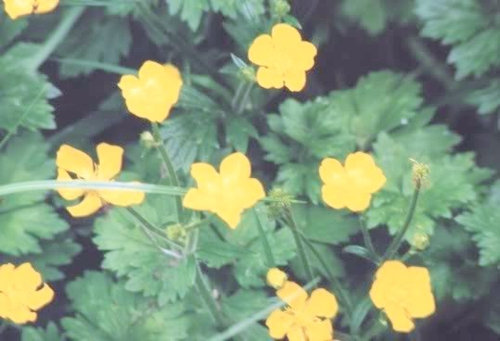
Wet yard, swampy parts, creeklets in winter, lots of this plant taking hold along creeklets and other spots, think it's Creeping Buttercup, Ranunculus repens, looks so tropical and foresty, lush vibrant green, exuberant, very pretty bright cheerful yellow flowers.

Do you allow a weed you like in your yard?

">

Comments (25)

  • 19 years ago

    Am I allowing the weeds, or are they allowing me?

  • 19 years ago

    It's too vigorous and hard to pull to allow it in my garden. I've been fighting it for years. I am slowly winning the battle. My neighbor uses lime to combat it in his pasture.

  • 19 years ago

    I agree with Botann. It's the most difficult weed to remove. Don't let it in your garden, you will regret it. It's almost as bad as the Varigated Bishops Weed/Aegopodium podagraria they sell at the nurseries.

  • 19 years ago

    Have a problem with horsetails here, don't want them, always pulling them up by the roots. Neighbor has them thickly and does nothing so no chance of starving the horsetail roots snaking underground.

    But this buttercup is so pretty. Looked up that Bishop's Weed, also very pretty, site said to plant that only in containerized area.

    Have had some type of weed not in either of my weed books, very large leaves, enormous tuberous root, now trying to get rid of that since it just keeps growing if left alone, taller and wider with no apparent end in sight.

    The buttercup seems to stay fairly compact. Figure not much else will grow along swampy creeklets. Apparently it was sold as an herbaceous perennial groundcover in nurseries.

    What some ppl think of as a weed is a treasured bought cultivated exotic to others. I'm just beginning gardening, know hardly anything yet, but having a lot of fun. Hopefully won't rue letting the buttercup creep along little creeklets.

  • 19 years ago

    That's one I'm trying to get rid of before it spreads into the woods. It just got started on our property a couple of years ago and had spread quite a bit before I spotted it. I assume it was birds that brought the seed.
    I can pull it with the tool designed for pulling dandelions, but I don't know if that eradicates it or if it just comes back from some roots left behind. Anyone with more experience with doing it that way?

  • 19 years ago

    ARRRGGGHHH!!! Buttercup!!

    My first year gardening here, I thought they were beautiful and harmless too, so I wasn't particularly serious about eliminating them. Now they are everywhere. Seek and distroy.

    I have a small ground hugging succulent sort of thing - I thought the previous owner planted it. I saw a picture of it on a weed list. I let it stay because the summer flowers make a nice background in a perinneal bed and it is very well behaved. I guess by that definition it is not a weed....

  • 19 years ago

    Pull it, pull it, pull it, or you'll be sorry, it crept into our garden from the neighboring yard I found it hiding behind a poor unsuspecting shrub over 40 years ago and I still can't get rid of the damn thing.

    A......

  • 19 years ago

    I am going to use Weed and Feed in our lowland rental. Hoping it will take care of it. Lawn is almost 1/3 buttercups. Killing out the lawn (the buttercup is). Hope this will work. Please do not cultivate it. I am sorry you are having to deal with it at all. good luck

  • 19 years ago

    Ahhh, Buttercup! I was lured into growing it when I first got my house. Believe me, big empty beds; few plants; and I didn't have much money. People warned me about it, I ignored them all. Preferring to gush over the dainty butter yellow flowers. "I have plenty of room for them to spread" I said, "It's such a sweet little flower, it could never be a thug."

    The truth, buttercup spreads rampantly! You will not be able to control the growth, it doesn't edge well (grows into the lawn very easily, if that's what you want); if you don't pull it when it's young, then it's very hard to get rid of. It grows into other plants, oh and it tends to flatten out and get a bald spot in the middle.

    Just thought you should know.

  • 19 years ago

    Fields near my house are covered with the stuff. It gets a foothold and next thing you know it is coming up everywhere. It is a real problem in my yard this year and when I finish getting my vegetables in soon I will go around and dig out all the plants I can and bag/throw out the flower stalks to prevent more seeding. If I'm not mistaken it is poisonous to livestock so not a good thing in fields.

  • 19 years ago

    You wrote:
    "Have had some type of weed not in either of my weed books, very large leaves, enormous tuberous root, now trying to get rid of that since it just keeps growing if left alone, taller and wider with no apparent end in sight. "

    It's probably wildcucumber.

    As for the yellow cutie, as others have said, get rid of if you can. If you don't, it may someday knock on your back door!

  • 19 years ago

    I like that one too. Don't have it here, but did up north.

    Also, I like to leave some dandylions in our lawn for color, as well as daisies.

    In our yard now, I let some oak seedlings remain here-and-there.

    A few violets too.

  • 19 years ago

    I'm not sure if those are the same as in our yard, but if they are be careful when handling them, they've got some spikes. I'm in an onward struggle with them. They're scheming behind my back I tell you.

  • 19 years ago

    I have those nasty (but deceptively pretty) buttercups too, some are growing right in the middle of fav rose bush so I can't even dig them out properly. I just keep pulling them out the best I can and hope they give up.

    I do leave the daisies alone though. They get mowed down regularly and don't spread much.

  • 19 years ago

    I couldn't figure out what was choking out my grass in the backyard and making it lay down instead of stand up tall. I bent over and really looked it was this same weed. So I spent last Sat on my hands and knees in my yard pulling by hand this ugly weed. Thank goodness it never flowered and went to seed. My advice if you like your flowers and or grass I'd get rid of it before it gets rid of your flowers and grass.

  • 19 years ago

    Or, you could alternatively have a jungle of the stuff.
    It gets quite tall you'd be surprised.

  • 19 years ago

    Puppy3, try the dandelion weeder. I've used mine to pull it and it does a pretty good job if the soil is moist, which it usually is where they thrive. I haven't concentrated on one specific area to see if it completely eradicated them, but it definitely slowed down their spreading. I provided a link to a picture of one in case you're not familiar with them.

    Here is a link that might be useful: Weeder

  • 19 years ago

    Is that buttercup a type of geranium? It reminds me of some of my hardy geraniums because of its leaves and overall shape. I also didn't realize it was a problem weed. I have one in my yard that I was kinda liking. I'll go home and yank it out today since there are so many strong opinions here.

    Fran

  • 18 years ago

    Well this creeping buttercup is leaping all over my yard. I'm wondering, when my trees get big and it's all shade, if this stuff will persist longer than the fleur de lawn (dwarf rye, strawberry clover, yarrow) or whether it will vanish and the yard will be 100% moss and miniature ivy under the big trees?

    It is blooming now, tall bright yellow flowers swaying in the breeze, very cheerful. Really love this stuff but it IS rampant and gets high.

    Have a bunch of new weeds, have to take pictures and ask y'all to ID them if my 2 weed books don't.

    Really need a comprehensive bug book also ...

  • 18 years ago

    Cascadians, isn't gardening wonderful! The plants that are pretty and easy to grow turn into thugs...the ones you nurture and look after like they are precious gems die. It's fun though to experiment and find out what is good for your garden. I'm fighting the darned buttercup all over our place and right now it is winning.

  • 18 years ago

    I spend much time digging this weed from my garden. Cascadians, if you like the look of it, the civilized version is Trollius, looks like creeping buttercup but bigger flowers and not so thuggish, at least not so far. They like wet places.

  • 18 years ago

    I have lived on this property for 31 years. We have always had a patch of buttercup in a wet area across the driveway from my main perennial bed. It has not spread beyond the wet area. It is being challenged by mint which came from who knows where. On my property the mint is the much bigger problem and the buttercup has been well behaved. jwww

  • 18 years ago

    We only moved into our house about a year and a half ago. I am shocked this spring to see far the creeping buttercup has invaded since last year.

    I thought I was keeping on top of it reasonably well, but it has really gone to town in our lawn and is threatening two of my flower beds. It's very hard to dig up because the roots go very deep, and send out many, many shoots. If you don't dig deeply enough, the roots just break and new growth pops up again in a matter of days. Obviously, digging deeply, and widely, is not so easy in the middle of the lawn or an established bed! :-(

    We live adjacent to a natural ravine and the buttercup is also rapidly taking over that area, crowding out the already scant native plant presence. We are working with neighbours to try and save this area, but it is an uphill battle.

    Beware the buttercup!!

  • 18 years ago

    I've seen 3 kinds of Ranunculus in my yard, the short kind that likes water and shade, the tall one that has 1/2" flowers, and a tall one with smaller flowers and more branching in the flower stalk. Cascadians, the short one is taking over shady places at the edge of some of my Hazelnut trees so I think they may spread into your shade under trees too.

  • 18 years ago

    Surprised to see this stuff shooting up in March, like clover only comes up in big fluffy spirals. Is starting to flower now, yellow flowers, very pretty plant, looks much like upward spiraling clover until it flowers when the top leaves get more pointy than clover. Looked in my weed book and it is Lotus corniculatus, Bird's Foot Trefoil.

    "It is used in agriculture as a forage plant, grown for pasture, hay, and silage. Taller growing cultivars have been developed for this. It may be used as an alternative to alfalfa in poor soils. It has become an invasive species in some regions of North America and Australia.

    A double flowered variety is grown as an ornamental plant. The plant is an important nectar source for many insects and is also used as a larval food plant by many species of Lepidoptera such as Six-spot Burnet. It is regularly included as a component of wildflower mixes in Europe."

    "Birdsfoot trefoil is a perennial, fine-stemmed, leafy legume that has become of increased importance in American agriculture in recent years. Introduced by chance from Europe, strains selected in this country are now of major importance as pasture and hay crops.

    It is hardy and adapted to areas of ample moisture supply from the Ohio and Potomac Rivers north into Canada and west to the edge of the Great Plains, also in humid parts of the Pacific States. The leaves are sessile along the stems, each with 5 linear to oval leaflets. Stems are decumbent unless in fairly dense stands, reaching 20 to 40 or more inches in length. The plant has a deep, branched root system and tolerates both wet and moderately dry conditions.

    It is unusual among legumes in that it does not cause bloat in cattle. Both as pasture and as hay it is highly palatable and nutritious. Harvested seed increased 6-fold from 1949 to 1959, and in the latter year was sufflcient to plant about 300,000 acres, according to census data."

    Cool. Letting this one stay and grow, very pretty, blends in well with the strawberry clover. The slugs don't eat it!

Sponsored
Peabody Landscape Group
Average rating: 3.5 out of 5 stars8 Reviews
Columbus' Reliable Landscape Design & Contracting