Software
Houzz Logo Print
newgeneral

Dogwood developing brown leaves

20 years ago

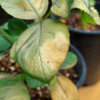
Last year, starting in about July, one of my dogwood trees developed brown crispy leaves. It began on the leave tip and edges and within a month or two each leaf was nearly entirely brown. The tree is a Chinese Dogwood (Cornus kous 'Chinensis'), which I believed was not susceptible to anthracnose. It is a young tree. I purchased it from a reputable nursery and planted it in the fall of 2004. Already this year I see signs that the problem is beginning again. Can anyone tell me what this is likely to be and how I can treat it?

Thanks!

Comments (11)

  • 20 years ago

    These are susceptible to a number of diseases and pests besides dogwood anthracnose. First make sure you planted at the right level. Then consider the type of soil you planted in. Is it getting adequate water? Suggest you take a plant sample to local nursery (perhaps the one you purchased from?) for qualified diagnosis.

    Here is a link that might be useful: Diseases

  • 20 years ago

    It does sound like anthracnose to me. I looked it up on the Oregon state web site, and it says that 'Chinensis' is very susceptible.
    Here's the site: http://plant-disease.ippc.orst.edu/disease.cfm?RecordID=421

    The WSU Hortsense page lists a bunch of resistant varieties, and 'Chinensis' was not listed.

  • 20 years ago

    C. kousa 'Chinensis' is generally considered a botanical variety not a clonal selection like most listed, though there is some disagreement on that point. According to Cappiello & Shadow: "Many of the better, more vigorous cultivars on the market are selections of var. chinensis." And, for example, "'China Girl' is likely a selection of C. kousa var. chinensis."

  • 20 years ago

    If you look earlier in their section on Kousa there is a full discussion on why C & S think var. chinensis is legit.

  • 20 years ago

    While kousas and their varietals and cultivars are often listed as anthracnose resistant, that doesn't mean they are immune to this problem. And as noted, there are other fungal problems that can affect dogwoods, specially in our mild damp springs. Often these may not show up until somewhat later in the season. Take a good sample into a local nursery that does problem diagnosis or your local extension office.

  • 20 years ago

    Anthracnose doesn't begin and progress as was described, namely "a leave tip and edges and within a month or two each leaf was nearly entirely brown"

    Drought stress does.

    This is a recently planted tree. Check the moisture condition of the *original* rootball. Likely it is dry. And this can be true even if you have "watered" it.

  • 20 years ago

    This is the tree's second summer. It was planted in the fall of 2004. I will pay closer attention to the moisture in the soil, as this will help no matter what the problem is. But it does seem too early for it to be showing signs of drought stress, considering all of the rain we have had this spring. The soil around the tree is mulched with bark.

    I have studied pictures of anthracnose and can't determine if that is the problem. Anthracnose exhibits a purple border around the leaf damage. Some of the brown spots on my tree's leaves do have a reddish, perhaps purplish border, when viewed from the underside. But nothing is visible from the top.

    The closest nursery that I would consider "reputable" is a 50 minute drive away. I will take a sample with me when I am next able to go there, probably in about a week.

    FWIW, I planted a Korean dogwood at the same time that I planted this afflicted tree. The Korean dogwood is in somewhat better soil, but not far from the Chinese dogwood. It has not experienced this same problem. That is what leads me to believe that I inadvertently planted a variety that is very prone to anthracnose, and I fear that I will ultimately have to destroy this tree.

  • 20 years ago

    You wrote: "it does seem too early for it to be showing signs of drought stress, considering all of the rain we have had this spring."

    But it takes at least two years of regular irrigations to help a new tree establish a vigorous rootzone that extends beyond the original rootball.

    Thus, even though we had a rainy winter, the original rootball could now be dry.

    The way to know for certain is to check the soil. The soil beyond the original rootball may well be moist and that's because the roots have not yet extended out very far at all. Thus they still rely on what is contained within the original rootball.

    A way to help determine if the tree has established a sturdy root system is this:
    Grasp the tree trunk at chest height; Rock the tree back and forth and, at the same time, watch the surface of the soil at the base of the tree.

    If the soil moves any small bit, the roots have not yet established.

    I still vote for drought stress. In part because the poattern of browning you described does not not fit anthracnose.

  • 20 years ago

    You wrote: "The Korean dogwood is in somewhat better soil, but not far from the Chinese dogwood. It has not experienced this same problem."

    It really wouldn't matter if you planted a dozen of the same kind of tree. Each tree is an individual. Some come with a better root system than others. Some are weaker, others are stronger, all due to previous care and handling begfore you even obtained the trees.

    And even if that dozen trees were in a row, each would have a slightly different exposure. And each could even have slightly different soil conditions. As you said, the Korean dogwood is in slightly better soil.

  • 20 years ago

    Ok, I will give this tree lots of TLC and hope for the best. The soil around the tree was damp under the mulch, but I have left a hose on slow trickle right at the trunk of the tree all day. The roots, as you suspected, are not well established.

    Thank you all for your help.

Sponsored
Peabody Landscape Group
Average rating: 3.5 out of 5 stars8 Reviews
Franklin County's Reliable Landscape Design & Contracting