Software
Houzz Logo Print
panic_panicum

Sedum/Succulent garden

16 years ago

I would like to start up a conversation again (the last posting on this subject was from 2005) about planting sedum, grasses such as Carex, etc to create a garden with a desert feel that winters well. The charts say I am in zone 6B. We are in north eastern Pennsylvania, five miles from the New Jersey border, and the Delaware River.

The area I will be planting is protected on three sides by our house. It faces west. Each bed surrounding this square shaped patio is about 18-24" deep.

One consideration I have is that close to half of the beds only get a half day of sun; green moss is actually growing on top of the soil in these areas now, which I didn't expect because the patio is a bit of a heat trap (and it has been in the 90s this month). However, the lavender I planted there is doing fine. Some of the Irises and bulbs did not flower in this area, or died altogether. I had amended the soil with sand but perhaps it needed better drainage, and certainly more sun.

I will be removing all existing plant material and starting from scratch, amending the soil specifically for the new plant material. A professional landscaper who I trust will be helping me.

I am looking for any plant suggestions, success stories, and the like. The deer do not come up onto this patio, so that is luckily not a consideration.

I like the grass, Carax, which I will put in for a bit of height and textural and color interest. Other than that, I am new to this. I had a lovely native plant garden in Los Angeles, which I miss terribly. This will be a little gem of a garden, an oasis from the unruly five acres of wild forest that surround the rest of the house!

My mother was a Master Gardener who wrote and taught about gardens her whole life so I picked up a bit about gardening from her. But mostly this is all new to me. Any help would be lovely. Thank you!

Comments (6)

  • 16 years ago

    I am also in zone 6B (Providence, RI) and have been growing several succulents, cacti and yuccas for years. And just a few weeks ago, I had a new wall and stairs built in front of my house, which faces south. I decided that a desert landscape would do well in the hot and sunny exposure. I added several new xeric plants and moved and replanted most of the others. Other than the large Yucca, which was OK where it was and not in the way of the construction. My only concern from your description is the moss and half-day of sun. But other that that, since you have added a lot of sand, these are some of the things I am growing which you might want to try:

    Yucca recurvifolia - trunk forming, leaves about 2-3 feet long and currently about 5 feet tall. Can reach 7-8 feet with age

    Opuntia humifusa - Eastern prickly pear cactus. Green pads and yellow flowers. Very easy and hardy. Evergreen but shrivels in winter - a survival tactic.
    There are also a lot of other Opuntias that are hardy.

    Sempervivum - Hens and Chicks. Very hardy and easy to grow, and a huge variety of sizes and colors. Evergreen.

    Delosperma - Ice plant. There are several kinds, some 2" tall to others maybe 8" tall. Some purples, yellows, two-tone and even apricot. Some bloom once in spring and others go all summer. Evergreen.

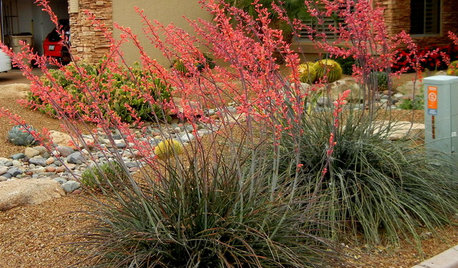
    Hesperaloe parvifolia - called Red Yucca but it's not a yucca although it sort of resembles one. Flowers over a long period most of the summer. There's also a yellow form.

    Corypantha - various species. Small ball cactus with pink flowers.

    I have others that I just added this year so I can't comment on hardiness yet, but all of them are supposed to be hardy.

    May I suggest you look at High Country Gardens web site.
    http://www.highcountrygardens.com
    They have a lot of xeric plants.

    Also, for cactus, try Intermountain Cactus. Been around for years. The website isn't flashy but they list a lot of items.
    http://www.intermountaincactus.com/Cactus/Home.html

    If you send me your e-mail I will send photos of the new front desertscape. billriz6@cox.net

    Good luck!
    Bill

  • 16 years ago

    There were a couple of red flags in your post, so I have to make a suggestion on one and ask for more information on the other.

    First, please be extremely careful adding sand to existing soil; if there's any clay at all in your native soil, you will be creating concrete. The moss could be an indication that that's what you've got here - moss likes concrete quite a bit! To accommodate plants that require very good drainage, the recommended material is coarse organic matter. If compost is too rich for the plants you intend to use, you can use peat, which has very low nutrient levels; there is also a commercially available "grit" that's much coarser than sand.

    My garden is in a glacial outwash plain, and contains layers of sand, silt, and clay. If I simply mix these together, I get concrete, so I always need to add high ratios of leaf mold or compost.

    Second; are you saying that you're planting a 18 or 24 inch strip right next to the foundation of the house? We normally advise people to leave about 3 feet between a garden and a house wall, to allow air circulation for the plants and access to the sidewall for maintenance. Those couple of feet next to the house are usually an extremely dry microclimate, because of the "rain shadow" from the house. Also, this seems like not enough space, and an odd shape, to boot, if your goal is to create an oasis.

    Am I misunderstanding the geometry, or are you planting a very narrow border?

  • 16 years ago

    There are a lot of red flags in this post. To the point where I'm not sure where to start, or even which are the most important things to cover.

    First off, unless you are south of about Reading (which isn't 'northwestern PA by a long shot), take that zone 6b with an enormous grain of salt. A watering softener bag full would be about right. It may turn out that there is enough of a microclimate that it's right, but I'd start out assuming 5b is more accurate.

    Second, all that having moss means is that you have moss. It means that for some reason, the soil is inhospitable to other plant life, but says absolutely nothing about why. It can be too wet, too dry, too compacted, too acidic, too basic - really a long list of things. The only real way to tell is to have a soil test done.

    The lack of sun is going to be the major limiting factor. Most xeriscaping plants that can handle eastern wet extremes are sun plants. So what you are looking for is plants with the look you want, but that are not necessarily plants that require excellent drainage (what ever that is) The carex would be an example of this. Carex is more of a swamp plant than a xeriscaping plant.

    I'd strongly recommend you back off from this project for now, and spend the rest of the summer doing homework. That would be looking around, visiting gardens, reading books, and paying attention to what happens around that patio. Oh, and having a soil test done. What you are trying to accomplish is not a trivial thing.

  • 16 years ago

    Mad gallica,
    If you reread the original post it says northeastern PA, not northwestern. Also stated that half (not all) of the beds get only half a day of sun, which implies to me that half of the beds get sun all day. While I agree that some research and soil testing are certainly things that should be done, it's also very possible to have succulents as well as cacti, yuccas and others that will thrive in eastern conditions. Sempervivum, many sedums, Yucca filamentosa and Opuntia humifusa all do very well in zone 6 as well as zone 5 or even zone 4. And they tolerate our wetter conditions. The Yucca and Opuntia are eastern natives in fact. So while it's wise to do one's homework, it might be noted that gardening should be an enjoyment. The plants I named here should do well, are not expensive and trying them could bring joy to someone who misses the Los Angeles garden they once had.

  • 16 years ago

    I appreciate all of these comments. I am going to spend the fall and winter learning about these plants, etc. I'm not quite sure where to start, but am thinking a soil test might not be a bad idea so I can amend the soil next spring correctly. I am also paying very close attention to the sun patterns. Given that the lavender and thyme are thriving and only the Iris in the shadier corner did not bloom, or, in some cases, failed to come up at all this spring, I think I have to really know which area is getting sun, how much, and so on. I may be able to achieve a neat desert sort of look with potted sedum, succulents and grasses. The only question there is what to do with them in the winter!

  • 16 years ago

    Panic,

    The Yucca filamentosa and the Opuntia humifusa (Eastern Prickly Pear cactus) will both thrive in any good soil with some sun. They don't need special amendments nor do they need full sun all day. I have both growing in ordinary soil in half day sun for years. The only caution is to not plant them in a low spot where water will stand in winter, so on a slight mound or slope will do fine. Most hardy sedums and sempervivums will also do well but do prefer more sun if possible. It's not necessary to grow hardy sedums or sempervivums (there are many hardy varieties) in pots so not to worry about what to do with them in winter.
    There are also several hardy ice plants (Delosperma) and they do fine as long as the soil isn't always soggy, so soil with decent drainage will suit them, and same caution about not standing in water. They do, however, need more sun in order to bloom well. If you do decide to plant something this year though, I wouldn't wait too long as you want the plants to have a chance to root in before the coldest weather begins. Good luck!
    Bill