Software
Houzz Logo Print
aunt_net

Problem with CORN!

18 years ago

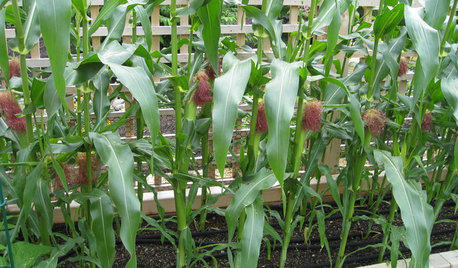
I have great looking corn stalks, variety - Candy Corn - but no ears! No silks! Nothing! Just the tassels dropping pollen on nothing.

I've been raising corn for years and have never had this happen before. Have already harvested the first planting, variety - Jubilee- and was eagerly watching the Candy Corn, 5 ears on 10 rows, very dissappointed.

Any thoughts as to what has happened? Seeds or weather?

I have never tried fall planting but am thinking about it after reading the posts.

Aunt Net

Comments (11)

  • 18 years ago
    last modified: 11 years ago

    Aunt Net,

    This is a perplexing problem. Any kind of physiological or nutritional problem that I can think of ought to affect your corn's male flowers (the tassels) and female flowers (the silks) equally. So, if you had said that you had no silks AND no tassels, my best guess would be that the weather had gotten too hot before tassels and silks formed. And, I suppose there MIGHT be a very slim chance that tassels formed at the correct temperatures and then a rapid rise in temperatures impeded the development of silks, but I have never once in my life seen that occur. Like I said, whatever would normally impede the formation of silks would likewise impede the formation of tassels.

    Aside from the fact that your tassels are shedding pollen and there are no silks to receive that pollen and form ears, do the plants seem otherwise healthy and normal? Is there any whitish, yellowish or rusty brown-colored streaking on the leaves? How about blotches or spots on the leaves? I would ask if you have had any problems with corn smut, but I think the corn smut fungus only forms on existing ears, not on silks.

    Is anything chewing on the leaves, stalks and tassels? Can you see any place on the stalks where it appears that the tiny would-be ears tried to grow and were nibbled off before they could form and set silks? There might be a slim chance that corn earworms arrived at the very time the tiny ears were coming out of the stalk and the ears were nibbled off, but if that occurred you should be able to see where the tiny ears tried to grow. Grasshoppers can devastate a corn crop by eating the ears/silks too, but I still think you'd see substantial evidence of their chewing on other parts of the plants too. Also, you said you have 5 ears....are they normal looking?

    If I had to guess, I'd guess insects as most likely and weather as second most likely. I don't think it is a seed or variety problem. Kandy Korn is an immensely popular variety of sweet corn and I've never heard of this happening. Also, it has been around a while, so if there was a genetic tendency for this to happen, we would have heard about it. I've grown Kandy Korn myself and not had any problems with it.

    Finally, sometimes there is quite a bit of time between the tasseling and the silking. Do you remember how many days ago you first saw tassels? Do you remember how many days ago pollen began shedding? And, if you can narrow down that time frame, have you had any bizarre weather since the tassels formed?

    Maybe someone else who grows a lot of veggies will be able to figure out what happened. I think George (Macmex) is probably most likely to know what happened, but think he is going to be too busy to be on his computer for a couple of days. Maybe Scott, Dorothy or Annie will have some ideas too.

    Be patient and give people time to see this and respond. Sometimes responses are a little slower in the summer because so many people are traveling or are spending every waking minute outside.

    Dawn

  • 18 years ago
    last modified: 11 years ago

    Went out and had a good hard look at my lovely corn stalks and this is what I've come up with.
    The 3 stalks that have ears are normal looking and the ears are a nice size, these stalks are the closest to the first planting of corn that did well. All the other earless stalks have dry brown leaves on the bottom, more so than the corn that I'm ready to chop down. So, I'm guessing that I was so focused on the developing corn ears that I failed to water the new planting at a crucial time and those three were just close enough to the soaker hoses. I could just kick myself! Lesson learned!

    Okiedawn:
    I would like to try a fall planting of corn, could you give a few more details about how to decide when to plant.

    Thanks,
    Aunt Net

  • 18 years ago
    last modified: 11 years ago

    Aunt Net,

    Based on your description and analysis, I bet you've got it figured out! There's three times in the development of corn when adequate moisture is imperative, and I think you know what they are: (1) when the corn seed has been planted and needs moisture to sprout; (2) when the tassels and silks are forming internally and have not yet sprouted--if there is not sufficient moisture, tassels and silks are not initiated, and (3) immediately after pollination has occurred and the kernels are filling out.

    Don't be too hard on yourself--when you have a lot going on at one time, it is hard to keep track of everything that every plant needs, and if rain had been falling consistently, you wouldn't have had to give it a second thought. I have a lot of trouble keeping track of succession plantings too, because I tend to be focused on getting the initial planting to the harvesting stage and sometimes I assume the follow-on crop is progressing just fine on its own. (Sometimes it is, sometimes it isn't.)

    For fall, the first thing to do is to determine the average date of your first fall frost. If you don't know what it is, tell me what county you're in, and I'll figure it out.

    Then, figure out what variety you want to plant. Look at the days to maturity on your seed packet and count backwards that many days. That date is your "drop dead" date by which your corn must be SPROUTED AND GROWING. So, suppose your average first fall frost is November 1st and you choose a corn that takes 75 days to mature. Count back 75 days and that puts you in mid-August. Allow a decent time for your corn to sprout--say one to two weeks. Thus, you ought to have your corn seed in the ground in early August or, to give yourself a little extra margin of safety--in case the first fall freeze is early--maybe plant it the last week in July. That's all there is to it

    One thing to remember--August is usually very hot and dry, so if you want to improve your corn's chance of germination, pre-soak it in water overnight before planting it. And, water it in well to settle the soil around the roots, but don't drown it either because hot temperatures plus excessively wet soil can rot the seed.

    You may notice that corn planted in very hot weather grows very fast and you may worry it will start to tassel and silk too early (while daytime highs are above 90 degrees), but I haven't found that to be a problem. As the temperatures cool down, the rate of growth slows in a corresponding manner. IF, by chance, wickedly hot weather hangs on deep into September and you are getting silking and tasseling in those temperatures, water it lightly with an overhead sprinker twice a day, if possible, to cool down the pollen. This can help improve germination since temps. over 90 can make pollen sterile.

    As the days cool, it is common to watch the temperatures and watch your plants and worry that your corn won't ripen before a frost occurs. One way you can "know" for sure is to jot down the date that silking begins. From the day that silking begins, corn generally ripens in 18 to 24 days, and it varies based on the air temperatures at that point. So, if you keep track of when it silks, you'll know about when it ought to be maturing....and you'll just have to watch the weather and hope the first fall freeze doesn't arrive too early.

    If freezing weather is expected and your corn is near maturity but not quite there, throw anything you can find over the top of your plants....sheets, a tarp, heavy plastic etc. If a frost occurs, that should keep it off the ears. Often, we have one early freezing night or two and then weeks and weeks more of mild weather, so if you can get it through that night, it should be smooth sailing ahead.

    For what it is worth, I usually plant fall corn around August 10th and I am as far south as you can go and still be in Oklahoma--right across the Red River from Texas. For every 100 miles north that you are from me, plant about 6 or 8 days earlier.

    If you have any questions about fall planting, let me know.

    Dawn

  • 18 years ago
    last modified: 11 years ago

    I planted my corn in poor soil this year and the endless rain and other priorities in May cause me to never fertilize it or weed it. Finally, when it was just dry enough to walk into the tilled ground (and the stalks were about a foot high) I sprinkled some nitrogen along a few rows I could get to just as another thunderstorm approached. I was worried that the ground was not dry enough for it to soak in, but it did.

    I now have a few rows of nice looking stalks and a bunch of stalks that are yellow and look terrible. The yellow ones that I did not fertilize still have the tassels, but I could not find ears on them when I looked last week. The ones I fertilized have small ears, but I do not think they will end up being worth harvesting. I have not checked closely in about a week, but will again in a couple of days.

    I don't think your cause is necessarily the same as mine, but I just wanted to let you know that I am having a similar problem. I would never have thought when I first tilled it that I would not be getting any form of nitrogen to it later due to excess rain. (This is a new area I tilled up and have never improved the soil on. My native soil there is pretty bad.) Fortunately I gave better care to my other garden area. My wife is not happy about the corn, though.

  • 18 years ago
    last modified: 11 years ago

    Scott,

    Fall is approaching and there's still time for a fall crop!

    Excess rain does leach out nitrogen, and no one has had more rain than you've had.

    Last year, with all that rain, ALL my plants showed signs of various nutritional deficiencies. Partly it was from nutrients leaching out of the soil, but the other part was that the plants' roots and vascular systems were so clogged up with water that the nutrients just weren't being taken up and used. I finally bought some Miracle Grow and gave them a foliar feeding and they recovered, albeit slowly. I normally won't use a chemical fertilizer, but it was probablly the only viable option in those conditions.

    So, I'm just saying it might be that your plants were just too waterlogged and couldn't take up and use the nitrogen that was there, and there's no way you can really anticipate when such a thing will happen. If you'd known ahead of time just how wet the spring would be, you could have planted rice! LOL

    Dawn

  • 18 years ago
    last modified: 11 years ago

    I've been watching my corn the past few days so thought I would add my experience. This is the first year that I can ever remember not having to water corn a lot. We have had a gob of rain. 3" yesterday and the ground wasn't dry yet after last thursday's .8" We fertilize the ground where we are going to grow corn in the late fall or late winter with chicken litter--wood chip bedding and manure. Then plant two crops ther first in early to mid April to come off by 4th of July and the next by the 1st of May to come of mid July. This year the weather was so cold that our corn went in a few days late. Then moles ate part of the seed, and part of the seed rotted, so we replanted right away. (Oh I plant presprouted seed so I know that it is good) Long story short, I picked a few earss of corn on July 6 and will have more to pick this weekend. Then the last planting won't be ready till the end of the month I am guessing. With what I've picked so far there is a bit of fill out problem, I suspect to too much rain as the pollen was shedding. Some ears tho are beautiful. Don't know what your problem is as our main variety is also Kandy Korn. Better luck next year. Dorothy

  • 18 years ago
    last modified: 11 years ago

    Dorothy:
    Prespouting? Sounds interesting, care to share any details?

    Dawn:
    Thanks for all the info on fall planting and I did get a minute to check out your posting on fall planting. You're such a great resource, who needs all those thousands of books out there.

    Thanks everyone for your input, I think this has just been a hard year to guess the weather and we are all having new challenges.

  • 18 years ago
    last modified: 11 years ago

    Aunt Net. I presprout a lot of my seeds that I direct sow. I just soak them in water for 8 hrs or so, then pour off the water and cover them with a damp paper towel and leave overnight. Then three times a day I rinse them with warmish water and replace the damp towel. As soon as they sprout I plant the good ones and discard the duds. I do corn and beans, okra and squash this way. That way if I have a failure I always know that it wasn't "bad seed." Dorothy

  • 18 years ago
    last modified: 11 years ago

    Dorothy,

    I presprout many seeds too--and especially corn in the springtime when cool soil can inhibit germination.

    I even presprout beans (though you are not "supposed" to). With the beans, though, I only soak them in water for a hour or so, and then I wrap them in slightly damp paper towels and put then in an open plastic zip-lock bag-left open to allow better air flow.

    I pre-sprout everything I can so that I can plant with the assurance that all my rows will be "full".

    Dawn

  • 15 years ago
    last modified: 11 years ago

    Very interesting to find this thread when I googled "corn tassels no silks" as I am having the same problem, and with Kandy Korn. I have 8 corn stalks of Kandy Korn (this is the first year I planted Kandy Korn), the oldest 3 are starting tasseling but no corn ears. The oldest one's tassle is completely open with pollen starting to drop as of today. I planted first week of July. My vegetable garden is irrigated (so it is not a water issue - my whole veg garden is lush and healthy) and I amendeded the soil with nutrients, a fertilizer with a higher nitrogen content. I have grown King Arthur for a few years. I planted that in the early spring and did successive rows every couple of weeks. I never had any trouble with King Arthur.

Sponsored
Peabody Landscape Group
Average rating: 3.5 out of 5 stars8 Reviews
Franklin County's Reliable Landscape Design & Contracting