Software
Houzz Logo Print
kumar6851

Need help with my dying/diseased Trees & Shrubs

16 years ago

Folks,

I am here to ask for help. My wife and I were fortunate enough to move into a house a few years ago with lots of trees and shrubs on the lot. Now, I am not particularly knowledgeable about plants and apart from the Crepe Myrtles could not even name most of the plants.

About end of last year, I started to note that some of the leaves on the bushes were turning reddish brown and beginning to fall off. Well the problem has now spread to other shrubs and also seemingly to some trees. Not sure if its the same problem. This year based on recommendation from our local nursery I even treated the plants twice for fungus, but it does not seem to have helped.

Please help me identify the plants and please recommend how I can salvage the remaining plants.

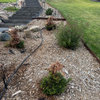
I am attaching one picture, but have several other plants that are facing the same or similar situation so please take a look at the entire album at photobucket:

http://s852.photobucket.com/albums/ab90/kumar6851/

I have a sprinkler system that I use to water once a week (it is maintained). I have True Green feed the trees and also fed them myself last year and this year, separately for the crepe Myrtles from the rest of the trees/shrubs. In the past I have had Mites on the crepe myrtles and treated them.

I am in Texas, just east of Plano for those of you wondering.

Thanks for your help and eagerly awaiting replies.

Here is a link that might be useful: Pictures of the diseased shrubs and bushes

Comments (21)

  • 16 years ago

    Hard to say for sure, but some of that may be herbicide drift.

    tj

  • 16 years ago

    First, you are wasting your money on TrueGreen feeding your trees and shrubs. You can stop that practice immediately. They don't need any fertilizer save what your soil analysis says to add.

    Second, very hard to diagnose with the info given. First guess is herbicide drift as well.

    Dan

  • 16 years ago

    Hi Dan & tj,

    I worry that this didn't happen overnight and is happening all across my garden. Can herbicide drift cause leaves to turn dark brown and then slowly fall off. A couple of my now dead shrubs took six months or so to die.

    If it is is herbicide drift - Any recourse?

    The local nursery said it was fungus? How long does it take to effectively treat fungus?

    Dan - I stopped TRue green after the one year.

  • 16 years ago

  • 16 years ago

    Oops, didn't mean to post that pic all by itself.
    Anyway, like Dan was saying, too much going on and not enough info to really figure it all out and by "info" I don't mean just the things you could describe but stuff that one can only find out by showing up and poking around.

    But I do have to say that in the picture I posted above, the problem looks a lot like what we use to call "Miracle Grow Blight" at a place I use to work. Not because Miracle Grow products were involved but because the guy responsible had the nickname "Miracle Grow" for unsavory reasons not fit for discussion on a public forum. Miracle Grow use to run around dropping hand fulls of urea straight on top of bushes when it was time to fertilize shrubs. No broadcasting, no watering in, not even shaking the bush to get the fert down. Just a handful of urea on every shrub's head. That dude was hilarious.
    But I digress.....

  • 16 years ago

    Where do you live? What have the prevailing temperatures been? How do you water? How often? And how long?

    My opinion: Lack of sufficient water.

  • 16 years ago

    Yes, gargwarb teases out a more nuanced interpretation of what I hastily posted upthread (during a break from landscaping in the yard) - a couple of these look like chemical burn. Some look like watering issues. Some I can't tell from here.

    A distance diagnosis isn't going to identify the multifold issues going on in this yard. You'll want to find someone knowledgeable (likely not the guy who cuts your/your neighbor's lawn in 5 minutes, waves a leaf blower around for 2 minutes and squeals the tires to get to the next job to tear the bark from trees with his string trimmer...um...ahem) to spend some time in your yard, ask you about your cultural practices, and catalog the issues going on and offer solutions. Sorry.

    Dan

  • 16 years ago

    Dan and Gargwarb,

    Thanks for your feedback.

    Chemical burn! Hmm... I did have our lawn guy spread the fertilizer to feed the bushes & trees earlier in the year. He and his guys are usually very responsible, but I wasn't here when it was done. I'll have to ask him.

    If some of this is indeed a chemical burn, will the bushes recover? At least the one like those above that don't seem to be completely affected, just around the center. Should I give the bushes a thorough rinse? Any other means to provide TLC?

    As far as jean001 's questions, I am in a town just east of Plano, TX. The temperature for the year has been a little hotter than usual. Typically I water for 10 minutes once a week per station, with an extra five minutes in July and August. The sprinklers are fairly well spread out.

    I have just added another 5 minute round per week to the schedule. Will this be sufficient?

    Thanks you all for your advise.

  • 16 years ago

    Will this be sufficient?

    Impossible to tell from here. You'll want to find someone knowledgeable (likely not the guy who cuts your/your neighbor's lawn in 5 minutes, waves a leaf blower around for 2 minutes and squeals the tires to get to the next job to tear the bark from trees with his string trimmer...um...ahem) to spend some time in your yard, ask you about your cultural practices, and catalog the issues going on and offer solutions. Sorry.

    Dan

  • 16 years ago

    OP said "Typically ... Will this be sufficient?"

    I doubt it.

    As was said, unable to tell from here. But *you* can easily determine whether or not it is.

    About an hour after you water, put a trowel into the ground and to determine how deep the water went. (My thought: Not very deep.) In general, soil for shrubs should be moist to 12 to 15 inches deep.

    In general, you shouldn't need to water shrubs daily or even every several days.
    Instead, the guideline is deep & infrequent. In your climate, perhaps every 2 weeks during the summer. (That's info you can learn from a knowledgeable person in your region.)

  • 16 years ago

    Do you mean another 5 minute irrigation cycle? Or adding 5 more minutes to an existing cycle?

    I've seen hundreds of home irrigation systems that are set for 15 minutes....which is barely enough to get through the mulch, let alone well into the soil. I strongly suggest that you follow the recommendations above and see what the actual results of your watering might be.

  • 16 years ago

    Just wrt to watering, IME it is best to double-cycle, where first short cycle run to pre-wet then second long cycle to do the actual watering.

    Dan

  • 16 years ago

    ...oh, and if that '15 mins' is for drip, likely inadequate.

    One must know the type of irrigation to make recommondations wrt time.

    Dan

  • 16 years ago

    I TOTALLY agree with you, Dan, about the double cycling. In fact, it's probably the only way to make sure that plenty of water gets into the ground instead of all over the driveway and street.

    By the way, kumar: some of your images look exactly like what I've seen (as someone else has said) of something being thrown right into the center of the plant. I've seen that kind of damage with inappropriately placed fertilizers, with buckets of cleaning solution, etc.

  • 16 years ago

    Have you talked with anyone at your local office of the Texas A & M University (TAMU) Cooperative Extension Service?

    Here is a link that might be useful: TAMU CES

  • 9 years ago

    I live in southwest Ga and i have the excact same problem as kumar need help


  • 9 years ago

    You would probably get lots of answers if you start your own thread on this and post pictures of the shrubs in question; you can see from kumar's thread the sort of answers we need before coming up with anything.

  • 8 years ago

    Did you ever find out what this was? I was search for the same thing and came across your post. We have several similarities coincidentally. (see pics) We just moved into our first home East of Plano in the Dallas area. The beds in the front of the house are new and were put in by the seller to give the house curb appeal.


    Shortly after moving in the crepe myrtle turned back, quit growing leaves and powdery white spots appeared all over it.

    The landscaper we found on NextDoor said fungus and pulled it out and that's when he covered everything in the red mulch. He also moved all the boxwoods and magnolia a foot forward because they were a few inches from the foundation. Later in November he pulled the magnolia tree because it was too close to the house and said they are known to have invasive roots. It had also dropped most of its leaves.

    The above pictures are how it looked at the beginning of November.

    Here are a few from today...


    Since then the boxwoods have all turned from green to dark red. I am worried I am going to have to yank these too. We have a RainBird sprinkler system but do not plan to use it much so I am thinking we might just need to replace them with native Texas plants that are drought tolerant, but I am worried about the existing issue. Especially if it is fungal related. Does this mean that my soil has fungus in it and will affect everything I plant in it? Could the mulch have caused this as this seems to be when the decline started? Also, the magnolia tree was sitting on top of a root the size of a mans leg. It was directionally going toward the house. Should I cut this so it quits growing?

    Have I wrecked my beds? Please help!


  • 8 years ago

  • 8 years ago

    There is nothing inherently wrong with a dyed mulch.....other than aesthetics :-) It or any other mulch type product is not harboring a fungus or one that would cause that sort of symptoms on the plants. To be honest, they all look excessively drought stressed. I would guess the plants were only minimally watered when planted and then ignored until the sale. And I don't get a good sense of your watering practices since from your post so you might well have contributed to the problem.

    Landscaping to sell a home is very often done only for "show" and with no real sense of what plants would work best and what they need in the way of care. they just stuff them in and call it good. And the ones shown are just so-so and not very creative nor have much relationship to the site or your location. You could do much better :-) But newly planted plants of any type - even ones with a reputation for drought tolerance - will need routine deep watering through their first growing season at the very least, often longer, depending on species and size.

    As to the large root, what sort of big trees are in the vicinity? You certainly do not want to cut one that large without knowing the source.........

  • 8 years ago

    Thank you for your reply. The tree that is on the other side of the lawn is an oak that drops acorns. I am not sure what type of oak it is. Also, the same landscaper extensively pruned it. Here are the only pics I have.

    Before. So beautiful.

    This is what I have. I am sorry, I do not have any straight on pics of the tree now.


    The root that is growing on the other side of the sidewalk, and toward the house, and is not under the canopy of the tree. It is at least 20 feet outside of the canopy.

Sponsored
Peabody Landscape Group
Average rating: 3.5 out of 5 stars8 Reviews
Columbus' Reliable Landscape Design & Contracting