Software
Houzz Logo Print
baci_gw

Strelitzia crossing

20 years ago

Does anyone know what varieties of bird of paradise are crossed to obtain the following varieties?

Strelitzia reginae 'Mandelas Gold': S Ã kewensis Strelitzia is a hybrid between S. reginae and S. augusta. Any chance MandelaÂs gold could be the same cross? I am wondering if it is the same; if the patent wore out.

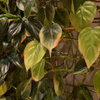
Strelitzia alba variegated: Could this be a giant black crossed with a white or repeated cultivation of some sort of mutation?

S. reginae v. juncea: Does the no leaf & narrow leaf both fall under this category? Does the variegated form of this variety come from repeated crossing with the white or is it due to cultivation of some sort of mutation?

Comments (5)

  • 20 years ago

    I've never worked with Strelitzias or seen a variegated one, so I can't comment on the origins of S. alba variegata except to say that variegation can occur as a sport of a mature plant, or as a seedling mutation, but in most cases you can't breed for it, it just happens. It is not the expected result of crossing 2 species or varieties, if that is what you're suggesting.

    As far as Mandela's Gold, here is a link that explains the origins:

    Here is a link that might be useful: Mandela's Gold

  • 20 years ago

    Thanks, Lisaclv. Here is a picture of the variegated white:

    http://davesgarden.com/pf/showimage/67144/

    I also have read reports of attempts to breed a variegated leafless.

    I have read your link; it looks like the MandelaÂs gold is a mutant in which seeds are developed by cross breeding with a like variety. I am guessing since S Ã kewensis Strelitzia is a hybrid between S. reginae and S. augusta it may be possible to obtain a similar flower with similar crossing.

  • 20 years ago

    Thanks for the link, that's a very nice-looking plant, baci. There seems to be some confusion as to whether it's S. alba or S. nicolai albo-variegata, though. Is that why you think it might be a hybrid?

  • 20 years ago

    I can only comment on the S. reginae - S. juncea question.

    Back in the 1970s there was a debate in the botanical literature as to whether these should be treated as different species. The American botanist Hal Moore published a paper in the journal Baileya (I can't find the exact reference), arguing for the one-species concept.

    But a group of South African botanists published a longer paper based on population studies in the wild. My recollection is that populations were spread out in an east-west line in Eastern Cape and adjacent Natal, with 'pure' reginae at one end and juncea at the other, with a zone of intermediates (S. 'reginae var. parvifolia') in the middle. They suggested that this gave support to recognising two separate species, plus a range of hybrid forms.

    I used to keep a database of such references and am pasting this one below:

    Van der Venter, H. A., Small, J. G. C. & Robbertse, P. J., 1975.
    Note on the distribution and comparative leaf morphology of the acaulescent species of Strelitzia Ait. Journal of South African Botany vol. 41, no. 1, 1-16.

    A follow-up paper looked at the chromosomes and gave some support to the one-species concept.

    Small, J. G. C., Van der Venter, H. A. & Garner, C. J., 1980.
    Acaulescent growth forms of Strelitzia: hybridization and chromosome numbers. Journal of South African Botany vol. 46, no. 2, 167-171.

  • 20 years ago

    Thanks, tonyfromoz. It looks like my confusion stems from the fact that even the botanists differ in their view of whether to separate the species. The plants do differ in appearance, but similar chromosomal makeup would make a good argument for placing them in the same classification.
    Lisaclv, my guess is the variegation arose from an event like you posted above; some sort of seedling mutation. I am unsure of the botanic name  I wonder if the debate in the botanic name (S. alba or S. nicolai albo-variegata) arises from the fact that both of these plants can mutate. I am guessing if you plant enough of these seeds from one of the above species & a variegated mutant arises & survives, you have a variegated foliage plant. I have seen variegation occur in offsets of some plants, but not the bird of paradise. It may occur; I have just not seen it.
    I am unsure about seed crossing in the variegated bird of paradise. A similar example is variegated leaf cliviaÂs. Seeds sold for this variety are developed by cross pollinating variegated leaf with like kind. If a seedling is completely albino, it will likely not survive, so it is a risky seed. I am guessing it could occur with the bird of paradise. Obviously the best way would be division  if one could find the plant.