Software
Houzz Logo Print
ifraser25

Ypê amarelo

19 years ago

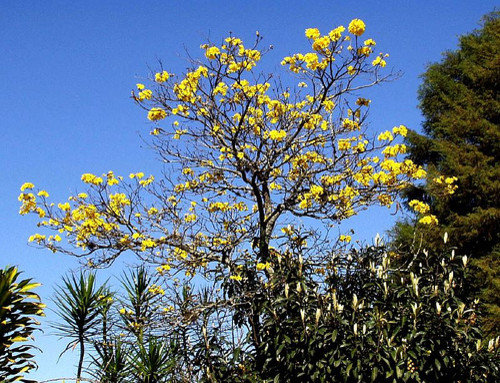
Here is a shot I took a couple of months ago of our yellow Ypê (Tabebuia sp). This is not a particular good specimen. I have seen trees where hardly a twig was visible for flower.It's deciduous over winter (dry season) and the flowers always appear before the leaves, usually well before the rain begins again. The other trees in the pic are, bottom right, Loquat (Eriobotrya japonica) some Dracaenas and an unknown conifer. It's not a Brazilian native, maybe Hemlock.

Comments (5)

  • 19 years ago

    Brazil is one mighty interesting and colorful place to visit and has always been at the top of my "want to visit places" list for a destinaition, if I'd ever had the money to do so. I guess as well , though most of us norte Americanos would figure the climate in all of Brasil is much the same in any part of that huge country, and that's of course not true, with the plains or pampas type areas to the far south , which are also much cooler in the winter , than the typical tropical areas of the country, and with many different plants accordingly. I didn't catch where in Brazil you live, but I do love the photos, and only have a small knowledge of Brazilian native plants, though I love many of the common tropical ones now found as plants in our garden centers and our more tropical gardens and as indoor plants for out colder parts of the country. I would guess as well, like most parts of the very big tropics which circles the equator, you now have many "exotics" that were introduced from many other parts of the world many years ago, and some of which have become invasive , as is so often the case sometimes even within a few years of introducing foreign species. Lots of extra color and fun , none the less!!

  • 19 years ago

    JFraser,
    Do you know if this would happen to be Tabebuia chrysotricha? This species, and T. impetiginosa are the only two reliable species to bloom in northern California, although neither one is very commonly grown here. I love Tabebuia trees, although I don't remember them as being at all common in Salvador, Bahia, where I used to live... They seemed to be all over the place in the mountains outside Rio and Sao Paulo, along with the various tree sized Tibouchina species.

  • 19 years ago

    I have to say in the case of large trees etc. it seems one never gets much in the way of closeup photos of flower details etc. for most trees, and I'm always looking for details like flower size, shape, and leaf size and shape, etc. and finding one site that did show closeups of the flowers, I was reminded of our cold hardy Catalpas, with perhaps a similar shape and form, and shouldn't be surprised to find they're in the same plant family, so perhaps the teason for the similarity. I'd be curious if they have the large leaves of our Catalpas, or something else, not finding any pictures of the leaves? Our Catalpas also have very fragrant flowers and your's??

  • 19 years ago

    Birdinthepalm,
    You should get acquainted with using search engines such as google image to see details of plants/trees that are unfamiliar to you, and this would give you plenty of photos of such details. Tabebuia species almost always have palmate leaves, so look nothing like the leaves of Catalpa, and the flowers are not fragrant either. What you do get with an Ipe/Primavera/Tabebuia tree in bloom is a vision of pure color, often when the tree is seasonally leafless at the end of the winter dry season, with flowering and seed production timed to take advantage of the wet season and better chance of new seedlings getting established. Tabebuia trees always stand out in a forest situation, as they are often the primary tree in bloom, and as colorful as temperate Flowering Cherry or Plums in bloom. Some Tabebuia species, such as T. impetiginosa, will even repeat bloom again in late summer or fall, which is typically not quite as showy, as there will be leaves at this time of year.

  • 19 years ago

    I did research a bit more , after posting my innacurate earlier post, and saw the difference in the leaves. The flowers however did look similar in shape or at least to my less than perfect vision. It is also true, that the Catalpas do flower well after the dormant trees have leafed out into their summer growth so the flowers are not quite as well displayed or dominant in the appearance of the tree then, though they are good sized flower clusters, that do put on a show from a considerable distance. At any rate , any comparison I made was not meant to detract from the beauty of the Ype, trees of course, and only a bit of a digression on my part. I'm one person prone to look for comparions and relationships between some of the tropical plants and their northern counterparts.

0