Software
Houzz Logo Print
doof_gw

What disease do I have now?

18 years ago

This spread very quickly across a Galina's. It was right next to a Paul Robeson on one side, and a Gardener's Delight on the other, both of which show no signs of it.

Yet on the other side of the house, another Galina's has already shown signs of it, and it has spread to the Brandywine next to it.

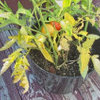
The picture of the leaf on the right (the sick one) was taken in somewhat dim light, and I've tried to correct for it, but it's not as yellow as it shows. The problem is that the leaves are speckled with very fine cream color spots. The leaf itself is not dead and it is not crinkly yet. The leaf on the right is a healthy leaf from the plant next to it that I took for contrast.

Some of the leaves on this plant only have a light dusting of this color. The leaf shown is advanced. The coloring does not rub off. A few days ago, I first noticed it but didn't think that much of it.

What is it?

Comments (14)

  • 18 years ago

    Rust Mites? Known to be a CA problem, but no good reason why just Galina's Yellow. Possible TSWV but again, no good reason why just Galina's Yellow.

    Did you raise all the plants yourself or were some purchased?

    Carolyn

  • 18 years ago

    I grew these from seeds. The damage to the plant that I showed the leaf from was so bad I pulled the plant, today. Whatever it was, it really snuck up on me. It had many unripened fruit on it, and a few nice looking ripe ones which I saved. The other Galina's is in better condition.

    The picture I offered was awful. I couldn't take a better picture because my camera can't do flash and close-up at the same time. I'll try to get better pics tomorrow.

    I went looking just now for better pics on the web of rust mite damage, and I can't say for sure, but I don't think this is that. As I said, it doesn't appear to be anything that you can rub off. It's also a strange color -- not yellow, like a damaged tomato leaf, but a creamy yellowish-white, the color of french vanilla ice cream. As if somebody sprayed it out of their mouths onto the plant and it landed on the top of some of the leaves. (That's why I rubbed -- because it looks so much like a foreign substance dusted on them.) The younger leaves have it more than the older ones.

    The closest pic on the web to what it looks like is this, from Hawaii, Abutilon striatum mosaic virus. I find it unlikely to have surfed all the way to southern California. I'm just showing it to give you an impresison until I can get a better pic.

    Here is a link that might be useful: Hawaii Pest and Disease Image Gallery

  • 18 years ago

    The closest pic on the web to what it looks like is this, from Hawaii, Abutilon striatum mosaic virus. I find it unlikely to have surfed all the way to southern California. I'm just showing it to give you an impresison until I can get a better pic.

    ****

    OK, we'll wait until you can get a better picture b'c Abutilon is also called Flowering Maple ( look at the shape of those leaves) and the virus doesn't infect tomatoes.

    Carolyn

  • 18 years ago

    Before I go to the new pics, let me say, I'm pretty sure now it's tomato russet mites. The close-ups pics were revealing.

    New pics taken today...

    ANYBODY IS FREE TO USE, DISTRIBUTE, STEAL OR ABUSE THESE PICS AS YOU PLEASE. I hope people do, because there is a shortage of GOOD pics on the net of tomato diseases and pests.


    This is the other Galina's plant that I haven't pulled yet. I took this in the shade about 6:30 and had to do some color correction. I'm going to yank this guy tomorrow.


    This is a branch that I plucked off the Galina's. Two closer views of the same pic to come.


    The top leaf, closer view from the previous pic.


    The bottom part of the same pic, closer view.


    Another leaf from the same plant.

    {{gwi:1376613}}
    This is a leaf from the Paul Robeson plant that was next to the other Galina's, the one I discarded. I looked at it more closely for something that might resemble the same creamy speckling, and picked this leaf from the side that was closest to where the pulled plant had been.

    For a bigger, blown-up version of the same pic, {{gwi:1376604}}

    {{gwi:1376614}}
    This is the underside of the very same leaf. For a bigger, blown-up version of the same leaf,

    It's worthwhile to do look at the bigger version; it shows a lot more damning detail that couldn't have been noticed on the other, more damaged leaves.

    So, there we have it. The last pic was the most damning one, and it makes me think this is tomato russet mite damage.

    Now what? The UC IPM suggests spraying with sulfur. Well, I have some sulfur spray, but I'm reluctant to do it because, well, it's August! And I have done so much damage to my plants before using photo-toxic sprays in warm weather. Do you have any suggestions for how to do this best? I really, really want to keep the Paul Robeson plant. It's producing, it's tasty, and the plant is otherwise big, green, and in great health. The Galina pictured at the top is kaput, so I don't care about that one.

  • 18 years ago

    Doof,

    Get rid of those plants and your problems are behind you. I cannot imagine keeping a badly diseased or infested plant in the garden. First, there's a very, VERY low chance of cross pollination but ripping out plants with severe problems means that their disease-tolerance problems won't be passed into a next generation--there will be NO next generation. Second, if the troubles are spread by contact then removing the plants means no more contact--it ends with their removal. After removing the bad plants and you clean up the rest by removing effected leaf and stem your garden will be all the healthier. Also, you're going to reduce your concern and worries a great deal--as well as the expense in both product and time for treating problem plants.

    In my garden I wind up culling a few plants each year; they're having problems, they're performing below expectations, or they're an off type--I don't want their genes populating the gardens of people I share seeds with.

    Good luck with your garden!

    T

  • 18 years ago

    Doof, Rust Mites was my first suggestion in my first post in your thread and your newest pictures suggest it even more so.

    CA is somewhat unique in having rust mites, we don't have them where I garden so I can't be of any personal help when it comes to making suggestions for them.

    You know your growing area the best but I wonder if you were to take cuttings from some uninfected areas and dip them in a sulfur solution now if you could replant them for you Fall crop?

    Most of my S CAL friends grow a Fall crop and as I recall they don't plant out until the first to middle part of September.

    Once taking the cuttings then I'd do what Trudi suggested and pull and dispose of the infected plants if you don't want to try a cure. And I have no idea whatsoever how good Sulfur is at curing russet mite infections. Sigh.

    Carolyn

  • 18 years ago

    I don't think it's as much a matter of removing disease-prone plants as it is a matter of removing the disease vectoring pests. However, a whole lot of that damage is the result of sap-sucking critters. A virus, if any is present, is a secondary issue.

    Doof, take immediate steps to apply and insecticide that will kill mites and aphids while meeting your personal specifications for ecological concerns.

    Bill

  • 18 years ago

    I usually do not offer advice on tomato problems, because I'm no expert. But in this case, I can wholeheartedly agree with hoosierchokee and Carolyn, and offer my 2 cents. The years I worked in commercial greenhouses, I saw a LOT of these buggers. The leaf damage you show is classic for mites. They spread very fast, and love dry, hot weather. The fact that they are on the newer leaves tells me you have a very severe infestation. They generally attack the older leaves first, and move up the plant.
    For sure, rip out the worst infected plants and treat the rest. They can double their population every 7 to 10 days, so if you find a miticide that is OK for tomatoes, be sure and apply it once a week. Keep checking the undersides of the uninfected plants for those rust colored specks, and the tiny white specks, those are the eggs. If you nudge them with your thumb nail, you can tell if they are alive or dead....they will crawl away if alive. Do not wait until you see damage to check, by that time they will be pretty well established. Keep checking any plants in the vicinity that appear healthy by turning over the leaves and doing the nudging with your fingernail thing.
    On the bright side, these pests have very definite likes and dislikes. They will devastate one plant, while ignoring the one next to it if it's not to their liking.
    Good luck to you, I hope you nail all the little buggers!!!

  • 18 years ago

    I am in CA and had a severe infestation of these buggers. Every tomato plant I had was severely damaged before I figured out what was going on.

    Get an oil spray that says it kills mites. Spray in the early morning or late afternoons once a week. Soak the plant top and bottom. If I skip a week I see some damage starting again so dont stop. Mid week I give them a good hosing off with plain water as well.

    Out of 20 plants I ended up losing 1. 10 of the remaining 19 were so poor looking I was tempted to rip them out. They resprouted, everywheres. They are now green bushes covered with flowers and they bounced back quickly. If they have a good root system it will rebound faster than planting a new plant.

  • 18 years ago

    jmsimpson9:

    What oil spray did you use? I used Neem Oil for mites on my toms and it had no effect at all.

  • 18 years ago

    That's what I would like to know. What to spray with? The UC IPM said to use sulfur, and yet more googling on russet mites brings up agricultural articles saying that sulfur is almost totally ineffective in studies. They suggest Avid, which is a commercial product, the cheapest that I could find it for sale being $99 for a jug on some of the pot-grower sites. So that's out of the question.

    I'm very concerned about spraying with anything that might be photo-toxic, that would burn the leaves in the heat of the daytime sun. I had a nice bout of that earlier, when Digdirt gave me the advice to stop spraying my plants with so many wonderful things.

    I read, too, that neem oil isn't very effective.

    The Galina's in the picture is going to the trash heap, and the Brandywine next to it as well. (One tomato for the whole season from the Brandywine. What a waste of real estate.) But I REALLY want to keep the Paul Robeson's, the one that provided the leaf for my last two photos. It has ripening fruit on it, and it's a big, green healthy plant. I had to look at the plant pretty hard to see any signs of the mite damage.

    One other note: Isn't it interesting how the two Galina's, on opposite sides of the house, were the ones devastated? Which is fine by me, because I absolutely hate Galina's and would never plant it again even if it hadn't developed problems. Worst cherry tomato ever. But it is interesting that mites would plague two of the same kind. Maybe it smells tastier to mites, eh? I suppose that's not impossible. Or maybe the other tomato plants have more of some natural resistance.

    Here is a link that might be useful: http://www.extento.hawaii.edu/kbase/crop/Type/a_lycope.htm

  • 18 years ago

    I absolutely hate Galina's and would never plant it again

    ****

    I'm so sorry b/c it's one of my absolute favorite cherry tomatoes. LOL Must be a CA thing however I know lots of CA folks who also love it.

    Beautiful PL plant with deep gold cherries with great complexity of taste, as in not sugary sweet.

    But we all know that for any one variety there are folks who love it those that don't. Sigh.

    Carolyn

  • 18 years ago

    For both mites and aphids, I've had moderate luck with Safer insecticidal soap. When that didn't work, Sevin did. Luckily, I've had use for neither this year.

  • 18 years ago

    Russet mites aren't your typical mites. That is, they're not spider mites. They are, instead, eriophyid mites. Thus the management may be different than for spider mites.

    That said, the only instances where I had russet mites on tomatoes was late season and/or stressed plants.

    So my thought is that something has gone wrong in the environment for your plant such that it's been set up for a fall.

    Beyond that, it seems to me that your plant is so extensively affected that the wise choice is to discard it. I doubt you could ever manage to get rid of all those very, very tiny eriophyid mites.

    Jean, who gardened for 30-some years in Long Beach, CA