

Carrier Performance Series vs Comfort Series
Geting ready to replace two units in our Dallas-area home; one 3.5 ton, one 2.5 ton, pretty much settled on Carrier 16 SEER units. What exactly is the difference between their Performance and Comfort series? All I can find is that Performance is a bit quieter. Is that both the indoor and outdoor units, or just the outdoor? Are there any other differences that would impact comfort, dependability/longevity, or cost of operation? Thanks
Comments (64)
 11 years ago
We're in the Boston are and I just had an seer 13 Comfort series installed. Very nice unit, but the multi speeds are not user adjustable. Changing speeds requires switching wires behind the service panel. This is basically a one speed unit, it comes shipped set on medium and setting it to a different speed requires a service call.
The variable speed Performance series has the ability to self adjust, a higher speed when conditions need it and a slower speed once it has reached it's temperature setting. I wish I had gotten the Performance series for the simple reason that an air conditioner should run on it's slowest speed 90% of the time for economy and comfort, and only use the higher speeds when needed. Even in the NE area we have hot and cool days, and I plan to use this all year to circulate the heat from the fireplaces and filter the air. 11 years ago
I can attest to the fact that the Carrier Comfort series outdoor units are pretty noisy (the dB rating is not helpful as its a weighted average and perceived noise is very frequency dependent). They also use two blade fans which doesn't appear to help.
Ken: I think you are talking about the furnace/air handler whereas I believe the previous discussion is referring primarily to the outdoor condenser units.
Related Professionals
Tallahassee General Contractors · Muskogee General Contractors · Sterling General Contractors · Middlesboro Home Remodeling · Southaven Home Remodeling · Lynchburg Home Remodeling · Waterloo Home Remodeling · Riverside Home Remodeling · Sacramento Home Remodeling · Evanston Home Remodeling · Hilo Home Remodeling · Lagrange Home Remodeling · Gainesville Bathroom Remodelers · Missoula Bathroom Remodelers · Everett Bathroom Remodelers- 11 years ago
Yes, right, I was talking about the fan coil, not the condenser. The noise you mentioned is outside and not bothersome to me, however I still would have preferred the upgraded unit. The ability to adjust the fan speed from low to high to suit the conditions is big. Today it's 96* and running fine on medium, but most days I would prefer it to run on low, and if your coming home to a hot house, and didnt leave the AC on, high would exhaust and cool the house much quicker.
 PRO6 years ago
I came across this post while looking to see if there are any recall notices on my Carrier Performance 16 unit. I've had this unit and its been nothing but an expensive headache every summer. In 5 years I've had to replace the coil, the txv, the compressor and every year I have to add refrigerant, and some kind of oil/gas mixture that must be added to the unit every 2 years because of the bad design of the unit. Hopefully you did not get this unit because the money saved on energy is nothing compared to the money I've shelled out to fix this unit.
 PRO6 years agolast modified: 6 years ago
Dwight, there is some irony in your post.
Carrier as well as Bryant are brands that are often recommended here along with Trane and American Standard these brands are touted here as something special than all the other choices you have.
There is no brand that's perfect. But there are brands with lower ownership costs. (It's not the aforementioned brands though)
You want to know why? You already know, but I will tell you: Money.
It's the old con game: My brand is better than your brand. Then the price of ownership kicks in. The costs to repair these brands are thru the roof.
Once the part warranty runs out, it's even worse.
This is why you can't trust everything you read on the internet from other homeowners offering what appears to be the golden apple.
I service the Katy, Texas area.
- PRO6 years ago
I don't know anything about AC units. This unit was recommended by the contractor who was doing the renovation work on our home. I had heard the carrier name all my life and when he recommended them I didn't see any reason not to go with them. We even upgraded from the model he previously recommended to the model we have now because it was supposed to save us money on energy over the course of the units life. When the unit is working, our AC bills are low even in the summer. When its not working, which is often, its very costly to repair. At this point, I am weighing the option of replacing the entire AC unit because it looks like its going to continue to suck money out of my wallet year after year. The AC person I have been using lately did some homework and found out that the design of this unit was just a bad design from the beginning by Carrier. I also found information on a class action suit against Carrier because my problems with this unit aren't unique to just me.
It looks like you are a profession HVAC company, what brand and model units do you recommend if I do end up going down the road of replacing this unit? - PRO6 years ago
I'm not necessarily an 'equipment' seller. I am a HVAC retrofit repair specialist.
I do sell equipment but it is more about the goals of the customer, mixed with what I believe is the best fit to achieve that goal. ( I have used a combination of 8 different brands within the time my company formed a name on the side of the box means nothing.) The person working on it, maintaining it, servicing it --- means everything.
I sell more than one brand, I work on all brands. There is no perfect brand. If that is what you are looking for in terms of a recommendation --- no, concentrate on installation and service. The more cooks in the kitchen, spoil the broth in my experience. Or if you prefer --- turns it to corona soup.
To cut costs avoid the major name brands, if you can. While there is nothing wrong with any brand... what is wrong is what they charge for replacement parts. (they all offer 10 year parts, but if you hire a truck of clowns then expect someone like me to try to fix it after a bunch of clowns have manhandled it, you're not going to like what I have to say. There isn't much I haven't seen in 26 years of doing this. There is no warranty for improper installation.)
In some cases you can not get away from this: like for example you want to install a more efficient unit.
Now I could just tell you a brand I use, but due to the aforementioned criteria you just select anyone to install it and possibly with in a few years you may be in a worse situation than you are in now.
That's the way this game works (more or less) for the past 5 years or so. Every manufacturer is squeezing whatever they can from the units they produce. This increases breakage.... puts me in a good spot being a repair man.
You, not so much. You call someone up... what do you think they will tell you about their brand?It's like moths to a bug zapper. The whole goal of an equipment seller is to more or less dupe you. Prove it to yourself... what were you told when you bought the Carrier?
Nothing has changed in that regard.
With that said, there is off brand equipment that is garbage. This is why you hire a pro and actually use said pro to install the equipment.
But money, what people perceive as a bargain 'up front' often turns into what you have now. Again 26 years doing this.
I service the Katy, Texas area. - 6 years agolast modified: 6 years ago
"and every year I have to add refrigerant, and some kind of oil/gas mixture that must be added to the unit every 2 years because of the bad design of the unit."
Well, the design has nothing to do with the need for frequent refrigerant and oil "top ups". These are permanently sealed systems You have a leak and you need to find it and fix it. Could be in the outdoor condenser, the indoor evaporator or the lineset.
- PRO6 years ago
These are permanently sealed systems.
That's what they are supposed to be, but in as little as a year you may develop a refrigerant leak. It seems more and more that the average is trending down.
If you don't spring a leak you may develop a problem that mimics a leak. Those kinds of problems can be just as bad as if you developed a leak... because they will probably tell you that's what's wrong with it any way.
Any brand can suffer these problems and more.
I replaced a bad Lennox coil just over 3 years old. Had so many leaks in it, wouldn't hold freon for longer than couple of weeks. Sure the unit is under a part warranty... but as usual the builder didn't register it. Not like registering it is going to matter that much.
If the first coil failed in just over 3 years how long does the exact replacement last?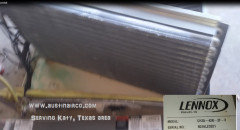
It doesn't end there.... Just a shade over 5 year old Trane...... well similar problem... but repaired it without much fan fare. Homeowner wasn't too happy except for the fact the air conditioner is working again in nearly triple digit heat.
Ah the life of an AC repair man. The manufacturer's make them, I fix them.You could go out and buy a brand new shiny AC and suffer a similar fate. You will never get away from the repair man. (Knowledge Required)
I service the Katy, Texas area.
 2 years ago
In summer, is a heat pump more reliable than an AC? I am considering to have my HVAC system replaced very soon with a dual fuel system or heat pump or Furnace&AC. I am living in the bay area. Any input or sharing of experience is greatly appreciated.
- 2 years agolast modified: 2 years ago
Dual fuel systems rarely recoup the (high) initial outlay. You are in a mild climate so an air-to-air heatpump with electric strip backup is probably OK. If your electricity rates are high then a natural gas furnace and ac unit might be better.
Heatpumps and ACs have pretty similar reliability for any given usage duration.
- PRO2 years agolast modified: 2 years ago
In summer, is a heat pump more reliable than an AC?
Not really. There are more parts on a heat pump than an AC, those parts are made practically anywhere but the USA currently brought to USA then parts are used to assemble a unit with. Not that this alone would be the result of failure as many factors come into this.
For the most part *nearly* any AC or heat pump is reliable so to get this to "more reliable" what does more reliable mean?
5 years? 10 years? While what I wrote a few posts back paints a different picture how common is that? (not really that common) so how do you describe something that is not common but does happen as a problem.
Things in life that happen are rarely fair.
How this might relate to Jane2000? She lives in the Bay Area, sounds like near salt water body of water. Salt is corrosive to metals so keeping a machine problem free in areas like that are going to require more work and even then may not live up to the expectation of "more reliable".
The salt water challenge (salt spray in the air) degrade / corrode the outdoor coils of the condenser (heat pump or AC either one) develops leaks or develops cancer of the coil and loses the ability to remove heat as efficiently. They make units designed for coastal applications but this isn't to solve the problem of salt spray as nothing is going to stand up to salt for long. If you're getting better than 10 years out of your current machine that's really all that can be expected.
You could ratchet up the maintenance spend more to have your coils cleaned more frequently. If the salt spray makes it's way indoors / like the house is really close to the "salt spray" this could degrade and effect the indoor coil as well.
So Jane2000 maybe you could expand further on the problems you are having: like is it due to Freon (refrigerant) leaks or?
Any AC or even heat pump for that matter can break at any time while it's "more common" for an older unit to break this is the variety that keeps this HVAC career fluid sometimes. Everyone has this belief that there is some kind of AC or Heatpump (slap a name on it) that is the holy grail to air conditioning problems. You know the problem you have is that your brand is inferrior to our brand. (selling to sell you, that is a trap.)
While some brands are better than others? Some will argue the opposite for xyz reason. At then end of the day it's all mechanical equipment that will break. From a national perspective you get "most of the time" a parts warranty of 10 years. If you're exceeding this time span that's about the best that could be expected I believe for a location of salt spray issues.
If the issues you are having aren't due to refrigerant leaks? It could be poor service practices. Some HVAC companies exist to sell you new equipment (that may be your best choice or it might not) Can't make real assessments without all the facts of your situation.
I have a vivid imagination and a 30+ year HVAC career... asking me to guess is probably not a good idea by any stretch of the imagination.
I service the Katy, Texas area.
- 2 years ago
A heat pump has to operate in the winter and summer. Each year is has more hours of operation compared to an AC. That leads to a shorter life span and more repairs. I would think a heat pump will be less reliable compared to an AC of the same brand and equivalent model.
- 2 years ago
Thank you so much for your information and help, @sktn, @Austin Air Companie, and @mike_home. I think I will go with the Carrier 2-stage Variable Speed Furnace Performance Series 58TP1A070V1412 and the Single Stage AC Perforrmance Series 24SPA636W003. My home is a single-story, 1700 squre foot house. The AC unit will be installed on the roof, and the furnace will be installed in a closet. Does this seem like a good choice? The contractor said that I don't need to pay extra for a 2-stage AC. I don't have solar panels and live in the SF bay area. I really appreciate any advice.
- last year
A furnace can be installed can be installed in a closet it there is enough clearance to allow servicing in the future. I recommend the AC condenser is installed on the ground and not on the roof. It may add additional installation costs but I think it it is worth it in my opinion.
- last year
Thank you very much, Mike. The current setup has the furnace in a closet and the AC on the roof. I am replacing the old HVAC system, so the new units will be installed in their original locations.
- last yearlast modified: last year
Where do you live? If you live in a dry area of the Bay area (inland), a single stage AC should be fine.
- last yearlast modified: last year
I am living in Fremont. Would a single stage AC be fine? Thank you.
- last yearlast modified: last year
Well, you're on the western side of the Diablo range . The eastern side would be nice and dry, but you're in the coastal side so that would be a bit more humid. You're probably fine with a single stage unit, provided you don't oversize it. We lived in SF for 3 years and it never got too hot and muggy, but that was almost 50 years ago (pre-global warming?)
If it were me, I'd still get a two stage AC - nothing worse than being woken up in the middle of the night by a blast of cold air from that AC coming on full tilt! The two stage condenser should be about $500 more than the single stage.
 last yearlast modified: last year
" The eastern side would be nice and dry "
The western side is too. Humidity is low in the Bay Area regions where AC is useful to have. On the coast, as in the fog banks of Half Moon Bay or down in Monterey, dampness and coolness from the ocean counters the need for AC. Heat and humidity together are very rare in this state.
A one stage would be fine and I too would recommend putting the AC equipment on the ground. New equipment usually involves a new coil and that's easily connected to a furnace in a closet. New piping to run there but that's no big deal.
- last year
Thank you very much, @sktn and @Elmer. It's not humid in the summer here. However, if upgrading from a single-stage to a two-stage AC only costs about $500 more, I will consider it. I've requested an upgrade from the Comfort Series to the Performance Series singe-stage AC, which adds $800.
@Elmer and @mike_home, would you please share your thoughts on why placing the AC unit on the ground might be better than keeping it on the roof, as it is now? Currently, the AC unit is on the flat roof above the garage.
Really appreciate all your information and help. - PROlast yearlast modified: last year
thoughts on why placing the AC unit on the ground might be better than keeping it on the roof, as it is now? Currently, the AC unit is on the flat roof above the garage.
It's mostly about ease of servicing the unit. Some residential areas lack land required to place an AC condenser or they just unnecessarily cram it in up really close to the structure or put the unit in areas not well thought out. Condenser sizes have grown much larger than they used to be which makes this a considerable challenge for some properties.
The AC unit needs to be able to breathe so while accessability is a bit troublesome on a roof it at least doesn't have blockages.
If it can be placed on the ground with clearances of 24" to 30" around the unit then by all means place it on the ground the costs will be line set replacement and new electric run to the condenser plus a slab to place it on.
The cost to put it back on the roof is the cost of a crane to hoist it up there, maybe around $500 or so? Maybe more due to HCOLA. You'll pay more up front to move it to the ground level.
Because roof placements are considered hard or difficult access by many the cost to service & repair is likely to be higher than a unit that is located on the ground or "easy access".
- last year
You mentioned the condenser will sit on a flat roof. Flat roofs are designed to be waterproof. The roofing material has a typical life span of 15 - 20 years. What is the age of the current roof and will the condenser need to be removed the next time the roof is replaced?
- last year
jane2000 "However, if upgrading from a single-stage to a two-stage AC only costs about $500 more"
I upgraded from a single-stage to a two-stage package heat pump. The upgrade was definitely worth it because the fan runs slower in stage 1 making operation virtually silent and reducing drafts. In my pretty-well-insulated DC condo (new windows and doors), the unit was still operating in stage 1 even when it was 100 degrees outside.
I recommend the Honeywell T10 Pro wi-fi thermostat.
- last year
@wdccruise Thank you very much for sharing your experience. If I decide to go with the variable speed inverted heat pump (38MURAQ36AA3), I will choose the dual HVAC system. Is this option better than the Carrier Performance Serice 2-stage furnace and a single stage AC? For the dual system, can I just use the furnace in winter and the air pump in summer? I've requested the installation of the Ecobee premium smart thermostat, as I've seen many good reviews.
- last year
If you plan to use a gas furnace for heating, there's no reason to buy a heat pump. A vanilla AC unit will be cheaper.
I'm in the Bay Area and unless I had a large solar power install that could cover my consumption, I would never voluntarily choose to use a heat pump to heat a house. Just too expensive at our electricity rates. Gas furnaces provide heat at a lower cost.
- last year
@Elmer J Fudd, thank you for your suggestion. Then I won't go with the dual system since I don't have solar panels.
@Austin Air Companie, @Mike Mike, thank you both for explaining why it's better to install the AC unit on the grond rather than keeping it on the flat roof. I will discuss this option with the contractor.  PROlast year
Hi, Jane2000
When deciding which option (heat pump vs. air conditioner/furnace vs. dual-fuel system) is best, you should consider any applicable rebates and tax credits. The IRA provides federal tax credits of up to 30% of the installation cost of a heat pump or $2,000, whichever is less, and the California Clean Tech Program provides rebates of $1,000 per system, limited to a maximum of two systems per household. Those might make the dual-fuel heat pump/gas furnace option less expensive than a furnace and air conditioner. Plus, it gives you the flexibility to use whichever utility costs less at any time in the future.
- last year
" use whichever utility costs less at any time in the future. "
That's a fool's errand. Our PG&E electricity rates are high and only going up.
This guy doesn't restrict his comments to things he knows anything about. Like now.
The PGE baseline (lower rate) for an all electric house in Fremont would be about 400 kwh per month in the winter. A house with a furnace installed would likely not qualify for that bracket and would instead have 300 kwh per month at the lower tier.
Pricing from my most recent bill:
First tier electricity - 38.8 cents per kwh
Second tier - 48.8 cents per kwh
Gas - $2.29, first tier. I didn't go into the 2nd tier, just heating water, cooking and drying clothes doesn't exceed the first. It would normally be 50 cents or so more.
CR homes, do you want to heat your house with 49 cent electricity or $2.29 gas? - PROlast year
If the rebates and credits make the installed cost of a heat pump/gas furnace dual-fuel system less expensive than installation of an air conditioner and furnace and they give the owner the option to use whichever utility they like, it would be silly to do otherwise, Elmer.
- last yearlast modified: last year
@Charles Ross Homes, thank you for your suggestion. I asked my contractor about this last time. Unfortunately, no rebates apply to a dual fuel system because it still connects to a gas meter. Rebates only apply to an all-electric system, such as installing a heat pump.
- last year
I'm not surprised to learn that the rebate situation is in step with the baseline amounts given, as I speculated would be the case for a dual fuel system.
On equipment replacement projects, no one I know has replaced a gas furnace with a heat pump. No one. Advice from 3000 miles away is uninformed and should stay closer to home and with what the person is familiar with.
Contractors are not advising it even though it can be more money for them. Any savings from rebates is overwhelmed in short order by the outrageous expense of running heat pumps as a primary heating source with the cost of electricity here.
Small minisplit systems are used for converted space, small spaces added with a remodel, or a region of the house that the main system doesn't serve adequately. Or, by people with motivations more political than financial who have massive solar installs that can power their large houses, run heat pumps, and charge their electric cars. That's a different story, and not what would typically be seen with a 1700 sq ft house in Fremont. Which I'm sure is very nice but not a Silicon Valley palace as found in Portola Valley or the East Bay hills.
- PROlast year
Too bad the furnace precludes the rebates and incentives for heat pumps. No one can predict with certainty what the future holds for utility pricing. That said, there's a good possibility that California's current carbon cap-and-trade system will be expanded to include a carbon tax if emissions don't meet targets by 2030. Installing a hybrid system is a hedge against that possibility. The incremental cost to hedge is simply the difference in initial cost between an air conditioner and a heat pump.
Assuming the $.38/kwh electric and $2.29/therm gas prices Elmer quoted, the break-even COP for a heat pump vs. a 92% AFUE gas furnace is 4.5. Conventional heat pump COPs would range from 3.5 to 5 in a mild climate so it's worth running the numbers. Inverter heat pumps like the one the OP is considering have COPs of 7 or more which would favor them.
- last yearlast modified: last year
You seemed to have not understood my comment. Try doing the calc at 49 cents per kwh, that's what the charge would be.
Funny how you seem to think you know more than local HVAC contractors do. How might that be explained?
- PROlast yearlast modified: last year
No one can predict with certainty what the future holds for utility pricing. That said, there's a good possibility that California's current carbon cap-and-trade system will be expanded to include a carbon tax
No one? LOL. With gas cars and everything else that runs on gas being forced out of California it's pretty much a given that electric prices are going no where but up, they will most likely have to put a carbon tax on gas to get the price anywhere near the price of electric. But if they don't get that electric production up they'll be telling everyone to shut off their heat pumps, unplug their electric cars etc and so forth or face rolling black outs / brown outs.
My prediction: Prices going up. ( I thought prices over there was high when they hit 20 cent a kwh and that would be considered cheap today "not in Texas though" cheap in Texas is anything under 15 cent a kwh if you can get it.) I think the only reason it's this high here is bitcoin mining another boondoggle of waste. Power companies like it though.
- PROlast year
"You seemed to have not understood my comment. Try doing the calc at 49 cents per kwh, that's what the charge would be." The calculation is straightforward. The breakeven COP at $.49/kwh would be 5.7 vs. a 92% AFUE gas furnace. That performance can be delivered by an inverter heat pump.
"Funny how you seem to think you know more than local HVAC contractors do. How might that be explained?" I'm not selling anything. I know it's easier to replace a gas furnace in kind than to replace it with a heat pump. And a lot easier to convince consumers it's to their benefit.
- last year
California is not going to provide any incentives to install an applicance which burns a fossil fuel. The goal is to ban all gas stoves and furnaces. I believe New York is banning installing gas appliances in new residential construction. Dual fuel systems will eventually disappear in these states and some others.
- last year
"Austin Air Companie: ... cheap in Texas is anything under 15 cent a kwh if you can get it.)"
My effective billed rates thus far in 2024:
Jan -- 13.13¢ (1,470 kWh)
Feb -- 14.99¢ (909 kWh)
Mar -- 16.37¢ (779 kWh)
Apr -- 16.15¢ (847 kWh)
May -- 12.25¢ (1,248 kWh)
Jun -- 12.61¢ (1,517 kWh)
Jul -- 12.16¢ (1,507 kWh)
Aug -- 11.88¢ (1,662 kWh)
- last year
CRHomes, I forgot having learned not to engage with you and your nonsense. I'll leave you alone to extract your foot from your mouth.
- last year
My comment was fact based with local info. Please stay where you are, far away.
- PROlast yearlast modified: last year
Mar -- 16.37¢ (779 kWh)
Apr -- 16.15¢ (847 kWh)
anything under 15 cent a kwh if you can get it. ---- Right in line with what I was saying Dadoes.
Looks like you slipped up in March and April? LOL.
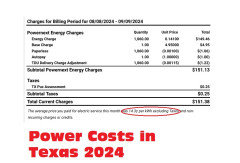
My most recent electric bill avg 14.3 cents (click to enlarge so you can read it or don't)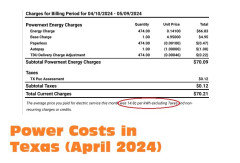
My April 2024 electric bill (why post another one? click to enlarge and you'll be able to see why.)The way Texas power works / and the costs thereof largely depend upon when you signed up for your utility price as laid out in the TOS contract. Additional costs there of can affect actual price per KWH and such that the provider passes thru.
For the most part the electric bill in Texas is largely more simple than the way they do things in California. (Let's hope we can keep it that way.)
What I said a few posts back? Nothing has changed in that regard. This is just further context for those that like to come here and "play games" and contort themselves in to pretzels to be against anything I try to say here.
~You're welcome Dadoes. (even at your lowest rate, your overall bill was higher than mine, ironic huh?)
- last year
My house probably is larger and has more electrical devices than yours. The provider is a coop, the effective rate always varies per the PCRF. There's no other provider available at my location.
- PROlast yearlast modified: last year
I don't know of any coop, I know there are 6 TDU's in Texas. Which one would include your area? I am on CenterPoint Energy TDU.
The 6 TDU's in Texas:
- AEP Central: Covers Corpus Christi and the Rio Grande Valley
- AEP North: Delivers power to Abilene and surrounding areas
- CenterPoint Energy: Serves Houston
- Oncor: Serves most of the Dallas/Fort Worth metropolitan area
- Sharyland Utilities: A TDU in Texas
- Texas-New Mexico Power (TNMP): Serves Lewisville and many Gulf Coast communities
After the TDU comes the distributor or the one who stays up late at night figuring out new ways to nickel and dime you (the company that actually bills you -- there's probably dozens of them on my TDU) I suppose smaller areas or areas further out in the boonies *may* be different.
Currently about the best I've seen is 12 cents per kwh if you are burning 2000 kwh's per month. But we're heading to the "cooling off season" here. Still hot, but cooler. When that happens power companies start shuffling contract terms around. If you're in the 1000 kwh's per month the rate is marginally higher. This isn't to suggest that a month later or even two weeks later you won't find a cheaper rate. The rates are always changing in Texas (up and down).
California from what little I know about their power concerns: *Is completely different* in about every way imaginable.
- last year
>A heat pump has to operate in the winter and summer. Each year is has more hours of >operation compared to an AC. That leads to a shorter life span and more repairs. I would think >a heat pump will be less reliable compared to an AC of the same brand and equivalent model.
===========================================
@mike_home, if the heat pump is only used in the summer and the furnace in the winter, would the heat pump be less reliable than an AC?
My contractor said that if I want to upgrade the Carrier performance series single-stage AC to a 2-stage AC, he could match the price of the variable-speed heat pump to the 2-stage AC, as the heat pump is only $1000 more.
I was told that the performance series single-stage AC is sufficient for people living in the bay area, especially for a house of only 1700 sq ft. But I don't know if the two-stage one is much quieter.
I have never used a heat pump, I am unsure how its reliability compared to an AC when only used in the summer.
Thank you very much. - last year
@mike_home, if the heat pump is only used in the summer and the furnace in the winter, would the heat pump be less reliable than an AC?
I know of no reason why a heat pump would be less reliable if it is used for cooling only in the summer. There were be no reason to spend the extra money on a heat pump if the plan is to only use it for cooling. The only exception is if the heat pump qualifies for a rebate which offsets the extra cost.
- PROlast yearlast modified: last year
>A heat pump has to operate in the winter and summer. Each year is has more hours of >operation compared to an AC. That leads to a shorter life span and more repairs. I would think >a heat pump will be less reliable compared to an AC of the same brand and equivalent model.
A heat pump gets more run time than an AC, so based on run time makes some people think that it's life will be shorter. mike_home is a home owner in New Jersey. Pretty sure he's got gas heat over there. He doesn't run service calls, doesn't do HVAC in any capacity other than talk about it here.
An AC can last as little as a little over 5 years? yes and no. (heat pump? yes and no)
You (as a home owner "same as mike_home btw") are presented options when failure occurs. How bad that failure is often determines whether you decide to replace the unit AC or Heatpump. Every unit breaks and not every break down is related to "run time" of the unit.
In my area Katy, Texas we operate AC's for 10 months of the year. A heat pump (in heating mode) would see very little use here. You think that little bit of use is going to matter in the grand scheme of things? Uh, no.
There's more parts to break on a heat pump? yes but nothing really more significantly than many AC unit brethren. If the unit is properly installed / properly maintained the typical life span remains the same from a national average stand point of 15 years. -Yes.
So why then did I say that an AC unit or Heat pump could last as little as just over 5 years?
This stems from part warranties that have ended for the unit in question and major failure, throw in refrigerant phase outs. (R22 & R410a are going away, R410a is in beginning phase)
Both AC or Heat pump need refrigerant and the proper kind, proper amount to work properly. In California this part warranty fiasco is mostly done away with, but the refrigerant fiasco may have legs. 2030 may clear things up or it may get pushed back if voters change their minds.
So for Texas and other parts of the country: if the AC unit or heat pump is not registered the warranty of the unit is only given a base warranty of 5 years parts. (The part is free, the labor and refrigerant, testing etc. is not free. The manufacturer requires a licensed HVAC contractor to exchange the part(s)) Typically new home builds are the most common for having a unit go out where replacing that some times young unit (just over 5 years and out of warranty) replacement options.
This situation is now more complicated due to refrigerant costs / changes / phase outs etc. The new refrigerants are mildly flammable which will require mitigation controls or liability goes up with the slim possibility of burning someone's house down.
Right now AFAIK, older Evaporator coil (indoor coil) can not be retrofitted to use R32 or R454b. It appears the manufacturers are going to force everyone to replace that Coil again to make the switch to the newer refrigerants. The primary reason Evap coils fail is due to: Freon leaks. (refrigerant).
---- So to just say blanket statements of why someone thinks this or that? It's rarely ever that accurate. The demise of a heat pump or an AC is more often than not linked back to issues that developed how they were or were not cared for, ignored or whatever.
To that end a heat pump that breaks in the winter is more trouble to fix. Not that it can't be fixed. Why? issues with refrigerant (too much or too little) as the heat pump every brand requires refrigerant charging in cooling mode. Why is that a problem? It's a rabbit hole of tech related jargon that we'll save for later if someone chimes in here that can't lower himself to buy refrigerant yet make claims that "it's not rocket science".
=================
Variable speed AC / Heat pump
There is really no comparison once you go to this level. However, in Carrier realm of equipment the limit this operation to 5 speeds.
Some inverter driven units only do 3 speeds. (Rheem / Ruud)
The better approach is 1% steps up and down with zero proprietary controls needed to operate it. (The Bosch BOVA 20 SEER (19 SEER2 if you prefer)
Another issue with Carrier Inverter is odd hissing noises when it cycles off.
With all that being said: if you have natural gas available a gas furnace is the better choice for colder climate. Even in my market while a heat pump option works really well for my climate it's more common to see gas heat via a furnace.
Due to long AC season here, some people choose the Bosch Inverter because it lowers energy use and installed properly reduces humidity in the home, much more so than a traditional on or off AC and even a 2 speed. Essentially the Bosch inverter has over 60 speeds of compressor operation. 1% capacity up and down.
This explains more why my electric bill is lower in many instances. As the Bosch delivers more in run time rather than cycles.
I service the Katy, Texas area.
- last year
A heat pump gets more run time than an AC, so based on run time makes some people think that it's life will be shorter. mike_home is a home owner in New Jersey. Pretty sure he's got gas heat over there. He doesn't run service calls, doesn't do HVAC in any capacity other than talk about it here.
Ray you are correct I do not run service calls to repair HVAC equipment. So in this case I am using logic in that a heat pump has more hours of operation by compared to an AC and the MTBF (Mean Time Between Failures) will be shorter.
In my area Katy, Texas we operate AC's for 10 months of the year. A heat pump (in heating mode) would see very little use here. You think that little bit of use is going to matter in the grand scheme of things? Uh, no.
I agree the hot summers and mild winters of Katy, Texas are not going to make a significant difference in the MTBF. If you lived in cold climate like Minnesota where the heat pump may be heating 10 months of the year I would think the reliability of heat pump versus AC would be a little different.
To that end a heat pump that breaks in the winter is more trouble to fix.
Here we agree again. If I did run service calls I would not look forward to repairing a heat pump when is it 10 degrees outside and it is covered with snow and ice.
- PROlast year
So in this case I am using logic in that a heat pump has more hours of operation by compared to an AC and the MTBF (Mean Time Between Failures) will be shorter.
The con with this thought is coming to a broken unit that is 20 years old and in some cases to repair it only requires minor electrical repair. While this isn't an everyday in the life of a AC repairman it does happen.
An AC unit that is 1-3 years old and broken? what happened to the MTBF there? I see these kinds all the time. Why I raised the point, it wasn't a strike against you perse but just the logic that is false. To suggest one version of something is going to experience more failures "just because it runs more" There are so many things that require proper operation?
For example both systems are connected to the electrical grid: Thru no fault of it's own the unit could fail due to electrical problems of the grid itself? uh yeah. Doesn't matter if it's a heat pump or AC. This is logic isn't it? Oh but these things are rare. Yeah you could say that too, unless it happens to you. It has happened more than once thru my illustrious HVAC career.
HVAC --- heat pump or AC they all break and never once in my career did I go to a call and say hey MTBF point has been reached, so sorry you need a new unit. [Some people logic maybe easier to fool than others, companies do exist that push new equipment sales via whole host of logic type thinking.] That said HVAC equipment doesn't last forever. I've been to those houses with a 20 year old dead unit that isn't worth trying to repair it. I've been to those houses with a 20 year old unit and repaired it / got it going again.
Just because an AC or heat pump is broken doesn't mean it's lights out and you need a new one.
Gas heat has it's problems too. HVAC was built on having trouble. I agree it's not fun working on a heat pump in 40-50F weather. (around these parts it's very rare to be lower than that for long)
So to suggest that you won't have problems by doing xyz? -some people may not have any better choice than a heat pump. I am in an all electric house myself, have a heat pump at my house. Would I like to repair it in 40 degree weather, no. Can't say I'd enjoy it more if it was 100F outside. So there's that too.
Ah the joys of a HVAC repair man. The main logic to consider: no matter what you buy you *will* have problems. The goal should be to "minimize" the problems as much as possible. This has served me well over the past 3 decades of running HVAC service and repairs.
I service the Katy, Texas area.








tigerdunes